Why insects orbit light at night
DOI: 10.1063/pt.uncq.agzc
As soon as human beings started making campfires at night, they noticed that flies, moths, butterflies, and other insects were attracted to the glow. Indeed, records of finding them trapped in the orbit of such artificially produced lights go back to the Roman Empire. Some biologists wondered whether the insects might be confusing the artificial light with the Moon, which some insects use for navigation. Others proposed that insects are instead attracted to its heat. But the kinematic data needed to test predictions are exceedingly rare. Tracking the positions of small, fast-moving insects in low light is technically difficult.
Flying insects need a reliable way to determine their orientation in midair. As the brightest part of the visual field, the sky serves that function—to indicate which way is up. The presence of artificial point light sources can mislead or confuse an insect’s sense of orientation. Dragonflies, butterflies, and other large flying insects can leverage their passive stability to stay upright. But the smaller size of most insects makes their lives more turbulent. Their Reynolds number—the ratio of the inertial and viscous forces they experience—is lower. So they must rely on visual cues to remain oriented in a gravitational field.

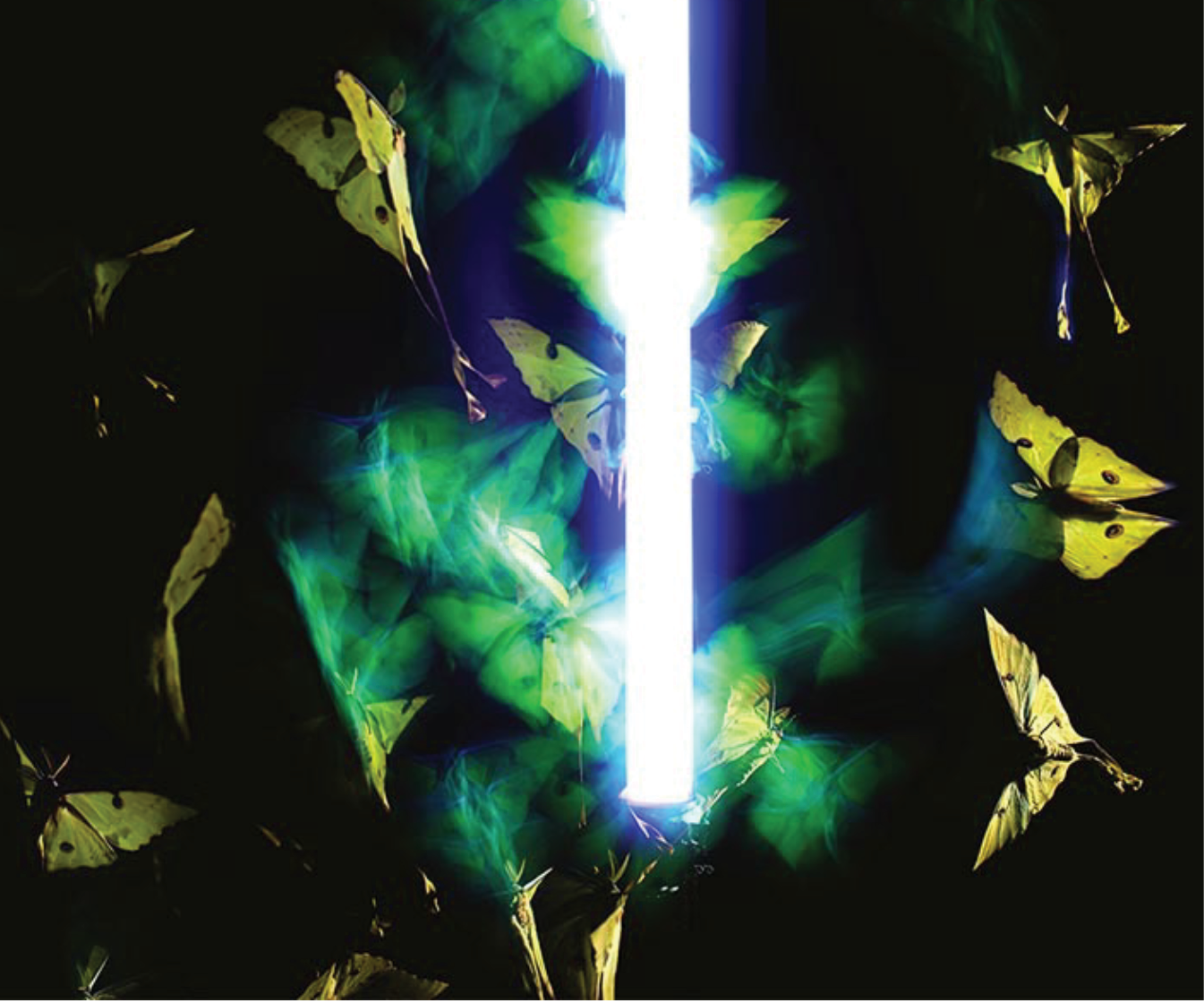
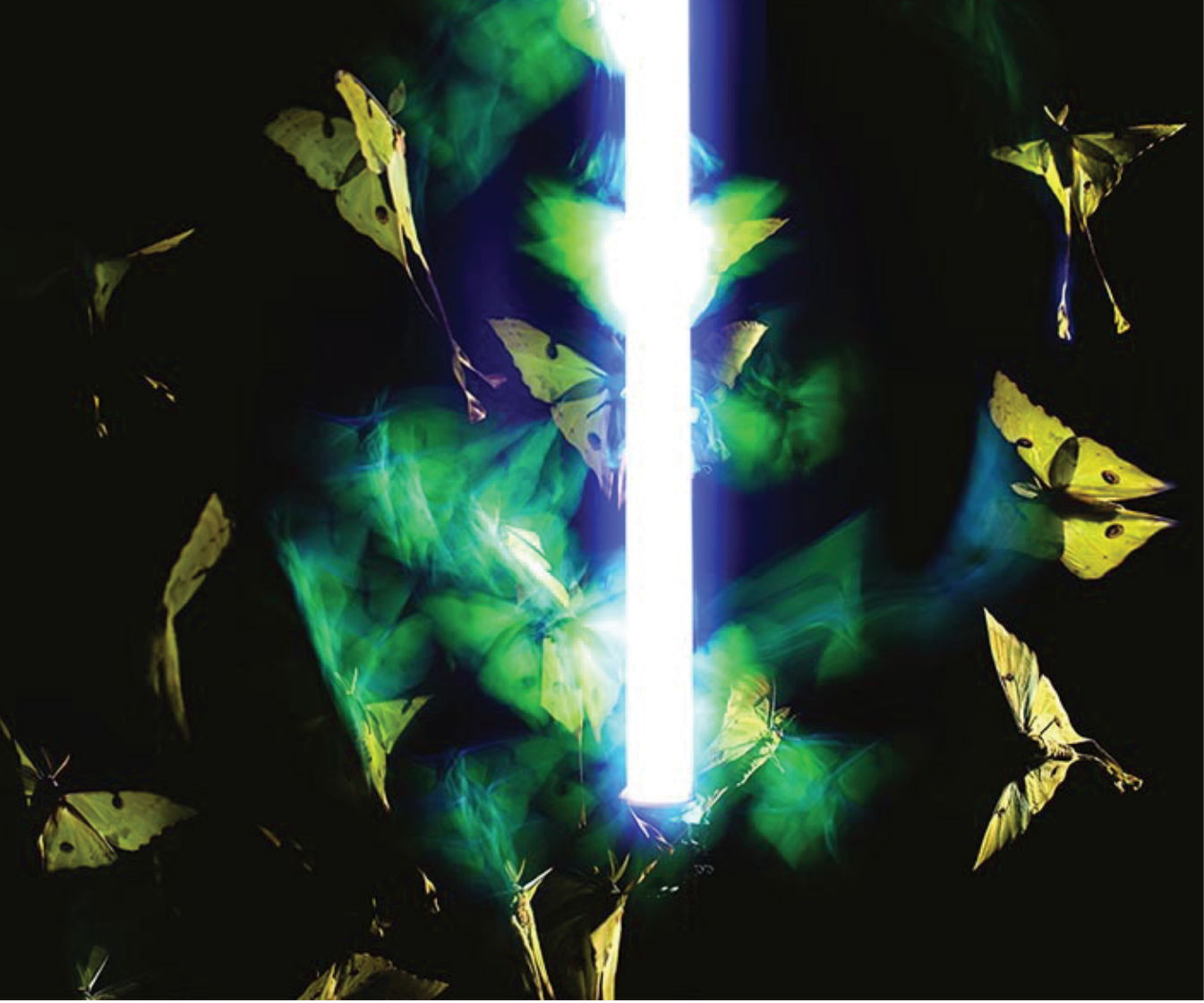
Multiple exposures track an African moon moth as it flies around a UV tube light at a laboratory at Imperial College London. (Courtesy of Sam Fabian.)
Two postdoctoral researchers—Sam Fabian from Imperial College London and Yash Sondhi from the University of Florida in Gainesville—and three colleagues have now taken high-resolution video footage of the trajectories of 10 taxonomic orders of insects in the presence of two artificial light sources. A UV LED bulb or tube light first attracted the insects’ attention. IR light was then used to photograph their motion without influencing them. That work was done in different locations: first in a controlled laboratory environment in London and subsequently in the wild during trips to Costa Rica.
In the laboratory, the researchers attached reflective markers to the insects’ bodies and tracked their positions and orientations using eight motion-capture cameras. That footage and stereo videography taken in the field at rates up to 500 frames per second revealed that the flying insects rarely head directly toward a light source but, rather, fly orthogonal to it. They tilt their backs toward the brightest area they perceive, which can cause an asymmetry in the distribution of the forces on them.
Known as the dorsal-light response, the behavior normally keeps the insects aligned with the horizon. But a point light source disrupts that cue and prompts insects to turn their backs on what they mistake as the sky. The result is a circular orbit in which they’re subsequently trapped, as shown in the figure. One of the most concise pieces of evidence revealing that the insects are confused, according to Fabian, is that they flip upside down while flying directly over the light. “That behavior is not explained by any other theory,” he says.
Despite the ubiquity of the behavior among insects, there are exceptions. Some species, such as vinegar flies and oleander hawk moths, appear less affected by UV light. Why some species are more sensitive than others remains an open question that the researchers plan to address. (S. T. Fabian et al., Nat. Commun. 15, 689, 2024 .)
A version of this story was originally published online on 6 February 2024.