Twin Photonics Centers Funded by High-Tech Entrepreneur
DOI: 10.1063/1.1387586
Undecided whether to donate $25 million to Duke University or Stanford University, Michael Fitzpatrick and his wife Patty doubled the stakes and gave that sum to each. The money is tagged for two new photonics centers to help advance the development of optical electronics.
“We’re moving from an electronic world to an optical world,” says Fitzpatrick, a veteran of numerous startups and currently a partner at Seabury Venture Partners in Burlingame, California. New applications for photonics are being developed in areas such as biomedical engineering, three-dimensional visualization, and wireless and optical networks. Such networks are expected to result in a higher performance Internet, says Fitzpatrick. “The only technology that can solve the bandwidth problem is photonics.”
“There’s been explosive growth in the industry,” says David Miller, an electrical engineer from Stanford who is director of the university’s new Fitzpatrick Center for Photonics. Attendance at optics conferences has skyrocketed in the past couple of years, but the US still only produces about 100 photonics PhDs annually, he says. “We are not even close to meeting the demand for people.” (See Physics Today, May 2000, page 25 .)
The Fitzpatrick photonics centers will aim to fill that gap. Eventually the centers will house about 200 researchers each and offer undergraduate, master’s, and doctoral programs, student scholarships, and short courses for industry and government engineers. Both universities have begun beefing up their photonics curricula, hiring new faculty, and forging tighter ties with industry. Partner companies will help determine research directions, and will provide internship programs, equipment, and funding.
Each center will cost about $100 million, with university and industrial contributions fleshing out the Fitzpatricks’ seed money. Despite the recent dot-com bust and economic slowdown, confidence in photonics growth remains high, says David Brady, an electrical engineer who moved from the University of Illinois at Urbana-Champaign to become the Duke center’s first director. Also joining the Duke center, to found a new visual analysis laboratory, is Brady’s wife, Rachael, who was director of Illinois’ Integrated Systems Laboratory.
Creating such centers, says Stanford dean of engineering James D. Plummer, “is a strategy we often use when there’s an emerging research area that’s interdisciplinary. It’s a way to be flexible and collect people around research themes.” Adds Brady, “We don’t want to create a new discipline; photonics is the bridge between the physical, biological, and information sciences and we want to make it so people can move where their research takes them.”

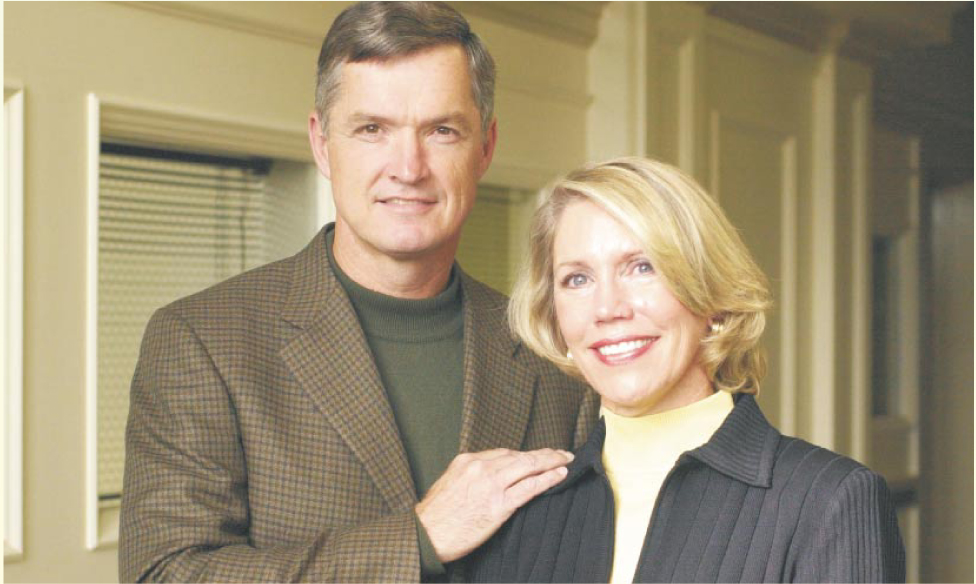
Michael and Patty Fitzpatrick are seeding photonics centers at Stanford and Duke universities.
LINDA CICERO, STANFORD U. NEWS SERVICE