Hurricane season in the North Atlantic officially kicked off on 1 June. Forecasters at the National Oceanic and Atmospheric Administration have predicted a relatively normal season, with four to eight hurricanes, up to four of them major.
On a seasonal basis, the frequency and intensity of hurricanes depends on factors such as the presence or absence of El Niño in the Pacific Ocean. But in an era of warming temperatures due to climate change, many researchers want to understand long-term trends about the frequency and intensity—as well as other attributes—of tropical cyclones. Although the recent historical record doesn’t provide a definitive answer, the newest generation of models suggests that storms will occur less frequently but may pack an ever-greater punch. Gaining confidence in those predictions is essential now, as the population of coastal communities most prone to hurricanes continues to grow.
Tropical cyclones are among the most expensive and lethal natural hazards on Earth. By drawing energy from the underlying warm water, they accumulate tremendous kinetic energy that can lead to catastrophic consequences if the storm makes landfall. In August 1992 Hurricane Andrew led to financial losses of more than $57 billion (in 2016 dollars). In 1970, up to 300 000 people lost their lives when a tropical cyclone made landfall in Bangladesh. Damage comes primarily from strong winds, storm surge (wind-driven ocean waters coming ashore), and heavy precipitation that leads to flooding.
The destructiveness of a tropical cyclone that makes landfall depends primarily on the storm’s intensity and size. Intense storms can batter coastal communities, carving out a concentrated zone of destruction. On the other hand, Hurricane Sandy was only a category 2 storm when it struck the Northeastern US in 2012; the impressive storm, shown in figure 1, spanned 1800 km in diameter. Although Sandy’s intensity paled in comparison with that of extreme cyclones, the large storm caused more than $50 billion of damage due to an intense storm surge that coincided with high tide.
Figure 1. National Oceanic and Atmospheric Administration GOES-13 image of Hurricane Sandy on 30 October 2012. Credit: NOAA/NASA GOES Project
The argument linking climate change and the destructiveness of future tropical cyclones is persuasive. The intensity and size of tropical cyclones depend on environmental factors, particularly sea surface temperature and atmospheric humidity. Higher sea surface temperature favors stronger tropical cyclones, and some research suggests that a moister environment favors larger tropical cyclones. As the environment warms, atmospheric moisture content increases as well. Climate models uniformly show that the integrated water column—a measure of the amount of water vapor in a vertical column of air—will increase in the tropics as the atmosphere warms. If the atmosphere is going to get warmer and moister, the number, duration, and intensity of tropical cyclones may change.
To study the impact of climate change on tropical cyclones, scientists begin by analyzing the recent trends of tropical cyclone characteristics and determining whether they are caused by anthropogenic forcing. Some observational studies show that hurricane frequency and intensity in the North Atlantic has increased since 1995. The trend is well correlated with increasing sea surface temperature, which in turn is attributed to human-induced climate change.
MIT atmospheric scientist Kerry Emanuel defined an index to quantify the potential destructiveness of hurricanes and found that the index has increased greatly since the mid 1970s in the North Pacific and North Atlantic. The trend of increase is strongly and positively correlated with increasing tropical sea surface temperature. That suggests tropical cyclones are likely to cause more damage in a warmer environment.
In 2005, scientists from Georgia Tech came to a slightly different conclusion. They reported that over the previous decade the frequency of cyclones actually decreased in the North Pacific, Indian, Southwest Pacific, and North Atlantic Ocean basins. Yet despite the relative lack of storms, the scientists found a large increase in the number of extreme tropical cyclones (categories 4 and 5) in all the basins.
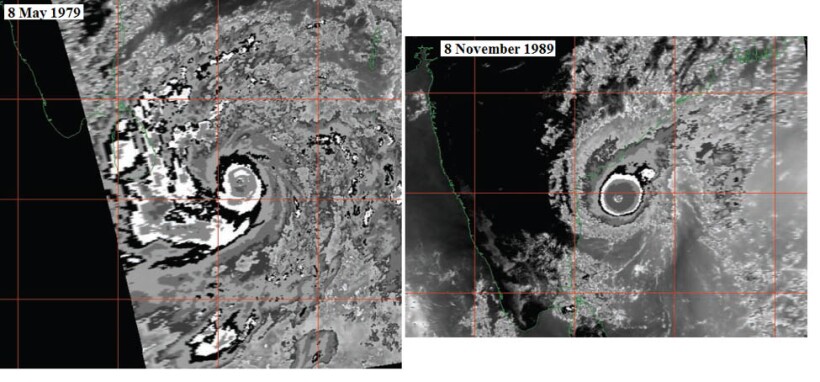
Not everyone agrees with the Georgia Tech team’s results. Some researchers have noted the shaky reliability of measurements before the dawn of satellite meteorology in 1966. And a team led by NOAA’s Christopher Landsea pointed out that databases from the 1970s and 1980s are unreliable because scientists tended to underestimate storm intensity. At the time, meteorologists based intensity estimates on visible satellite imagery, which could not directly measure surface winds and was useless at night. For example, the two tropical cyclones shown in figure 2 are listed as category 3 or weaker, but each was later determined to be category 4 or 5. In 2010 a group of scientists concluded that, due to the inconsistency of observing capabilities over time, it remains uncertain whether past changes in tropical cyclone activity (including frequency, intensity, duration, and rainfall) go beyond natural variability.
Figure 2. The two tropical cyclones pictured turned out to be stronger than meteorologists previously estimated. An inconsistent historical record makes it difficult to identify trends due to climate change. Credit: C.W. Landsea et al., Science, 2006
Society and scientists alike are very interested in how tropical cyclone activity will change in a climate-warming future. Researchers have conducted studies utilizing atmospheric general circulation models (AGCMs) to address that question. Early AGCM iterations were seriously questioned because of coarse resolution and relatively poor representation of the observed geographical distribution of tropical cyclones. The critiques have gradually faded due to advancements in computational resources and numerical algorithms. Those improvements ensure remarkably realistic mesoscale features. Today AGCMs are used extensively to predict future tropical cyclone changes under various climate-warming scenarios.
Every UN Intergovernmental Panel on Climate Change Assessment Report releases the latest projection of future tropical cyclone activity based on scientific studies, including AGCM research. The latest IPCC report, AR5, states that global tropical cyclone frequency is likely to either decrease or remain essentially unchanged due to greenhouse warming.
The IPCC’s take largely matches that of the World Meteorological Organization (WMO), which a decade ago formed an expert team to conduct research and assess the relationships between tropical cyclones and climate change. The resulting document predicted that by the late 21st century the number of tropical cyclones will decrease 6–34% globally, while the mean strength of tropical cyclones will increase 2–11%. Extreme (category 4 or 5) storms will likely occur much more often in some basins, and rainfall rates brought by tropical cyclones are likely to increase, especially for areas within 100 km of a storm’s center. The WMO panel did not find dramatic changes in tropical cyclone tracks, duration, or areas of impact.
Improved prediction of tropical cyclone activity in a warmer environment is critical. Although underreaction to a tropical cyclone can be devastating, overreaction can also cause problems. Evacuating in anticipation of a storm that ends up weakening or changing direction can lead to large financial losses and hesitation on the part of officials to call for future evacuations. Policymakers should pay close attention to our improving simulations of tropical cyclones, and should use the results to create strategic plans for minimizing damage and loss of life.
Fei He is a PhD candidate at the University of Michigan. She explores the use of uncertainty quantification techniques on examining dynamical systems and applies them to assess the sensitivity of simulated tropical cyclone characteristics to components in atmospheric general circulation models.