The freest of free falls
DOI: 10.1063/PT.3.3221
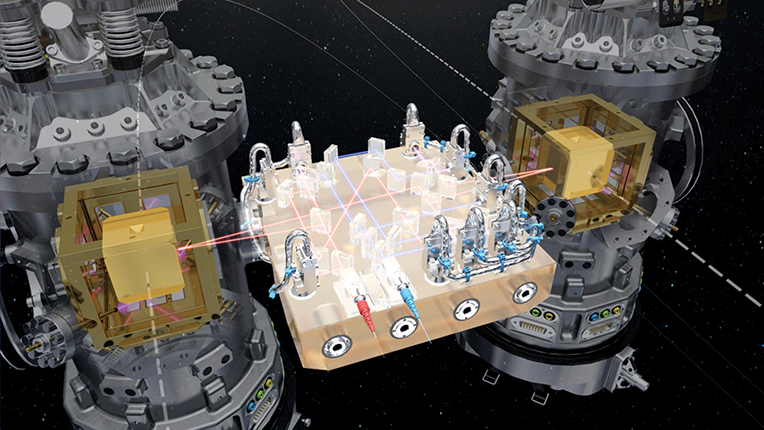
The European Space Agency plans to launch a gravitational-wave observatory in 2034, likely based on the Laser Interferometer Space Antenna (LISA) model. Once it is operational, mission scientists will look for tiny, oscillating changes in the million-kilometer lengths separating a triangular arrangement of test masses—the signal that a gravitational wave has passed by. The LISA concept requires that the test masses at each vertex be maintained in nearly perfect free fall. Any other accelerations—due to stray charges or radiation pressure, for example—could mimic the effects of a gravitational wave; the test masses must therefore be exquisitely shielded from all forces other than gravity. Enter LISA Pathfinder, launched on 3 December 2015 and designed to establish that a pair of test masses floating inside the spacecraft could be shielded to the exacting demands of LISA. Today the mission team announced its first result: To within 25%, it has already achieved LISA’s shielding goal. LISA Pathfinder has two cube-shaped test masses that are separated by roughly 40 cm; each is made of a gold–platinum alloy with a mass of about 2 kg. (The figure shows the cubes and, between them, a position control system.) Lasers measure the separation between the two masses; electrostatic nudges keep it as constant as possible. Meanwhile, thrusters apply micronewton forces to the spacecraft, maneuvering it to keep the test masses centered in their housings. From several days’ measurements of the mass separation and from the size of the electrostatic nudges, the LISA Pathfinder team deduced the amount by which test-mass motion deviated from free fall. The single biggest cause of deviation is likely damping by residual gas in the cubes’ housings. (M. Armano et al., LISA Pathfinder collaboration, Phys. Rev. Lett. 116, 231101, 2016, doi:10.1103/PhysRevLett.116.231101 .)

ESA/ATG MEDIALAB