Teen Physicists Compete in Turkey
DOI: 10.1063/1.1420508
At the end of June, high-school students from Albania to Australia converged on the seaside city of Antalya, in southern Turkey, for the 32nd International Physics Olympiad. Daniyar Nurgaliev of Russia beat out 305 other students to earn the highest score in this year’s competition.
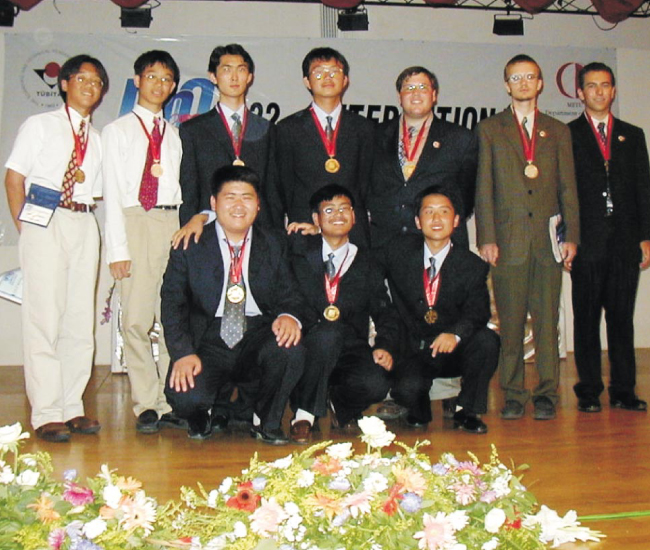
For the second year running, the Chinese team had the top total overall, winning four gold medals and one silver medal. The Russian, US, and Indian teams came in next — each won three gold and two silver medals.
The US golds were garnered by Andrew Lutomirski of Los Angeles; Willie Wong of Short Hills, New Jersey; and Brian Beck of Beachwood, Ohio. Daniel Peng of Colts Neck, New Jersey, and Vladimir Novakovski of Springfield, Virginia, won silver medals. The American Institute of Physics and the American Association of Physics Teachers were the primary sponsors of the US team.
Students competed in two five-hour exams during which, for example, they determined the gravitational constant with a rotating container of glycerin and a laser. This experimental task proved so popular, says organizer Sinan Bilikmen, that 30 countries’ representatives bought the equipment for $100 a set.
But that extra cash didn’t do much to offset the cost of the ever-growing Olympiad. Thanks to an ailing Turkish economy, the voluntary contributions from participating countries stretched to cover almost half of the low $450 000 tab for the competition. The Turkish government and a smattering of private sponsors paid for the rest.
Students took time out together to visit, among other things, an archaeological site, an old Roman theater, and Turkish bazaars. As Waldemar Gorzkowski, president of the International Physics Olympiads organization, said at this year’s opening ceremony, “Those who make friends for life are the winners.”
The 2002 Physics Olympiad will be held in Jakarta, Indonesia, in July.

The US and Chinese Olympiad teams pose with their medals.
AAPT