Stanford Lures Blandford, Kahn
DOI: 10.1063/1.2409953

Stanford University’s plans to start an interdisciplinary institute for particle physics, astrophysics, and cosmology are back on terra firma, thanks to a $7.5 million gift from Fred Kavli, physicist and founder of Kavlico Corp, a major supplier of sensors to the automotive and aeronautics industries. The directorship of the Kavli Institute for Particle Astrophysics and Cosmology will be endowed by Pehong and Adele Chen, whose original gift of $15 million to found the institute took a beating in the recent high-tech stock bust (see Physics Today, June 2001, page 30 ).
This fall, theoretical astrophysicist Roger Blandford will move from Caltech to take the helm of the Kavli Institute. Steven Kahn, an experimental astrophysicist, will move to Stanford from Columbia University to be the institute’s deputy director and an assistant director of research at SLAC. Getting the institute going “will be a big challenge,” says Blandford. “Kahn and are I really excited by this opportunity.” The pair will fill seven additional new jobs over the next few years, with an eye to balancing experimental and theoretical physics. “One goal is to be a bridge between SLAC and campus,” says Blandford. Initial activities, he adds, will start even before the Kavli Institute’s new building opens in 2005.

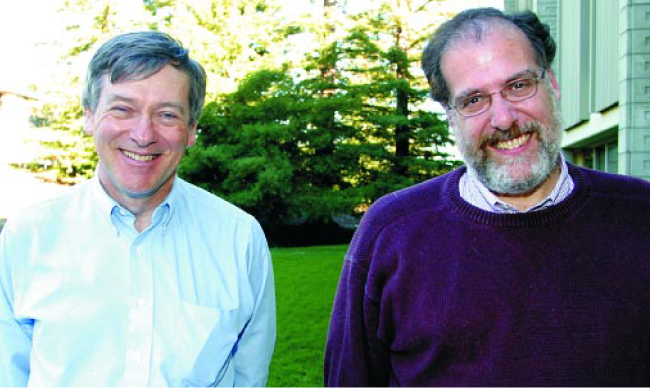
Roger Blandford (left) and Steven Kahn will head up Stanford’s Kavli Insitute.
DIANA ROGERS

More about the authors
Toni Feder, American Center for Physics, One Physics Ellipse, College Park, Maryland 20740-3842, US . tfeder@aip.org