Science without borders
DOI: 10.1063/1.2930736
Quantum information is a hot subject around the world, and many Iranian scientists and students are active or interested in the field; however, their mobility is constrained by financial and political considerations such as difficulties in obtaining visas. With those concerns in mind, Vahid Karimipour of Sharif University of Technology and I decided to plan a major international conference in Iran, capped at 100 participants, with a significant fraction of them coming from other countries. The first International Iran Conference on Quantum Information (IICQI) was held 7–10 September 2007.
A successful international conference requires a local base of respected experts in the field, an effective local organizing committee, excellent conference facilities, financial support, and a critical mass of students and faculty in the region who would attend. Those basic requirements were met by having an enthusiastic, energetic team of organizers, but a conference in Iran posed unique challenges—preconceptions and politics—that also had to be faced.
In the West, Iran is constantly in the news because of its nuclear program, the 2006 Iran-hosted conference that questioned the Holocaust, and the Iranian seizure of British sailors and marines shortly before the conference deadline, not to mention the seething insurgencies in the neighboring countries of Iraq, Afghanistan, and Pakistan. In addition, Iran and the US do not have diplomatic relations, although Americans can obtain visas to go to Iran.
Despite those problems, Iran has hosted successful physics conferences—for example, one on strings and another on cosmology, both held last year. Also last year Iran was the host for the highly successful 38th International Physics Olympiad. Thus we were optimistic that our proposed conference would be successful.
In my view, the complicated politics between Iran and the West is a compelling reason to support conferences in that country. Science is driven by a shared desire to discover the laws and nature of the universe in a way that transcends politics, local culture, race, creed, and gender. In a world divided, a scientific conference reminds us through our shared discourse that we are all human and all fundamentally the same on our journey of discovery. A scientific conference provides the opportunity for local participants to learn from, and be inspired by, foreign scientists who share their time and insights to globalize the scientific endeavor.
My views are not universally shared, however. Science and technology are separated by a nebulous boundary. Some would argue that scientific discourse, at least in strategically important fields such as nuclear physics, quantum information, and nanotechnology, should be constrained so as not to support technological advancement in unfriendly nations and to prevent the export of intellectual capital. I believe, however, that the majority of physicists would accept sharing knowledge that is or will be published in openly available peer-reviewed scientific journals and proceedings; a scientific conference dedicated to discussing such openly available knowledge really should not be controversial.
With those considerations in mind, Vahid and I planned the conference, greatly assisted by his student Laleh Memarzadeh Esfahani and a postdoctoral fellow in my group in Calgary, Ali Tayefeh Rezakhani, and with indispensable support and guidance from numerous other individuals. To minimize visa complications and to maximize the appeal of the location, the conference was held at Kish University on beautiful Kish Island in the Persian Gulf. The island is a “free zone,” which means that it does not require visitors to have visas issued in advance.
Kish Island is easily reached via several daily flights from Dubai. The host institution, Kish University, is an affiliate of Sharif University of Technology, one of Iran’s leading scientific and technological institutions. Kish University seems interested in hosting international conferences to further its ambitious academic plans. With the university’s support and its professional conference-organizing capabilities, we felt confident that the conference would be well run.
The next step was to arrange a good geographic and gender mix of international speakers. At least one-quarter of the participants were women, which is a better gender mix than I have observed at any other quantum information conference. We achieved a good geographic spread, with invited speakers from Australia, Canada, France, the UK, Italy, Japan, Spain, and Iran. The US, however, is conspicuous in its absence from that list. Although a few US residents were invited, none of them accepted, in contrast to the high acceptance rate by residents of other nations. However, one invited speaker is an American citizen who lives outside the US, and one attendee who contributed a talk is a resident of the US but not a citizen. Two Israeli citizens, one of whom resides in Israel, indicated their wish to participate, but Israelis are unfortunately barred from entering Iran, even in the free zone of Kish Island.
The discussions with potential invited speakers revealed interesting preconceptions about Iran and its hospitality or hostility to foreigners. Most invitees were enthusiastic about going; in fact, they relished the opportunity to visit a beautiful country rich in archaeological sites and not inundated by tourists. Others were wary or even afraid of going.
Some invitees were apprehensive about being in Iran should the US choose to attack it while they were at the conference. Other concerns included the possibility that Iran might use the IICQI for propaganda and the perceived repression of women. Some invitees were worried that they might be seen as supporting the Iranian regime. On the other hand, those who chose to attend the IICQI thought that the value of international scientific exchange with Iranian colleagues trumped all other concerns. Those who accepted invitations were confident that the conference would be safe and the Iranians respectful and courteous, which was certainly the case.
The conference met its target size (the actual attendance figure was 98); one-quarter of the participants were not residents of Iran. I was especially impressed by the Iranians’ enthusiasm: Many faculty members and students paid their own expenses. In contrast to most other conferences I attend these days, where participants skip talks, sit in the back typing on their laptop computers, or doze, IICQI participants were attentive and well prepared.
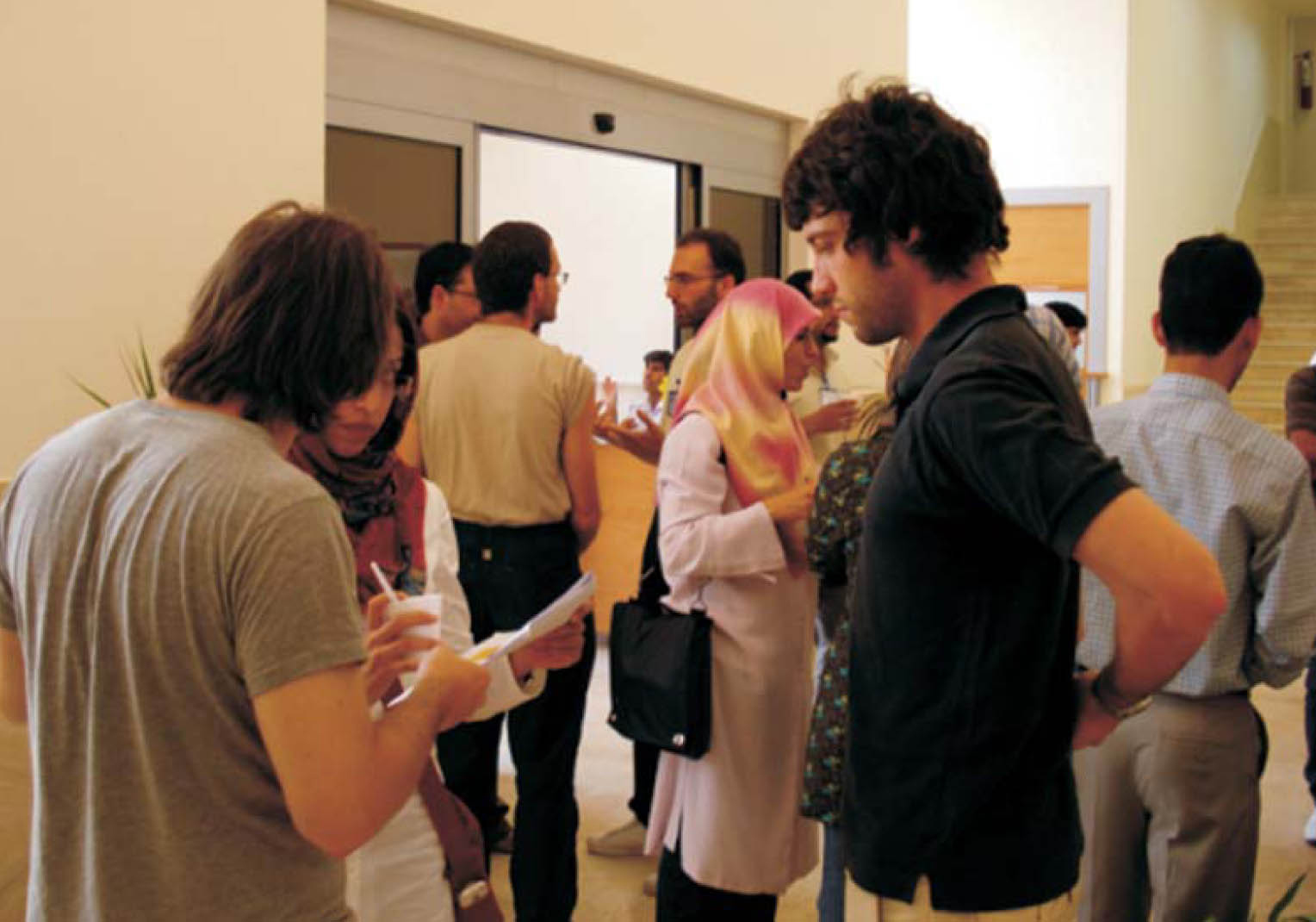
Many attendees had read in advance the arXiv e-prints of the speakers’ talks; they asked astute questions, and made valuable comments. It was the first international conference many of them had attended, and they obviously appreciated the event. The coffee breaks were opportunities for intense discussions about quantum information, and the poster session was remarkable in the quality of posters, both in terms of presentation and scientific content. We foreign participants were struck by how worthwhile the conference was and how much we were gaining from interacting with so many intelligent and enthusiastic Iranian scientists.
A bonus for many of the foreign participants was the opportunity to sight-see on the Iranian mainland. We bought a tour package arranged as an addendum to the conference. We flew from Kish to Eşfahān, then to Shīrāz, and then back to either Kish or to Tehran. We stayed in first-class hotels with meals included, and we visited fire temples, mosques, archaeological sites, and markets.
The sites were remarkable, and the dearth of tourists enhanced their appeal. I personally enjoyed the opportunity to celebrate the Jewish New Year with the Jewish community in Shīrāz, with the additional thrill of saying the blessing over authentic homemade Shīrāz wine. (Alcohol is forbidden in Iran, but this wine is legal when consumed for religious purposes.) As I was apparently the first non-Iranian Jewish visitor to the Shīrāz Jewish community in years, many wanted to talk with me, and my experience was both emotional and indescribable.
In view of the image reported by the media, I stress that we visitors had freedom in Iran: freedom to talk with people about any subject and freedom to go off on our own. We talked about politics and religion and science, and the discussions were lively and unconstrained. Despite restrictive dress codes for both men and women, our personal interactions at the conference were gender-blind: Women and men interacted as equals in presentations, question periods, breaks, and social events.
The conference was an unforgettable experience and reminded me how important science is as a bond between humans from all societies, as a global endeavor, and as a pursuit that transcends politics and prejudice. The goodwill from the conference has led to a two-week summer school to be held on Kish Island in September that will ensure Iranians are able to learn the latest and greatest that quantum information has to offer. The second IICQI is planned for the summer of 2009. I hope that these conferences are an example of bringing together the best science worldwide, independent of politics.
The website for the first IICQI is http://iicqi.sharif.ir , and my report on the conference is in the Topical Group on Quantum Information newsletter The Quantum Times at http://www.aps.org/units/gqi/newsletters/upload/fall07.pdf .

Coffee break at the first International Iran Conference on Quantum Information.

More about the authors
Barry Sanders is the iCORE Professor of Quantum Information Science at the University of Calgary in Calgary, Alberta, Canada.
Barry Sanders, University of Calgary, Calgary, Alberta, Canada .