Reevaluation of Top Quark Data Raises Estimate of Higgs Boson’s Mass
DOI: 10.1063/1.1801858
The quest for the Higgs boson is the central preoccupation of particle physics experimenters. The Higgs particle remains the only undiscovered building block required by the standard model of particle theory. The eponymous Peter Higgs (Edinburgh University) introduced it in 1964 to break the underlying symmetry between the weak and electromagnetic interactions and, in so doing, to give mass to the fundamental fermions (quarks and leptons) and the heavy gauge bosons that mediate their weak interactions.
The standard model makes no a priori prediction of the Higgs mass M H. But a global fit to the many well measured parameters of the electroweak interactions does provide an estimate of M H. In recent years, however, the best such estimate has been in slightly embarrassing conflict with the negative results of direct searches for the Higgs. Before the LEP electron–positron collider at CERN was finally shut down in December 2000, its decade of searches for the Higgs had excluded, with claimed 95% confidence, a Higgs boson lighter than 114. 4 GeV. The embarrassment, until now, has been that the best estimate of M H from the global electroweak fit was only 96 GeV.
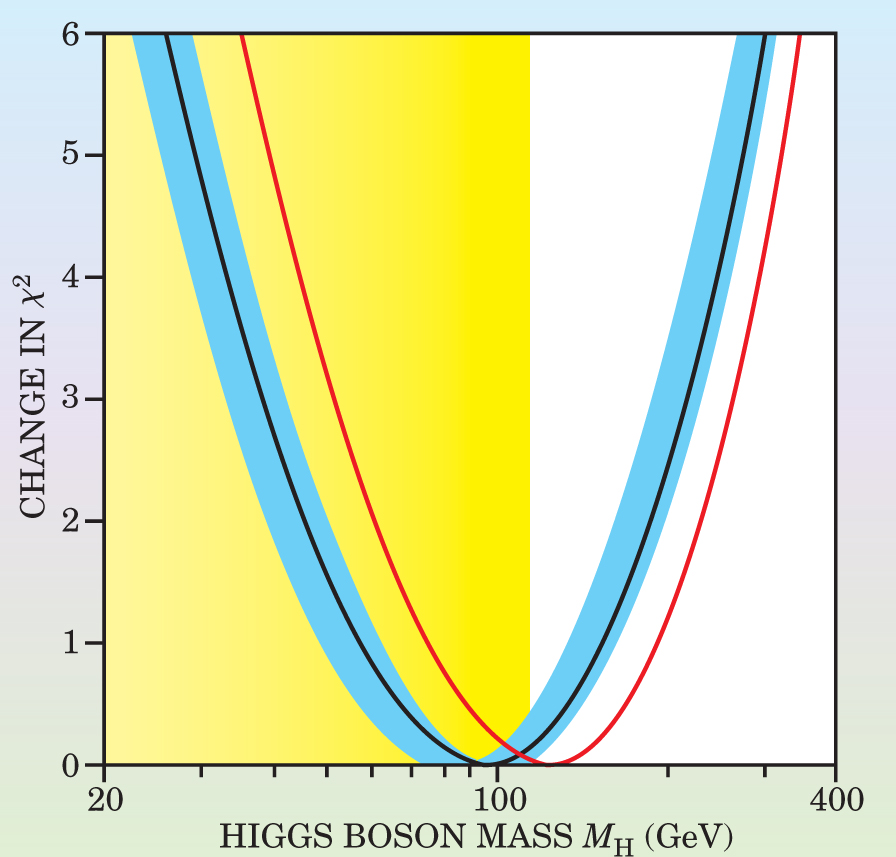
The apparent inconsistency was small; the uncertainty on the theortical estimate was about ±50 GeV (see the black curve in the figure). But the discrepancy engendered some anxiety about the standard model and its so-called supersymmetric extension.
The standard model, for all its brilliant success, is manifestly incomplete; it has too many free parameters and it fails to incorporate gravity. Supersymmetry, which posits the existence of five different Higgs particles, is the most widely favored and least disruptive of the proposed extensions of the standard model. (The theory has acquired the affectionate nickname SUSY.) If SUSY is correct, the lightest of its Higgs particles is expected to have a mass close to what’s calculated for the lone standard-model Higgs. But SUSY imposes a rather stringent upper limit on the mass of its lightest Higgs.
Weighing the top quark
Now there’s a new development. The D0 (pronounced D zero) collaboration at Fermilab’s Tevatron proton–antiproton collider has reported that an improved, innovative reanalysis of its data from the collider’s 1992–96 run yields a more precise measurement of M t, the mass of the top quark. 1 With a mass near 180 GeV (about 200 times the proton mass), the top quark (t) is by far the heaviest of the six known quark species.
The standard-model estimate of the Higgs mass is particularly sensitive to M t. Unfortunately, M t is hard to measure to better than a few percent. That’s because the lighter quarks into which the top inevitably decays are measurable only roughly through the collimated jets of charged and neutral hadrons they generate. And one usually has to contend with a neutrino that carries away momentum unseen.
The previous 96-GeV estimate of the Higgs mass was based on a world average of 174. 3 ± 5. 1 GeV for M t. The new D0 measurement raises the world average for M t to 178. 0 ± 4. 3 GeV. That’s a shift of only one standard deviation in the top mass. But it raises the best standard-model estimate of M H to 117 GeV (see the red curve in the figure), reassuringly above the range already excluded by the direct LEP searches.
Although a 117-GeV Higgs is energetically well within the range of the 1. 8-TeV Tevatron collider, it’s questionable whether the Tevatron can reach sufficient integrated luminosity to provide a convincing Higgs signal by 2008, when the 14-TeV Large Hadron Collider (LHC) at CERN is expected to take over the search and find either the standard-model Higgs or whatever Nature is pleased to offer in its stead. (See Physics Today, November 2003, page 22 .)
The new, higher top mass also raises the upper limit of the standard-model Higgs mass. At the 95% confidence level, the fit puts the upper limit of M H at 251 GeV. But if supersymmetry is right, the new top mass dictates 2 that the lightest SUSY Higgs particle can’t be heavier than 140 GeV.
Probably more important than the modestly higher upper limits and best estimates already produced by the new value of M t is the promise of D0’s new technique for determining it. Both D0 and CDF, the other large collaboration at the Tevatron, are now applying essentially the same technique to their new data from the present collider run, which began in 2001. That’s important because a really precise determination of the top mass can stringently test the standard model’s consistency and ferret out small anomalies that could point the way to a more encompassing theory.
The new method
Collisions that produce top quarks (always in tt pairs) are extremely rare, and only a small fraction of them decay in ways that are useful for a precision measurement of M t. So experimenters are at pains to squeeze the maximum information from each event. Traditionally, they try to find, separately for each event, the value of M t that best satisfies conservation of energy and momentum, given the known masses and measured momenta of the final products of the decay chains. And they reduce backgrounds by using rather coarse criteria to discard subsets of events.
Quite apart from the problem that the momenta of the lighter quarks produced in the decays are only fuzzily indicated by their hadron jets, there’s the plague of background mimics. The majority of the events that look like tt production are really other processes. The mimicry is particularly bad because the top quark is so shortlived (less than 10−24 s) that it decays before it can travel a discernible distance.
But this very problem carries the seed of its resolution. Precisely because the top quark has no time to “dress” itself in hadronic garb and form a meson or baryon before it decays, the probability distribution of its decay products can be calculated from electroweak theory—if one knows M t—with a precision that’s quite impossible for the decay of any lighter quark, which is always encumbered by messy hadronic complications.
D0’s “dynamical likelihood method” was developed by Juan Estrada (Fermilab) and coworkers to get the most out of the tt events by exploiting the theoretical cleanliness of top-quark decay. A similar technique had been suggested in the 1990s by Richard Dalitz and Gary Goldstein at Oxford University and, independently, by CDF member Kunitaka Kondo at Waseda University in Japan. The essential trick implemented by Estrada and company is to calculate, for each candidate collision, the probability density P tt̅ that the measured momenta would have occurred if it really was a tt̅ production event. P tt̅ is, of course, a function of the M t one is seeking to determine. Then one does the same on the assumption that the measured event is an impostor of the most common sort. This latter probability density, P bg, does not depend on M t. The calculations, carried out by Monte Carlo methods, take into consideration the resolution and acceptance of the detector.
Finally, one creates an overall likelihood function L by multiplying together the differential probability densities aP tt̅(M)−bP bg for all the candidate events. One then searches for the values of the two free parameters, M t and a/b, that maximize L. “The ratio a/b is our fitted overall measure of signal to background,” explains Estrada, “and the value of M t that maximizes L is the best determination of the top mass you can get from the data sample.” D0 spokesman John Womersley points out that “this reevaluation reduces our uncertainty by 37%. And it raises the top-quark mass, as determined from the our data alone, by almost 7 GeV.”
The consequent rise in the world average for M t is only 4 GeV. But the resulting shift of the best standard-model guess for the Higgs mass, as shown in the figure, is more than 20 GeV. The figure shows the dependence on the putative Higgs mass of the X 2 of a global fit of precision electroweak parameters-mostly from electron–positron collider data. 3
Eventually, LHC data are expected to reduce the error on the top mass to about 1 GeV. But theorists contend that a further tenfold reduction in the M t uncertainty is necessary for full exploitation of what LHC will have learned about the Higgs. Such spectacular precision, however, will require the 500-GeV electron–positron linear collider that’s at the top of the particle physics community’s wish list.

Global fit of electroweak parameters, based on the standard model of particle theory, provides the best guess (minimum X 2) at the mass M H of the still unseen Higgs boson. The change in the fit’s X 2 is plotted against M H. The fit is particularly sensitive to the mass M t of the top quark. The recent 4-GeV upshift in the world-average for M t shifts the X 2 curve (red is new, black is previous), raising the best standard-model estimate of M H from 96 GeV to 117 GeV. Direct searches had already excluded, with 95% confidence, a Higgs lighter than 114 GeV (yellow region). A X 2 increase of 1 above the minimum corresponds to one standard deviation, and the blue swath indicates the theoretical uncertainty of either curve.
(Adapted from ref. 1.)
References
1. D0 collaboration, Nature 429, 638 (2004).
2. G. Weiglein, Nature 429, 613 (2004).
3. The LEP collaborations et al., http://arXiv.org/abs/hep-ex/0312023 .