Physics bachelors find jobs despite recession
DOI: 10.1063/1.3265231

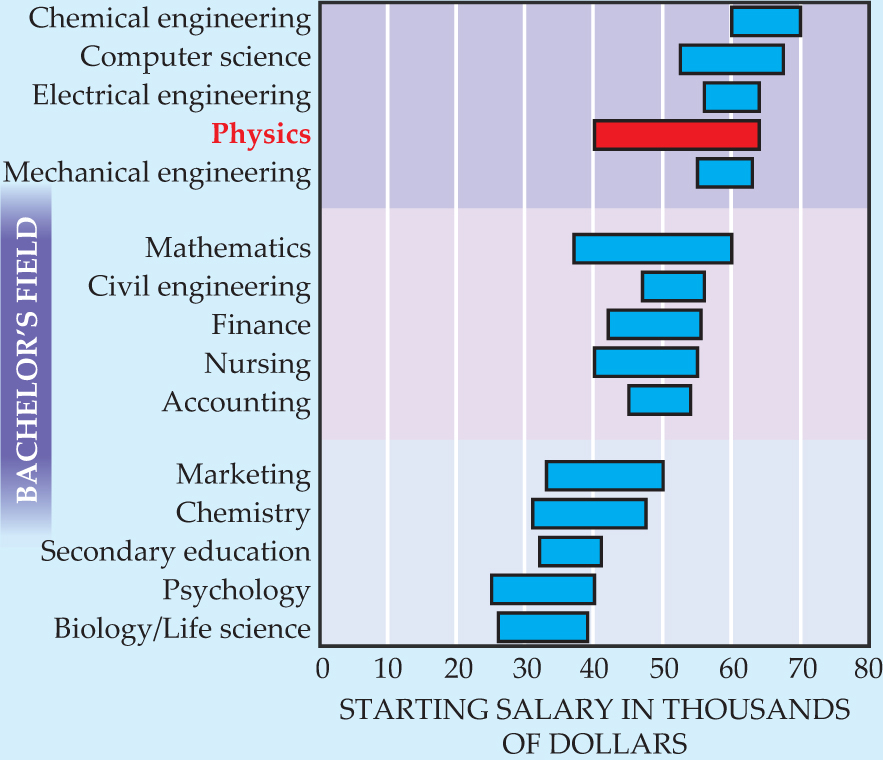
Physics bachelor’s degree holders who entered the workforce in academic year 2008–09 earned starting salaries in the range of $40 000-$64 000. That puts them among the highest-earning new college graduates, according to data collected by the National Association of Colleges and Employers (see figure).
Roman Czujko, who heads the Statistical Research Center at the American Institute of Physics, says, “It’s remarkable that during a tight economy campus recruiters were interviewing and offering physicists jobs, and that there were enough data to talk about. The fact that the data include physics is positive. The fact that physics salaries are among the top numbers is also positive.”
Recessions, Czujko adds, “come at least once a decade, sometimes twice. At least 3 out of 10 graduating classes have the misfortune to graduate during a recession. This time physics bachelors are doing well. But in general, I’d like to tell those kids to keep struggling. It will get better.”
Roughly, physics majors and the other top earners are working as programmers and engineers, graduates in the middle group of majors in the table are in math-intensive jobs, and the bottom group, says Czujko, “shows that when you read reports about a shortage of scientists and engineers, they are twisting the data. There is no shortage at the bachelor’s level. The 75 000 biology bachelors are going into the workforce with a set of knowledge and skills that are not valued. Biology majors do not do well in a strong or a poor economy. Their starting salaries are no better than secondary-school teachers’. It’s okay if they go on to grad school or medical school.”
Further evidence that the skills of physicists are valued can be found in the Statistical Research Center’s recently updated state-by-state listing of who has hired physics bachelors in the past three years (http://www.aip.org/statistics/whohires ). The jobs—only those that make use of a technical background are included—are largely in programming and engineering, and they span actuarial insurance companies, finance firms, startup companies, and large defense contractors. Says the center’s Patrick Mulvey, “The range of fields in which bachelors are applying their skills and knowledge and problem-solving capabilities is very broad.”

Typical salary offers by campus recruiters, academic year 2008–09
Data reprinted from the fall 2009 Salary Survey, with permission of the National Association of Colleges and Employers, copyright holder.

More about the authors
Toni Feder, tfeder@aip.org