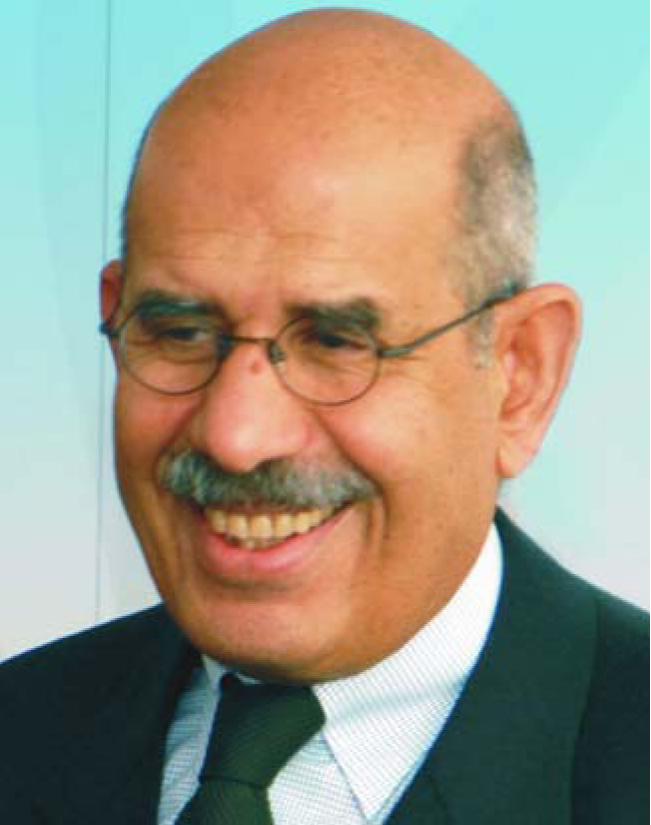
Peace Prize Goes to ElBaradei and Nuclear Watchdog Agency
DOI: 10.1063/1.2169434

The phone didn’t ring on 7 October for Mohamed ElBaradei, director general of the International Atomic Energy Agency. Instead, he found out with the rest of the world from a television announcement that he and the IAEA would equally share the 2005 Nobel Peace Prize.
Knowing the press was camped outside of ElBaradei’s office in Vienna, Austria, the chair of the prize committee, Ole Danboly Mjopes, skipped the customary telephone call because he didn’t want the news to get out prematurely. At 11:00am, Mjopes said in front of the cameras: “At a time when disarmament efforts appear deadlocked, when there is a danger that nuclear arms will spread both to states and to terrorist groups, and when nuclear power again appears to be playing an increasingly significant role, the IAEA’s work is of incalculable importance.”
The news stunned ElBaradei, who said in a press conference that he had sat down to watch the announcement on television “fully aware that we would not [win] because I did not get the call. … And then I heard in Norwegian ‘the International Atomic Energy Agency’ and my name, and I was just on my feet with my wife, hugging and kissing and full of joy and surprise.”
Law and diplomacy
ElBaradei was born in Cairo, Egypt, in 1942. He earned a law degree at the University of Cairo in 1962 and a doctorate in international law at New York University in 1974. After spending time in Egypt’s foreign service bureau and teaching international law on security and peace issues at the United Nations Institute for Training and Research, he moved to the IAEA in 1984. As director general, a position he has held since 1997, he has a reputation for skillful diplomacy and consensus building.
In the press conference, ElBaradei said that the award, given to a cause that is “not very fashionable today,” sends a strong message to “keep doing what you’re doing, be impartial, act with integrity, speak the truth.” In his announcement, Mjopes emphasized that the award was intended as a boost to disarmament, not as a “kick in the shin” to any nation or leader, as some people in both Iran and the US have conjectured.
Over the past 30 years, on decadal anniversaries of the 1945 dropping of atomic bombs on Hiroshima and Nagasaki, the Nobel Peace Prize has gone to groups and individuals campaigning against nuclear proliferation. In 1975, the prize went to Russian physicist Andrei Sakharov, who designed the Soviet Union’s hydrogen bomb and later became a peace activist (see May 2000, page 37 ); in 1985, to the International Physicians for the Prevention of Nuclear War; and in 1995, to Joseph Rot-blat and Pugwash Conferences on Science and World Affairs (see December 1995, page 61 ).
The anniversary is useful in bringing attention to nonproliferation, says Irving Lerch, former director of international affairs for the American Physical Society. “Sometimes we need to be bludgeoned so that our attentions are refocused.”
An embattled agency
Refocusing would be welcomed at the IAEA, where six months ago ElBaradei was fighting the Bush administration’s attempts to stop him from serving a third term as head of the agency. The five-year conference review of the Nuclear Nonproliferation Treaty (NPT) had just ended in disarray (see May 2005, page 30 ). Talks held with Iran by the UK, France, and Germany and, separately, the six-nation talks with North Korea led by China and including the US, were going nowhere. And during the summer the US and UK both struck agreements with India, which has never signed the NPT, to supply technology to India’s civilian nuclear programs, international efforts to stem proliferation of nuclear weapons notwithstanding. Those events were all undermining the role of the IAEA.
The IAEA was set up in 1957 in response to President Dwight D. Eisenhower’s call to the United Nations to create a program to promote the “Atoms for Peace” initiative—to spread the benefits of peaceful nuclear technology, while limiting military applications of that technology. The 139-nation agency works directly with governments and industrial partners in safeguarding nuclear material and developing safety and security standards at facilities involved in nuclear activity. “The IAEA is the only institution with this capability,” says Lerch, “but it is limited since—at the insistence of the five legacy nuclear powers [the US, France, the UK, Russia, and China]—weaponization does not fall under the mandate of the agency.” After the breakup of the Soviet Union, the IAEA increased efforts to stop the trafficking of nuclear material and took on the task of securing nuclear material in the newly formed republics. Nearly every UN member has signed the NPT, which forms the legal basis of the IAEA. But in 1974 India conducted a “peaceful” test nuclear explosion whose eventual impact was to weaken the treaty.
The discovery of Iraq’s clandestine nuclear weapons program at the end of the 1991 Gulf War led to a broadening of the IAEA’s mandate to include actively looking for covert military programs, and in 1997 the IAEA added a voluntary provision that allowed the agency to inspect undeclared but suspected facilities in member states. “This is where ElBaradei has demonstrated initiative bordering on brilliance,” says Lerch. ElBaradei and his predecessor at the IAEA, Hans Blix, who came out of retirement to be the chief UN weapons inspector, “worked hand-in-glove to develop an effective inspection apparatus in Iraq and elsewhere,” Lerch says. “So effective, in point of fact, that [Iraqi dictator Saddam] Hussein was persuaded to dismantle his original program to the extent that reinstituting that program became infeasible.” Only about half of the IAEA’s members, including Iran, have signed the voluntary 1997 provision.
Stopping the bomb
The future direction of the IAEA, and of nuclear nonproliferation efforts more generally, says Wolfgang Panofsky, senior adviser to the National Academy of Sciences Committee on International Security and Arms Control, is tied to the outcome of Iran’s determination to build an indigenous nuclear power program, including enrichment and reprocessing of uranium. Under the NPT, signatory countries are allowed to create facilities for a complete nuclear fuel cycle, but such facilities can shorten the time required to develop a military nuclear program, should a state withdraw from the NPT, as North Korea has done.
“ElBaradei has taken the lead in specifically proposing international management or outright ownership [of nuclear fuel facilities] in several of his more recent speeches,” says Panofsky. “It is this pursuit of independence and calling the facts as they emerge which in my view has made the award of the peace prize to ElBaradei a very deserved one.”
Still, says Pugwash executive director Jeffrey Boutwell, “I’m not sure the award will affect nonproliferation efforts all that much, I’m sorry to say. The award’s importance is symbolic, and while it does focus the world’s attention briefly on nuclear issues, the impact is not that long-lasting.”
But on 7 October, ElBaradei was still savoring the moment. “Overall I think my colleagues and I are going to sleep tonight with a good deal of satisfaction that finally our efforts have been fully recognized.”

IAEA
More about the authors
Paul Guinnessy, American Center for Physics, One Physics Ellipse, College Park, Maryland 20740-3842, US . pguinnes@aip.org