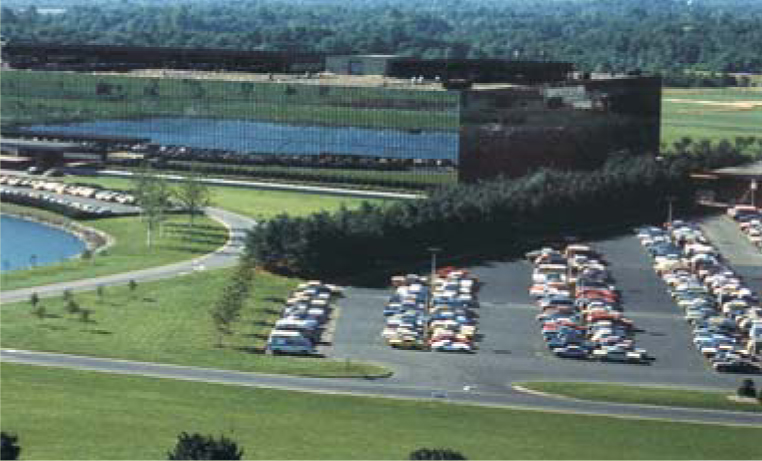
Former Bell Labs research building faces wrecking ball
DOI: 10.1063/1.2349724
It’s history—in more ways than one.
The decades-long reign of Bell Labs’ research campus in Holmdel, New Jersey, as a major force worldwide in technological discovery and development is over, and so is any chance for the building to recapture its former years of glory. Parent company Lucent Technologies is selling the 6-story, 2-million-square-foot industrial research laboratory to a private developer who plans to demolish it, probably next year.
The building’s size, combined with its lab-specific design—a windowless structure with a series of deep cement bays every 40 feet on each floor and a vast amount of common space—makes it economically infeasible to operate as is or to convert into an office building. The building was opened in 1962 by then-parent company AT&T during its fat and sassy years as a monopoly. Lucent was spun off in 1996, 12 years after AT&T was broken up by federal antitrust legislation.
“No one would build anything like that today,” said Michael O’Neill, CEO of Preferred Real Estate Investments Inc, based in Conshohocken, Pennsylvania. The firm has an agreement to buy the tree-lined, grassy 472-acre property next year from Lucent for an undisclosed sum. “Back then [in the 1960s], gas and electricity and oil were very cheap. Today the cost [to maintain the building] is way up, 10 times what it was.”
In an interview with Physics Today, O’Neill said he doesn’t want to knock the building down, but in the year and a half of talks between his company and Lucent about acquiring the site, he’s come up with no other solution for making it attractive to potential commercial tenants. “I lie awake nights figuring out how to preserve the history of this building,” he said. “I kick myself for not coming up with a way to save it. We are just as emotionally attached to the history of the site [as Bell researchers].”
Since its earliest days, the building—which at one time was Bell’s largest installation and home to some 5500 researchers and other staffers—was an internationally renowned research center where crucial scientific and technological discoveries and developments were made. But a market pinch in the 1990s, followed by the telecom bust of 2000, sent Lucent into a financial tailspin. Forced to cut costs, the company responded by downsizing its physical sciences research staff, including the number of researchers at the Holmdel site (see Physics Today, October 2001, page 26 ). Today, about 1000 researchers and tech staff still occupy the building, but by August 2007 all Bell employees currently there will be relocated to Lucent facilities in Murray Hill and Whippany, New Jersey.
“The reason for the sale of Holmdel is the proper utilization of our real estate portfolio,” Lucent spokesman John Skalko said. “Since we had existing space in Murray Hill and Whippany, it was financially wise [to sell the building].”
At least one former Bell researcher is wasting no time waxing sentimental about the work once done in the building. Its day in the sun is over, said Kumar Patel, a professor of physics at UCLA who worked at the Holmdel site from 1966 to 1976.
“The building became superfluous once Bell Labs decided to move its R&D activities [to other Lucent sites],” Patel said. “It’s only a symbol, not the central feature of what R&D at Bell Laboratories once was. It’s not useful to maintain a symbol that no longer has any real function.”
The site’s ultimate fate is still in limbo. O’Neill expects to close on the purchase of the property by next August and is conducting “neighborhood meetings,” informal hearings with area residents, to determine how they would like to see it used. That information will be integrated into his final plan for building and commercially marketing and leasing the site, a process that could take up to five years.
Skalko emphasized that the pending sale of the building does not affect Bell Labs’ continuing operation. “It’s important to note that Bell Labs is still in business,” he said.

A historic Bell Labs site’s future is uncertain.
LUCENT TECHNOLOGIES