ESO and ESA team up
DOI: 10.1063/PT.3.2944

On 20 August, Europe’s premier organizations for ground-based and space-based astronomy signed an agreement to formalize and increase their cooperation. The European Southern Observatory and the European Space Agency will work together mainly in the areas of scientific research, technology, and public outreach. On 20 August, Europe’s premier organizations for ground-based and space-based astronomy signed an agreement to formalize and increase their cooperation. The European Southern Observatory and the European Space Agency will work together mainly in the areas of scientific research, technology, and public outreach.
Cooperation between ESO and the science division of ESA goes back to the 1980s with the establishment of a European coordination facility for the Hubble Space Telescope. The overlap between space-based and ground-based astronomy is increasing, says Fabio Favata, who heads ESA’s science planning and community coordination office. “People are growing out of the distinction and using whatever they need to address the science goals.” Dark energy and exoplanets are examples where close cooperation makes sense, he says.

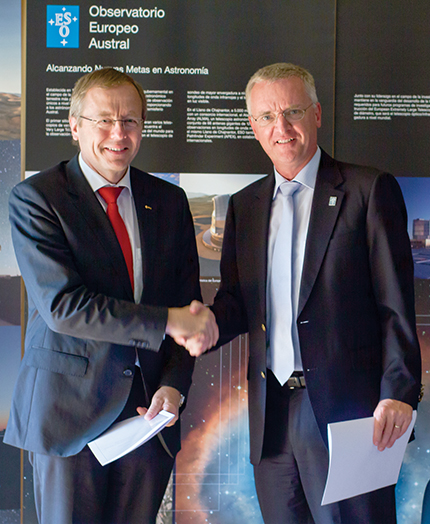
Directors general Johann-Dietrich Wörner (ESA; left) and Tim de Zeeuw (ESO) shake hands on their agencies’ new cooperation agreement.
ESO/J. GIRARD

The purpose of the new agreement is to set a general framework for cooperation and exchange of information. Implementation is being discussed, and could include such activities as joint data analysis, conferences, and exchange of personnel, says ESO director general Tim de Zeeuw.
More about the authors
Toni Feder, tfeder@aip.org