CERN Experiment Finds Evidence for More Pentaquark States
DOI: 10.1063/1.1688058
Last year, considerable skepticism greeted the first experimental reports of a new kind of hadron: a baryon whose combination of charge and flavor could not be made by a triplet of quarks. No fewer than five quarks (one of them an antiquark) would do (see Physics Today, September 2003, page 19 ). Why, the skeptics asked, had no one previously seen this alleged “pentaquark” or, for that matter, any other pentaquark?
With charge and strangeness +1 and a modest mass of 1.54 GeV, the Ξ+(1540), as it was named, should have appeared decades ago as a prominent resonance in kaon–nucleon scattering experiments. For three decades, every fledgling particle physicist knew that no positive-strangeness baryon had ever been seen because you couldn’t make such a thing with three quarks.
By year’s end, however, the number of experiments claiming to have sighted the Ξ+(1540) had grown to eight, and there was confident talk of a “new spectroscopy” of exotic hadrons (5-quark baryons and 4-quark mesons) that would do much to clarify the obstinate complexities of quantum chromodynamics. QCD is the standard theory of the strong interactions (see the article by Carleton DeTar and Steven Gottlieb on page 45 of this issue).
A second exotic
One exotic doth not a spectrum make. But now, it seems, a second exotic baryon has been found, together with at least one related pentaquark state that is not manifestly exotic. (A pentaquark baryon would be manifestly exotic only if its five quarks did not include a quark–antiquark pair of the same flavor.) Last month, the NA49 collaboration at CERN reported 1 evidence for an exotic baryon of mass 1.86 GeV. Like its predecessor, the new baryon, tentatively called Ξ–(1860), has a combination of charge (Q = −2) and strangeness (S = −2) that cannot be made with fewer than five quarks. The particle physicists’ arcane naming convention reserves the symbol Ξ for the so-called cascade baryons, characterized by S = −2. All previously known Ξ baryons have charge states (−1 and 0) that can be made with three quarks: two strange quarks (s) plus an up (u) or down (d) quark. The s and d have Q = −⅓, and u has Q = +⅔.
NA49, a collaboration of 11 European and US groups, found the Ξ– signal at CERN’s Super Proton Synchrotron in scattering events produced by a beam of 158-GeV protons traversing the collaboration’s 20-cm-long liquid-hydrogen target. This was a high-energy experiment, very different from the low-energy experiments that found the Θ+(1540) barely above kaon–nucleon threshold. The search for a heavy Ξ with Q = −2, motivated by predictions 2,3 related to the discovery of the Θ+(1540), was led by NA49’s Croatian contingent, whose spokesman is Kreso Kadija of the Rudjer Boskovic Institute in Zagreb.
In 1997, theorists Dmitri Diakonov, Victor Petrov, and Maxim Polyakov at the Petersburg Nuclear Physics Institute in Russia predicted 2 a Ξ– with a mass of about 2.07 GeV on the basis of an elaboration of Tony Skyrme’s 1962 theory of the nucleon as a topological soliton in the pion field. Diakonov’s “skyrmion” model also predicted an S = +1 exotic baryon near 1.53 GeV. That prediction was, in fact, the prime impetus for the search that found the Θ+(1540).
At MIT last year, theorists Robert Jaffe and Frank Wilczek took a quite different view
3
of the newly discovered Θ+(1540). They regarded it as a bound state of two highly correlated u–d pairs and a lone
Both models agree that the Ξ– would have Ξ partners of nearby mass with other charge states (−1, 0, and +1). But they disagree about the number of such partners, and about which of them could be seen by NA49. So the experiment has, potentially, an important role in distinguishing between fundamentally different theoretical views, not just of the exotic baryons, but of baryons in general.
The experiment
Searching for evidence of a Ξ–, the Zagreb group scoured several years of accumulated NA49 data for proton–proton collisions that produced, among other particles, a π− and a Ξ−(1320), the lightest of the cascade baryons, discovered 50 years ago. The production of a Ξ−(1320) is signaled by an easily recognized sequence of weak decays (hence the name cascade) to the proton. The NA49 detector complex identified, tracked, and measured the momenta of charged particles by means of large time-projection chambers and superconducting magnets. The SPS has been shut down for the past year, but the NA49 collaboration is still analyzing data from the 1999–2002 run.
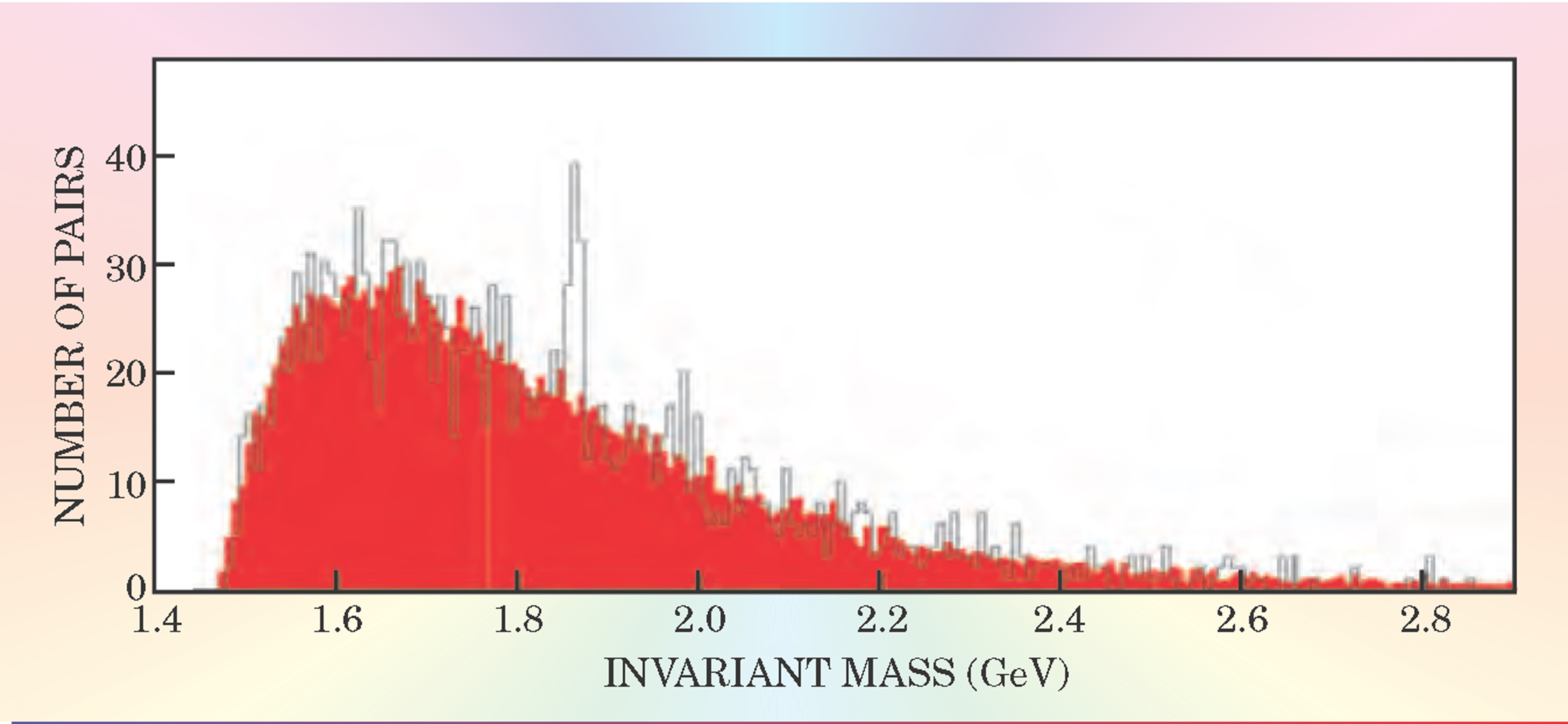
The predicted Ξ– would decay (on the 10−23-second timescale of the strong interactions) to Ξ−(1320) + π−. So Kadija and company, having found 1640 usable p–p collisions that produced a Ξ−(1320) and at least one π−, plotted the distribution of invariant masses for all Ξ−(1320) π− pairs (see figure 1). The invariant mass of a system is its energy in its center-of-mass frame.

Figure 1. Invariant-mass distribution of Ξ−(1320) π− and Ξ+(1320) π+ pairs produced by proton–proton collisions in the NA49 experiment at CERN. The prominent peak at mass 1.86 GeV is evidence for the existence of an exotic baryon tentatively named Ξ–(1860). The estimated background under the peak is shown in red.
(Adapted from ref. 1.)
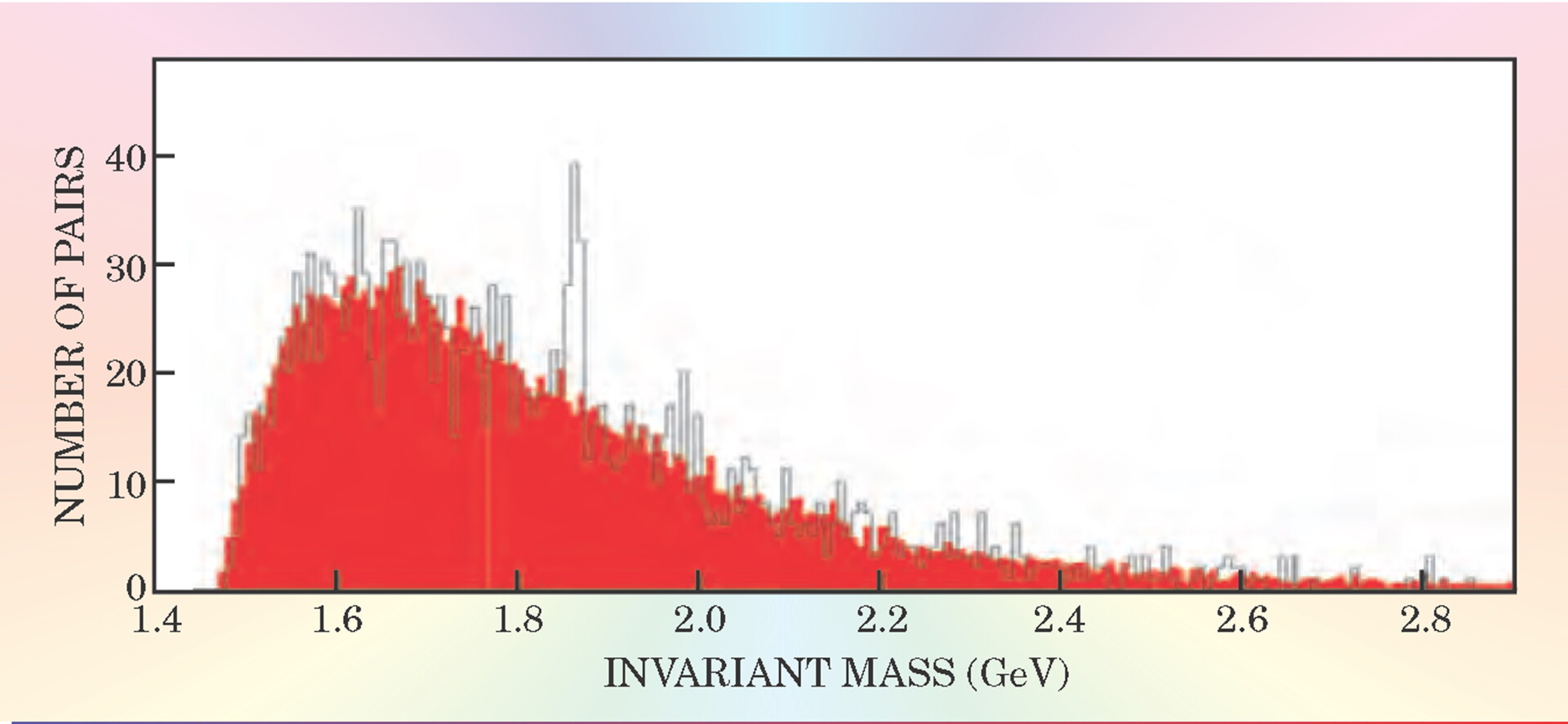
A Ξ– of mass M would manifest itself in such a distribution as a prominent peak at M. And that’s what we see in figure 1. For added statistics, the figure also includes the Ξ+(1320) π+ invariant-mass distribution from 551 events that had a Ξ+(1320)—the ironclad presumption being that every baryon species has an antiparticle. The peak, centered at 1.862 GeV, rises above the estimated background by about 5 standard deviations.
The peak’s 18 GeV width is consistent with the detector’s mass resolution, and therefore provides only as an upper limit on the pentaquark’s intrinsic width (an inverse measure of lifetime). This upper limit is surprisingly small for a baryon whose decay via strong interactions has so much available phase space. The surprise was even greater for the Θ+(1540). Its nondiscovery in low-energy K+ scattering experiments decades ago seems to imply an extraordinary upper limit of only 1 MeV on its intrinsic width. 4
Other charge states
Although the observed mass, 1.862 ± 0.002 GeV, appears to favor the correlated-quark model over the 1997 skyrmion prediction, it is, by itself, inconclusive. Indeed, Diakonov and Petrov have recently pointed out that a remeasured low-energy pion–nucleon scattering parameter now brings the skyrmion prediction of the Ξ– mass into good agreement with the NA49 value. 5
More can be learned, however, from NA49’s observation of the new baryon’s relatives in other charge states. The strong interactions respect an approximate flavor symmetry described by the Lie group SU(3). Just as SU(2) isospin symmetry depends on the similarity of u and d quarks with regard to the strong interactions, its expansion to SU(3) flavor symmetry brings the heavier s quark into the fold.
The skyrmion and correlated-quark models both regard the Ξ–(1860) as a member of an isospin-
NA49’s tentative sighting of the Q = −1 state, recently reported by Kadija at several meetings, is potentially much more instructive. Because NA49 couldn’t detect neutrals unless they decay to charged particles, it was blind to the expected principal decays of Ξ−(1860) to Ξ−(1320) + π0 or Ξ0(1320) + π−. But, unlike the Ξ0(1320), the Ξ0(1530) is a middleweight cascade state whose strong-interaction decay modes NA49 could measure. So
Octets and antidecuplets
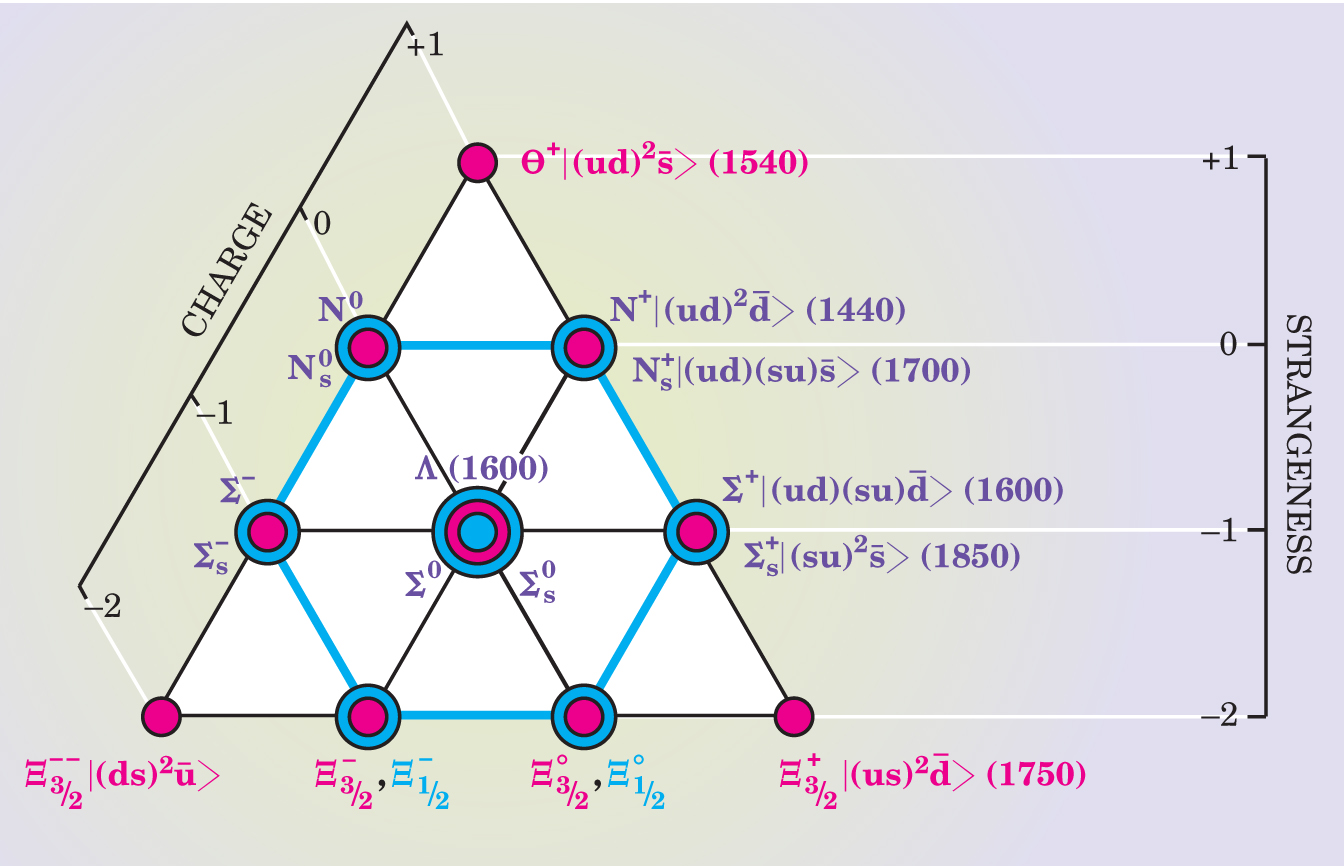
Confirmation of reaction 1 would support the correlated-quark model. 6 Figure 2 shows the SU(3) flavor multiplet of spin-½ pentaquark baryons predicted by Jaffe and Wilczek in the wake of last year’s Θ+(1540) discovery. These 18 states of different charge and strangeness form a multiplet that combines an octet with an antidecuplet (so called because its isospin-singlet state is at the top rather than the bottom). Only the three states at the corners of the antidecuplet are manifestly exotic, but all 18 are presumed to be bound states of two pairs of strongly correlated quarks plus a lone antiquark.

Figure 2. A flavor-symmetry multiplet of 18 pentaquark baryons, predicted from a correlated-quark theory after the discovery of Θ+(1540), is a sum of an octet (blue dots) and an antidecuplet (red dots). Predicted masses (in MeV) and representative quark compositions are shown for the component charge multiplets. Only the three states at the corners of the antidecuplet are manifestly exotic, but the theory presumes that all 18 are pentaquarks with two pairs of correlated quarks (indicated by parentheses) plus an antiquark. The recently discovered S = −2 baryons
(Adapted from ref. 3.)
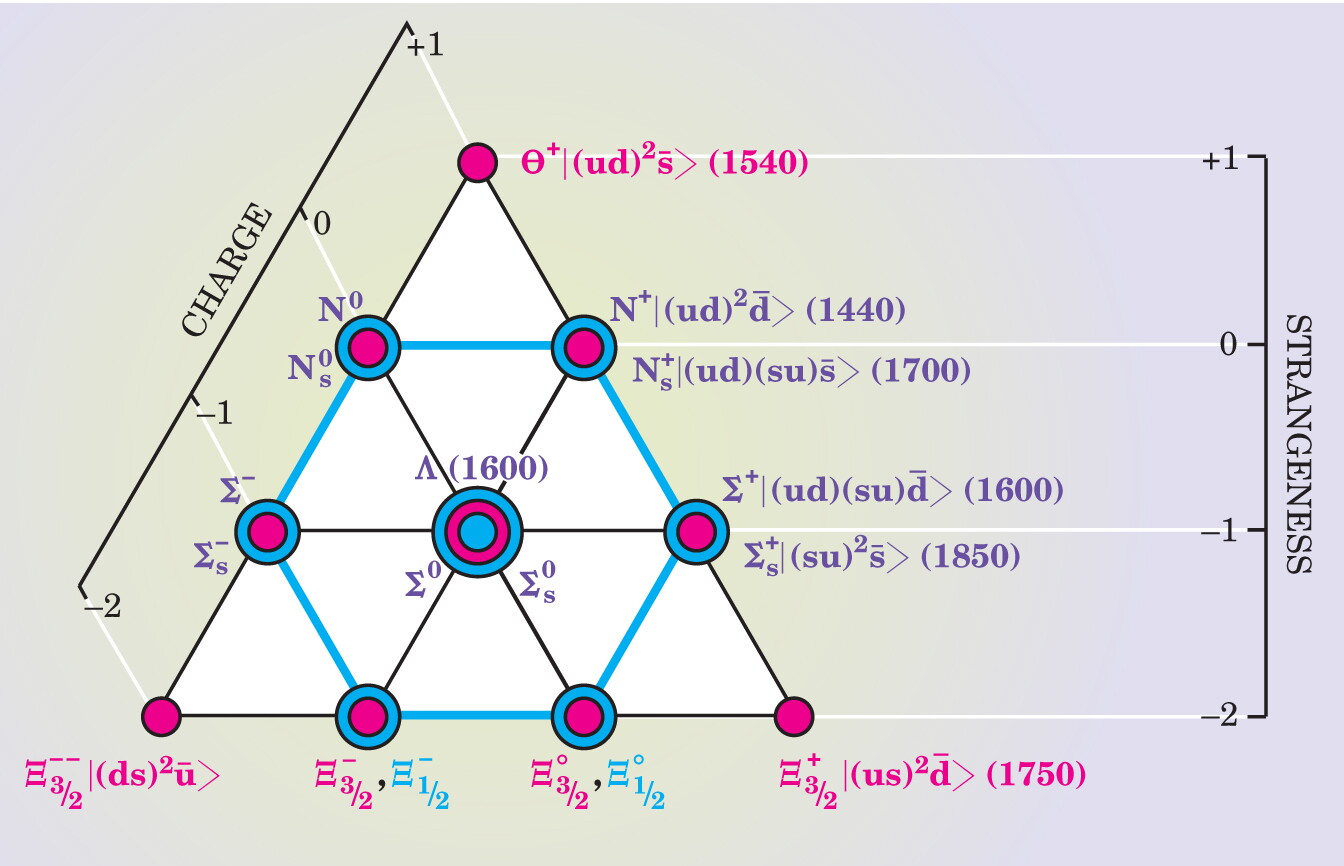
Except for the already discovered Θ+(1540) and the long-known but enigmatic N(1440) isospin doublet, whose identification as a pentaquark is a conjecture that fixes the bottom of the multiplet’s mass scale, all the other pentaquark states and their masses were predictions. What matters for the interpretation of the new NA49 results are the predicted six cascade baryons at the base of the triangle.
The Jaffe–Wilczek theory asserts that all six should have roughly the same mass. To distinguish the isospin-½ doublet belonging to the octet from the antidecuplet’s isospin-
So, the NA49 data would seem to require both antidecuplet and octet cascade states of mass around 1.86 GeV. Such a coincidence would be surprising in the skyrmion model, which also predicts an antidecuplet topped by the Θ+(1540) but not an obligatory octet with degenerate cascade masses (see Physics Today, September 2003, page 19 ). But precisely that mass degeneracy between antidecuplet and octet cascade states is a natural consequence of the correlated-quark model.
One might protest that, because flavor SU(3) is only an approximate symmetry, the observation of reaction 1 could simply be a symmetry-violating decay of the Ξ−
Pentaquark spectroscopy is off to a surprisingly vigorous start. Of course, the NA49 results have yet to be confirmed by other experiments. Theorists are especially eager to see data from detectors that can record neutral particles. “Whatever the final outcome, it’s clear that a new spectroscopy has been born,” says Jaffe. “For a particle physicist, it’s a refreshing change to be working again with theories that make falsifiable predictions and experiments that make discoveries.” CERN theorist John Ellis agrees: “Nowadays I check the preprint archive every morning for new experimental high-energy results,” he says. “It’s been a long time since I last did that.”
References
1. C. Alt et al. (NA49 collaboration),Phys. Rev. Lett. (in press).
2. D. Diakonov, V. Petrov, M. Polyakov, Z. Phys. A 359, 305 (1997).https://doi.org/10.1007/s002180050406
3. R. Jaffe, F. Wilczek, Phys. Rev. Lett. 91, 232003 (2003).https://doi.org/10.1103/PhysRevLett.91.232003
4. R. Cahn, G. Trilling,Phys. Rev. D (in press);
R. Arndt, I. Strakovsky, R. Workman, Phys. Rev. C 68, 042201–R (2003).https://doi.org/042201&5. D. Diakonov, V. Petrov, http://arXiv.org/abs/hep-ph/0310212 .
6. R. Jaffe, F. Wilczek, http://arXiv.org/abs/hep-ph/0312369 .