Building for Pakistan’s quake zone
DOI: 10.1063/1.2180170

Pervez Hoodbhoy’s mission is to erect buildings that can withstand a major earthquake, like the one that killed more than 70 000 people, injured 200 000 more, and made 2.8 million homeless in Afghanistan, Pakistan, and Northern India last October. Working with other physicists from Quaid-e-Azam University in Islamabad, Pakistan, 220 kilometers southwest of the earthquake’s epicenter, Hoodbhoy has so far raised $400 000, largely from US physicists and arms-control analysts. The relief-team physicists are using the money to build private homes, shelters, and schools.
In the urban areas rocked by the 7.6-magnitude quake, 60% of the buildings were made of un-reinforced concrete, and nearly all of them were destroyed. Costlier brick buildings survived in slightly higher numbers, but even they lacked reinforcements such as concrete bond beams, according to researchers at the earthquake engineering center of the University of Engineering and Technology in Peshawar, Pakistan. Shoddy workmanship and poor materials had made nearly every building in the affected region a death trap, the researchers say.
After the earthquake Hoodbhoy persuaded his university’s president to let him use the physics department’s trucks to ship supplies to the disaster zone. He and his team deliver materials and plans, and locals build their own homes. “Working through reliable local groups and individuals is fundamental to our efforts,” Hoodbhoy says. The team’s regular visits to monitor progress, he adds, “are crucial for ensuring that the most deserving get the materials we have obtained for them.”
The cost of a sturdy house designed to better survive an earthquake is $1000, Hoodbhoy says. But demand is making materials scarce and driving prices up, and the onset of winter is causing delays. At subzero temperatures, Hoodbhoy says, “cement does not set well, or at all. The urgent thing now is to protect the maximum number of people from snow, rain, and biting cold winds.”
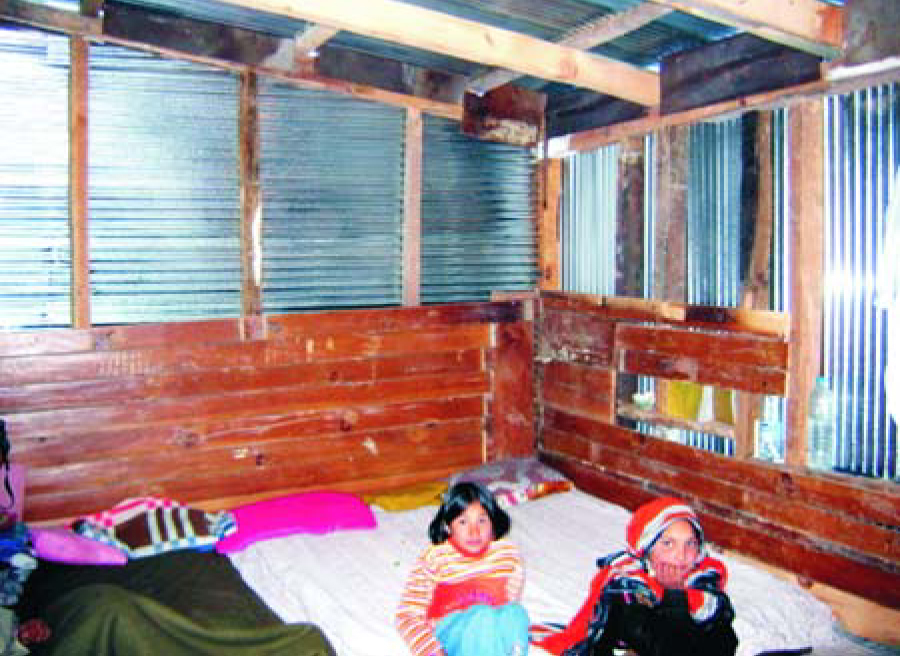
“If we build primitive temporary shelters constructed from corrugated metal sheets and nailed into wooden frames, we can reuse the materials in the spring for permanent houses,” Hoodbhoy continues. “Each shelter costs $300, minus the frame wood, and we hope to build several hundred with the money at our disposal.” Locals scavenge the wood from collapsed buildings and surrounding forests. More than 132 shelters, each big enough to house six to eight people, have been built already. The shelter design is proving so popular that the Pakistani army is using it for their relief efforts, says Abdul Hameed Nayyar, a retired physicist who is working with Hoodbhoy on the building project.
The biggest problem with these structures is insulation, Nayyar says. “Hay is a fire risk, using nets and mud has been abandoned as locals think the mud would rust the iron, so they suggest using a layer of wooden planks.” This would increase the shelter cost by about 20%, he adds, but would definitely save the people from bitter cold.
“We can’t handle any more money for homes,” says Hoodbhoy. “The need for spot allocation and inspection requires us to be there physically. Otherwise massive pilferage is certain.” Instead, he is contemplating the relief team’s next step: rebuilding schools. Nearly 16 000 schools were destroyed in the earthquake and those that have reopened are holding classes outside.

Shelters for earthquake victims are designed and organized by physicists in Pakistan.
PERVEZ HOODBHOY

More about the authors
Paul Guinnessy, American Center for Physics, One Physics Ellipse, College Park, Maryland 20740-3842, US . pguinnes@aip.org