Scientists across the UK and the rest of Europe are nervously pondering the implications of the UK’s 23 June vote to leave the European Union (EU). The 52% to 48% decision raises huge questions regarding not only funding but also Europe’s ability to maintain the degree of openness and collaboration that has pushed the continent to the forefront of many fields of science.
“It is hard not to see Brexit as being extremely bad for science in the UK,” says biological physicist Athene Donald at the University of Cambridge.
Scientists were not among the demographics that were sharply divided on the referendum. A survey conducted in March by Nature found that 83% of UK researchers, including 80% of those who planned to vote, favored remaining in the union. Public letters cowritten by Nobel laureates, university leaders, and other prominent UK scientists touted the advantages of EU membership.
Britain gets plenty of bang for its science buck with the EU. From 2007 to 2013, the UK paid €5.4 billion ($6 billion) to fund EU science and received €8.8 billion in research funding. No other EU member state receives more grants from the European Research Council.
Now many researchers are worried about the financial impact to their institutions and projects, despite the recent pledge by political leaders of the Leave movement to maintain levels of EU funding for universities and scientists. Cambridge, for example, receives about a quarter of its research funding from EU grants, Donald says. In the referendum, 74% of the city’s electorate voted to remain.
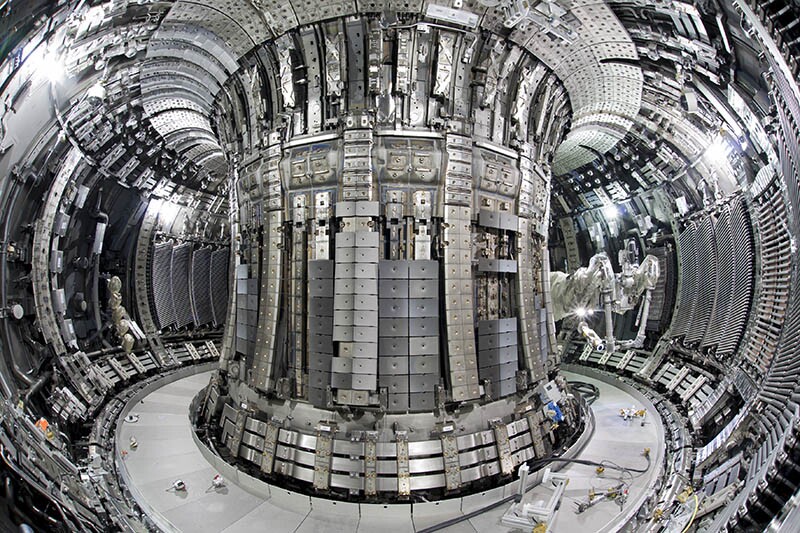
The EU is also providing €283 million through 2018 for the Joint European Torus, a fusion reactor in Culham, UK, that researchers hope will break the record for fusion energy yield in 2019. The torus results are crucial for scientists planning the next-generation reactor ITER, whose international partners include the EU as a single entity. Steven Cowley, director of the Culham Centre for Fusion Energy, says that the UK will have to join and pay individually to remain part of ITER, which has provided hundreds of millions of euros to British companies building instruments and equipment.
The Joint European Torus, located at the Culham Centre for Fusion Energy in the UK, is largely funded by the European Union. Credit: EUROfusion, CC BY 4.0
The UK’s exit should not directly impact British involvement in CERN, which predates the EU and receives funding from individual nations. But many UK scientists working at the particle-physics lab—particularly those early in their careers—are funded by EU grants, says Rolf-Dieter Heuer, CERN’s director general from 2009 to 2015. “My biggest concern is for the young people,” he says.
The EU’s Erasmus program offers money to early-career scientists to work at institutions across Europe; the UK received about €118 million in funding last year. Nearly twice as many Europeans studied at a British university in 2012–13 as Britons studied at a European university. UK voters in the 18–24 age range backed Remain by a three-to-one margin, according to an exit poll.
Scientists young and old may face challenges securing funds from lucrative EU initiatives. British scientists may no longer be eligible to compete for research grants from Horizon 2020, the seven-year, €80 billion fund that is financed by EU member states. It’s unclear exactly what the immediate impact of the UK’s withdrawal will be on existing grants, since the British treasury contributes to the program, and many awards involve researchers from multiple countries. The EU has extended eligibility in Horizon 2020 to non-EU members, such as Ukraine, who don’t contribute to the fund.
It’s also unclear whether UK researchers will have access to the €1 billion the EU recently pledged to support quantum technologies. “Being outside the EU might … leave the country behind in a race that waits for no one,” says Mauro Paternostro, a theoretical physicist at Queen’s University Belfast. Nearly 56% of Northern Ireland voted to remain.
Cowley and other scientists express skepticism for Leave advocates’ assertion that the UK could easily renegotiate participation in EU projects and initiatives. Countries such as Switzerland and Norway that negotiated their way into EU science initiatives have never been part of the EU. “I don’t think you have a particularly good negotiating position when you just left,” Cowley says. And Switzerland, which renegotiated its role in 2014 after its voters approved immigration restrictions in a referendum, lost access to benefits such as Erasmus.
Beyond the euros and pounds, many scientists are concerned about the potential deterioration of collaboration and openness that has fueled decades of science in Europe. “European science over my lifetime has recovered strongly from the effects of two world wars to become a leading power in many fields of physical and life sciences,” says Ken Pounds, an astrophysicist at the University of Leicester. “That would not have happened without the supportive structures of bodies such as the European Space Agency, European Southern Observatory, CERN, and the EU.”
Donald and Paternostro already report hearing colleagues, many of whom are from the EU, planning to leave UK institutions. “The department that I lead in Belfast is 70% made out of EU citizens, and this is not an exception,” Paternostro says. Institutions including University College London released statements assuring students and staff that their immigration status won’t change immediately and that their EU-sponsored grants are still valid.
“We must remember that whatever happens, science has no boundaries,” said Royal Astronomical Society president John Zarnecki in a statement. “It is vital that we do not give the message, particularly to our younger colleagues, in the UK and beyond that our country is not a good place in which to do scientific research, however uncertain the economic and political environment is.”
David Kramer and Greg Stasiewicz contributed to this article.