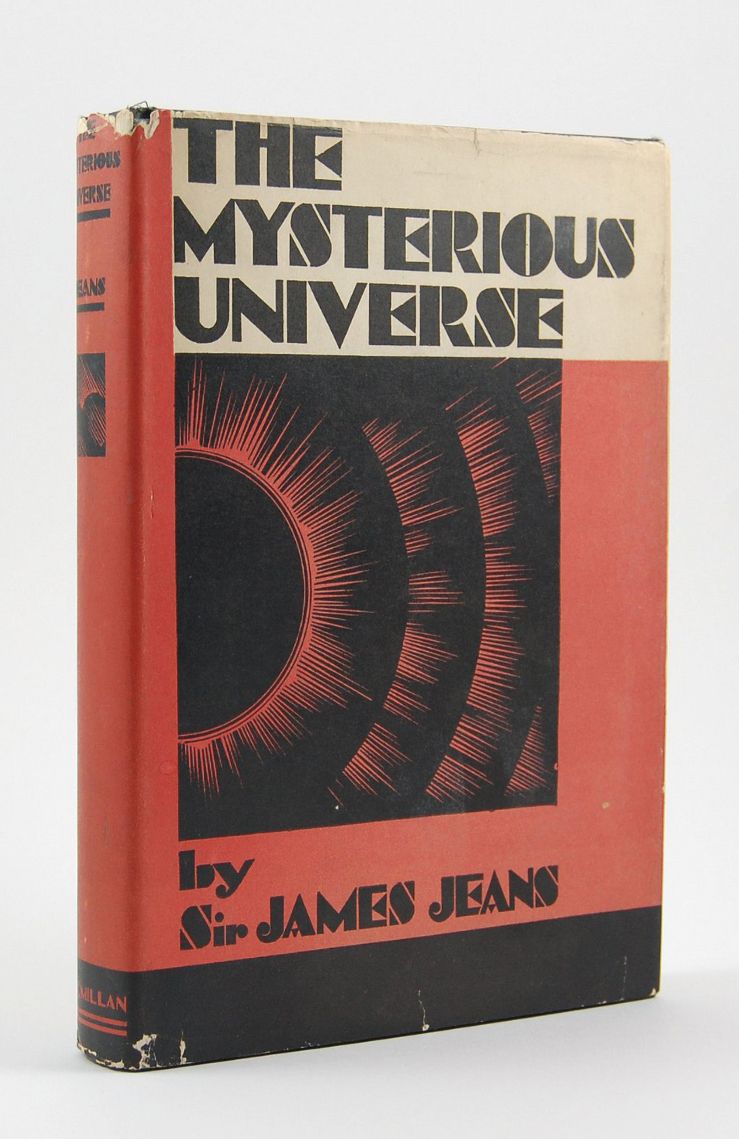
James Jeans’s views on the nature of reality
DOI: 10.1063/PT.3.4735
Daniel Helsing’s takedown of the views of James Jeans (“James Jeans and The Mysterious Universe,” Physics Today, November 2020, page 36 ) needs a rebuttal. The view that a real physical universe is “out there”—end of story—misses entirely the benefit of our huge and relatively recent mathematical insights into the nature of what seems to be reality, according to our evolved human senses.

LAURA MASSEY/ALEMBIC RARE BOOKS

We have achieved deeper insight only through our discovery of the immense power of often astonishingly simple mathematical equations that elucidate the nature of the so-called universe. That is profoundly yet almost trivially demonstrable! I offer an example: I expect Helsing would agree that the most mysterious thing about the universe is the nature not of matter or space but of time.
With Hermann Minkowski’s 1908 insight into Einstein’s 1905 special relativity, we humans achieved the almost unthinkable: a deep understanding of the utterly simple nature of time. For while
Such equations were created solely because of the existence of the human mind, and they demonstrate that the universe itself is intrinsically mental in its nature. In my 2005 essay “The mental universe,” I assist Jeans and Arthur Eddington in the Sisyphean task of educating the public on that point. 1 I also try to assist young students in seeing how simple the math is; for example, I concisely present special relativity at https://henry.pha.jhu.edu/2-pager.pdf .
References
1. R. C. Henry, Nature 436, 29 (2005). https://doi.org/10.1038/436029a
More about the authors
Richard Conn Henry, (henry@jhu.edu) Johns Hopkins University, Baltimore, Maryland.