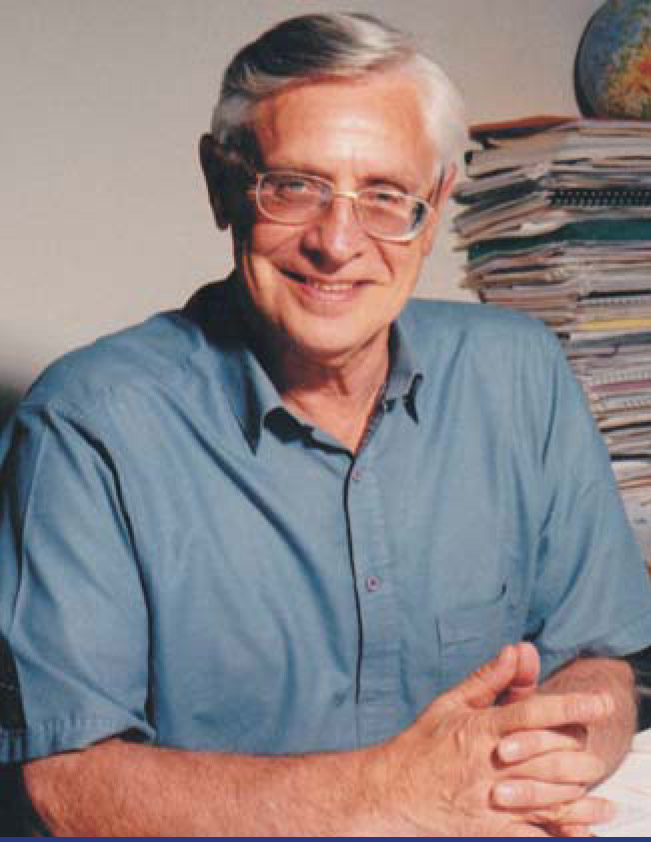
William Ian Axford
DOI: 10.1063/1.3463634
On 13 March 2010, William Ian Axford, a towering figure in cosmic research, died at his home in Napier, New Zealand, after a long battle with intestinal cancer.
Ian was born 2 January 1933 in Dannevirke, New Zealand. Having received his bachelor’s (1954) and master’s (1956) degrees in both science and engineering from the Canterbury University in Christchurch, he joined the Royal New Zealand Air Force as a flight lieutenant in 1957. He proceeded to the UK on a defense science scholarship and obtained his PhD in cosmic gas dynamics from the department of applied mathematics at the University of Manchester in 1959, under the guidance of James Lighthill, the leading aerodynamicist of the time. He then spent 1959–60 doing postdoctoral research at the University of Cambridge. From 1960 to 1962 he was a researcher on the Defense Research Board of Canada, then he spent four years as a professor at Cornell University before moving to the University of California, San Diego, as a joint professor in the departments of physics and applied electrophysics. He moved to Germany in 1974 to be director of the Max Planck Institute for Aeronomy (MPAE; now the Max Planck Institute for Solar System Research), from which he retired in 2001. From 1982 to 1985, Ian also served as the vice chancellor of the Victoria University of Wellington in New Zealand.
During his distinguished research career, which spanned almost half a century, Ian made seminal contributions to our understanding of a wide range of cosmic phenomena. More than two dozen of his papers are considered “citation classics.” In a remarkable early paper he wrote with Colin Hines more than 50 years ago, Ian drew on a vast number of ground-based observations to infer the global structure and dynamics of the terrestrial magnetosphere-ionosphere system and provided a unifying model for the understanding of diverse phenomena, including the radiation belts, aurorae, and geomagnetic storms and substorms.
In 1962 Ian was the first to predict the existence of a bow shock upstream of the magnetosphere. He was also the first to predict the existence of an extended magnetotail. Both were subsequently observed by satellites.
Another major area to which Ian made trailblazing contributions is the origin, acceleration, and modulation of cosmic rays. His concept of diffusive acceleration at interstellar shocks laid the foundation for our current understanding of cosmic-ray acceleration to very high energies.
Among the other areas to which Ian made highly influential contributions are solar-wind and heliospheric physics, cometary physics, and the physics of satellite–dust interactions in magnetospheres.
An outstanding teacher and mentor, Ian had several of his graduate students go on to become prominent members of the space science community. They include Len Fisk, onetime associate administrator of NASA, and Tom Holzer, onetime director of the High Altitude Observatory in Boulder, Colorado. Ian also inspired the research of numerous younger colleagues, including the two of us, who first met Ian at the University of California, San Diego. We not only learned a great deal from Ian but also were greatly influenced by his general approach, which was to describe complex cosmic phenomena with simple but insightful models that underscored the essential physics and to begin by making back-of-the-envelope calculations before proceeding to more detailed analyses.
Ian was a strong advocate of unmanned space missions and was involved in the spectacularly successful NASA Voyager program, whose scope of discovery spanned all of Ian’s interests—from planets to the solar wind, including its termination via the interaction with the local interstellar medium. During his tenure as the director of the MPAE, he not only transformed the institute, arguably into the leading space science center in Europe, he also got it heavily involved in the Ulysses and the Solar and Heliospheric Observatory interplanetary missions and in the spectacular Giotto mission to comet Halley in 1986.
Those successes all attest to Ian’s political and administrative skills, which are almost surprising considering Ian’s unassuming nature and his laid-back demeanor. Perhaps those qualities were his secret. Another quality that no doubt helped him was his deeply ingrained sense of fairness and inclusiveness. Early in the international space program, Ian stood up for Russian colleagues whose contributions, he felt, were not properly acknowledged. He also did much to help scientists from the third world and Eastern bloc countries.
Ian had several interests besides science. He was an avid reader with a particular interest in world history. He was also a keen follower of the popular New Zealand sports cricket and rugby. What concerned Ian greatly in recent times was climate change. It was the main topic of conversation when each of us visited him at his home in Napier during the past four years, when he was already in failing health. He clearly saw climate change as the biggest issue facing humanity at present.
Ian has been honored with many prestigious awards from scientific societies and national academies around the world. He also had the distinction of being awarded a knighthood in 1996.
We join the space science community in mourning the passing of an outstanding scientist, inspiring mentor, and valued friend.

William Ian Axford
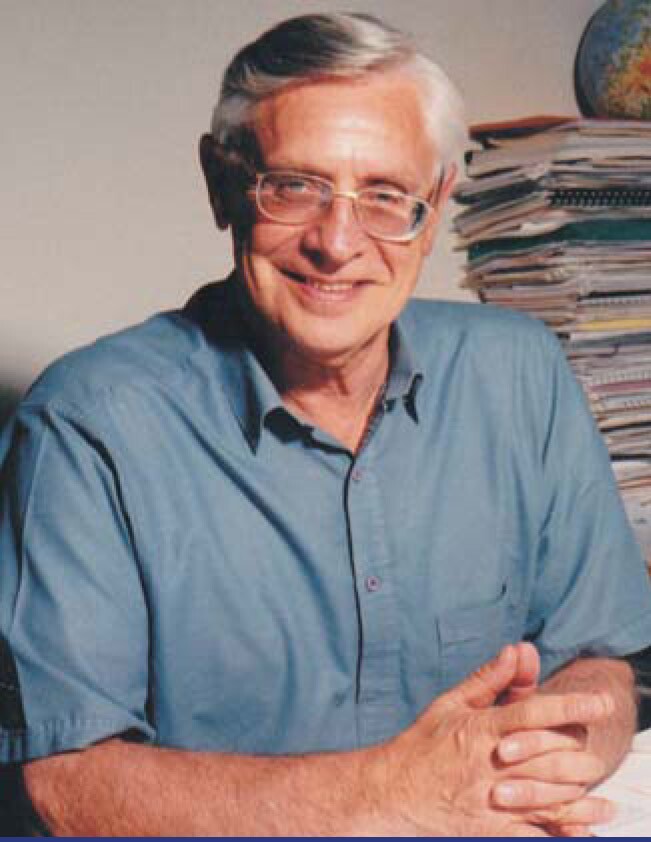
More about the authors
Asoka Mendis, University of California, San Diego, La Jolla, US .
Wing-Huen Ip, National Central University, Jhongli City, Taiwan .