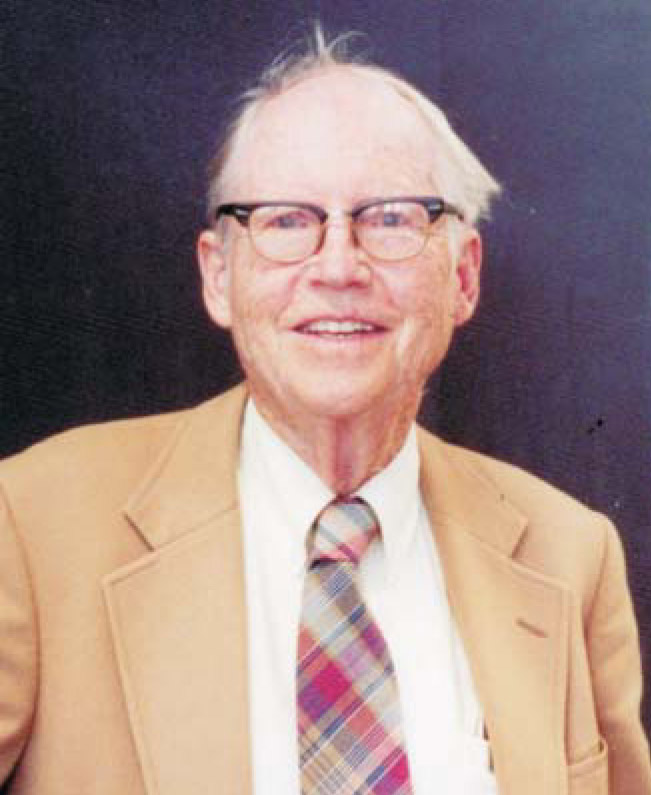
William Delany Walker
DOI: 10.1063/1.3480088
William Delany Walker, James B. Duke Professor of Physics emeritus at Duke University, died of cancer in Durham, North Carolina, on 8 April 2010.
Bill was born on 23 November 1923, raised in Dallas, Texas, and went to Rice Institute (now Rice University) in Houston, from which he obtained his undergraduate degree in physics in 1944. After being commissioned as an officer in the US Navy, he worked on far-IR detection at the US Naval Research Laboratory until the end of World War II. He then went to graduate school at Cornell University and studied with Richard Feynman, Hans Bethe, and his thesis adviser Kenneth Greisen. His thesis on cosmic-ray physics, entitled “A Study of Penetrating Showers,” earned him his doctorate in 1949.
After teaching briefly at Rice, at the University of California, Berkeley, and at the University of Rochester, Bill took a faculty position with the physics department at the University of Wisconsin. There he had a distinguished career, building up the high-energy physics program based on the cutting-edge technology of the time, bubble chambers. He served as department chairman for two years and, in recognition of his contributions to experimental high-energy physics, was awarded the Max Mason distinguished professorship.
In the early 1960s, Bill codiscovered the rho meson, one of only a few subatomic particles then known to exist. It was eventually realized that the rho meson was an excited state of the lowest-mass strongly interacting particle, the pion. The discovery, along with other observations of excited states of hadrons, led to the formulation of the SU(3) flavor symmetry of mesons and baryons. Bill was also project director for the construction of the 30-inch hydrogen bubble chamber that was used for many years of physics at Argonne National Laboratory and later for early experiments at the Fermilab Tevatron.
In 1971 Bill went to Duke University, where he again built up an experimental high-energy physics group and served two terms as chairman of the physics department. He continued making innovative contributions to elementary particle research through the use of hydrogen and heavy-liquid bubble chambers. Duke recognized his long and productive research career by awarding him a James B. Duke Chair. Bill had many interests in addition to experimental high-energy physics, yet his life formed an integrated whole. In his mid-thirties he experienced a radical conversion to Christianity, in part as a result of his physics research. Being a true academic, he decided to take seminary courses—he later jokingly referred to that work as earning his “merit badge in theology”—and was ordained in the Episcopal Church. Over the years he served in the leadership of a number of evangelical congregations. Bill and his wife, Constance Kalbach Walker, a senior research scientist at Duke, were often called on in both church and academic settings to explain the harmony that exists between the Biblical and scientific perspectives on creation and on the world around us. They eventually coauthored a booklet on the subject.
His technical knowledge, combined with a genuine concern for the welfare of society and the environment, led Bill to be a vocal advocate for the safe and responsible use of nuclear energy. He was also an outstanding athlete; he had been the top tennis player on his college varsity team and continued winning state and local tournaments until he was in his early eighties. He remained an avid player until a few months before his death.
Bill will be remembered not only for his numerous scientific achievements and strong faith but also as a man of gentle strength, deep wisdom, genuine concern for others, and amazing perseverance.

William Delany Walker
DUKE UNIVERSITY PHYSICS DEPARTMENT

We thank Constance Kalbach Walker for her numerous contributions to this obituary.
More about the authors
Alfred T. Goshaw, 1 Duke University, Durham, North Carolina, US .
Albert Erwin, 2 University of Wisconsin-Madison, US .