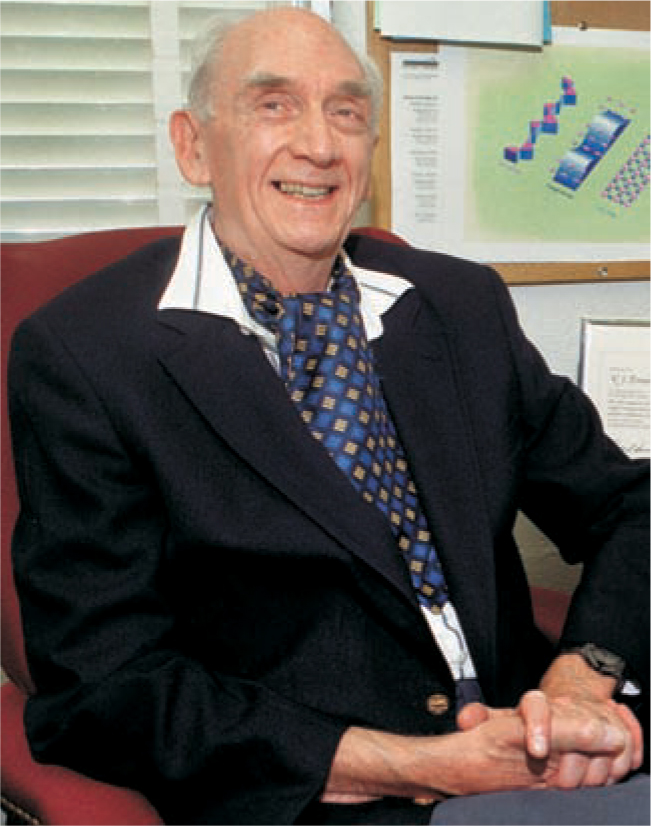
Victor John Emery
DOI: 10.1063/1.1825280
Victor John Emery, a leading many-body theorist and head of the condensed matter theory group at Brookhaven National Laboratory in New York, died on 17 July 2002 in Wading River, New York, as the result of amyotrophic lateral sclerosis (ALS), better known as Lou Gehrig’s disease, which he had battled stoically for several years.
Born in Boston, England, on 16 May 1934, Vic earned a BSc in mathematics at the University of London in 1954. Under the supervision of Richard Eden, he received a PhD in theoretical physics from the University of Manchester in 1957 for numerical studies of nuclear structure. His experiences with an early digital computer likely persuaded him of the value of more analytical approaches.
After postdoctoral stints at Cambridge University’s Cavendish Laboratory and at the UK Atomic Energy Establishment at Harwell, Vic spent a year on a fellowship at the University of California, Berkeley. Working with Andrew Sessler, he predicted pairing of the fermionic atoms in the quantum liquid helium-3 along the lines of the Bardeen-Cooper-Schrieffer theory of superconductivity, but with pairing in a state of nonzero angular momentum. That prediction (with refinements by others) was confirmed by the 1972 discovery of superfluidity in 3He by David Lee, Douglas Osheroff, and Robert Richardson, who shared the 1996 Nobel Prize in Physics for that discovery.
Vic returned to England and spent three years as a lecturer at the University of Birmingham. He continued his interest in and analysis of liquid 3He experiments. After then spending a year as a visiting assistant professor at Berkeley, Vic settled down at Brookhaven, where he initially continued his work on 3He and 3He–4He mixtures. His work on 3He–4He with Martin Blume and Robert Griffiths led to a simple model of phase separation that is now standard in textbooks on statistical mechanics. Around that time, Vic’s confidence in his own abilities was manifest in his assuming the leadership of an experimental cryogenics group involved in a variety of experiments associated with superconductivity and liquid helium.
Around 1970, Vic began to study the Kondo problem, which led to his investigations of the one-dimensional electron gas. In collaboration with Alan Luther, he found the exact solution of a class of model Hamiltonians and introduced methods and concepts that have become a paradigm for current approaches to strong-correlation effects in electronic systems. In particular, Vic and Luther introduced the separation of spin and charge, a concept whose implications beyond one dimension are now a central theme in condensed matter theory. For that joint work, they received the American Physical Society’s Oliver E. Buckley Prize in 2001.
The discovery of high-temperature superconductivity in quasi-two-dimensional copper oxide compounds in 1986 initiated a highly productive period in Vic’s career. One of his first contributions was to derive for the copper-oxide planes an extended three-band Hubbard model, from which he showed that the charge carriers are holes in 2p states of oxygen. Shortly thereafter, Vic began a prolific collaboration with one of us (Kivelson) by noting that holes doped into an antiferromagnet, as in the cuprates, have a tendency to phase separate. The long-range part of the Coulomb interaction frustrates macroscopic phase separation and leads to a state that can be viewed as a mixture of insulating and conducting regions on intermediate length and time scales. That idea provided a useful perspective for understanding various types of order—especially the stripe order found in certain high-temperature superconductors, nickelates, and manganites—and more general indications of a strong electronic tendency to form inhomogeneous states in a variety of highly correlated materials. Drawing on Vic’s experience with the 1D electron gas, the pair proposed a mechanism for high-temperature superconductivity that relies on intrinsic electronic inhomogeneity. The existence of electronic inhomogeneities provides an explanation of the notably small superfluid density found in underdoped cuprates. The inhomogeneities also explain the remarkable superconducting fluctuations that contribute to some of the so-called pseudogap phenomena above T c. Although the theory of superconductivity in the cuprates remains contentious, Vic’s work continues to influence theoretical and experimental studies of these fascinating materials.
At Brookhaven, Vic’s leadership tremendously influenced research in condensed matter physics. He spent terms as leader of the condensed matter theory group, head of solid-state physics, and scientific program head for the High-Flux Beam Reactor. A brilliant theorist, he had a talent for interacting with experimentalists that made the Brookhaven physics department an especially attractive place for staff and visiting experimentalists and theorists. He was generous with his time and extremely supportive of his colleagues. Vic was eager to discuss the latest experimental results and would willingly explain new theoretical ideas and repeat his explanations as many times as his colleagues needed.
Physics was central to Vic’s life. Even in his last few years, he did not allow the physical challenges imposed by ALS to keep him away from his work. Outside of the lab, he was an avid swimmer (a water-polo player in his youth). He always took great pride in his family, including his wife, three children, and seven grandchildren.
We remember Vic for his open and forthright character. Despite his many accomplishments, he was not arrogant and was happy to discuss physics with any interested party. His friendship, guidance, leadership, and insights are sorely missed.

Victor John Emery

More about the authors
John Tranquada, Brookhaven National Laboratory Upton, New York, US.
Myron Strongin, Brookhaven National Laboratory Upton, New York, US.
Peter Johnson, Brookhaven National Laboratory Upton, New York, US.
Steven Kivelson, University of California, Los Angeles, US.