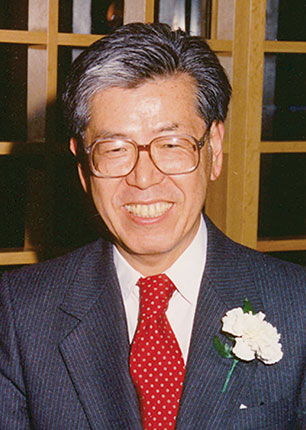
Susumu Okubo
DOI: 10.1063/PT.3.2989
Renowned particle theorist Susumu Okubo passed away peacefully at his home in Rochester, New York, on 17 July 2015 after a brief struggle with cancer.

Susumu Okubo

Born on 2 March 1930 in Tokyo, Okubo received his bachelor’s and master’s degrees in physics from the University of Tokyo before joining the University of Rochester as a graduate student in 1954. He received his PhD in theoretical physics in 1958, with David Feldman serving as his adviser. He was a research associate at Rochester from 1957 to 1959. He then spent 1959–60 at the University of Naples and the subsequent year at CERN. He also spent a brief period at the University of Tokyo before returning to Rochester in 1962 as a senior research associate, and in 1964 he became a professor of physics.
Okubo made seminal contributions to theoretical particle physics, and his insights led to a deeper understanding of physical phenomena. He came into the limelight when he proposed the mass formula for baryon and meson multiplets in the context of unitary symmetry, commonly referred to as the Gell-Mann–Okubo (GMO) mass formula. The known pseudoscalar and vector bosons and the spin-½ baryons belonged to octets of SU(3). Scientists believed that SU(3) must be a broken symmetry since there was no mass degeneracy in the baryon octet nor in the pseudoscalar or vector-boson multiplets. Okubo introduced an interaction Hamiltonian to break the mass degeneracy and derived a mass relation among the baryons in the octet of SU(3) that was satisfied to within 0.5% of the measured values.
One of the GMO triumphs was in the context of the mass relations in the spin-
Another of Okubo’s seminal contributions is the so-called Okubo-Zweig-Iizuka (OZI) rule governing decays of mesons through strong interactions. The rule was introduced to accommodate the decay of the φ meson belonging to the vector-boson multiplet of SU(3). The experimental observation that φ decayed predominantly to
Using current-algebra techniques, Okubo undertook a systematic study of the weak leptonic, semileptonic, and nonleptonic decays of hadrons even before the electroweak unified theory was proposed. He was first to find that partial widths can differ for charge-conjugate channels, and that finding influenced Andrei Sakharov’s formulation of the three fundamental requirements for understanding the baryon asymmetry of the universe. In his paper, Sakharov recognized Okubo through a short verse: “From S. Okubo’s effect, at high temperature, a fur coat is tailored, to fit the skewed form of the universe.”
Among his other notable contributions, in 1959 Okubo proposed, with Augusto Gamba and Robert Marshak, the idea of baryon–lepton symmetry, which eventually led to the suggestion of neutrino mixing that plays a key role in neutrino oscillations.
Okubo’s deep appreciation of group theory led to new ideas in the study of Lie groups and nonassociative algebras. His work on quaternions and octonions has proven quite useful in mathematics and theoretical physics. In parallel to the SU(3) of particle physics, he introduced a pseudo-octonion algebra that goes under the name Okubo algebra. Such algebras are quite fundamental and appear in mathematics and superstring theory. Okubo also was an outstanding researcher and teacher, and he supervised many graduate students at Rochester who achieved distinction in their own research.
Okubo was awarded fellowships from the Guggenheim Foundation in 1966 and the Ford Foundation in 1969. He received the 1976 Nishina Memorial Prize, the 2005 J. J. Sakurai Prize for Theoretical Particle Physics from the American Physical Society, and the 2006 Wigner Medal for his contributions to the understanding of physics through group theory.
Okubo loved to travel, was an ardent scuba diver, read voraciously, and tended to a Japanese garden at his home. He left a physics haiku as his death poem (jisei no ku) in the old Japanese tradition: “To be or not to be? Quantum Dream of the Schrödinger Cat. Farewell, Farewell Forever. Departure time now to the Black Hole. Never to Return. Farewell.”
He was a unique and kind human being, who will be missed greatly by his family, friends, colleagues, and students, on whose behalf these few words are offered.
More about the authors
Ashok Das, University of Rochester, Rochester, New York.