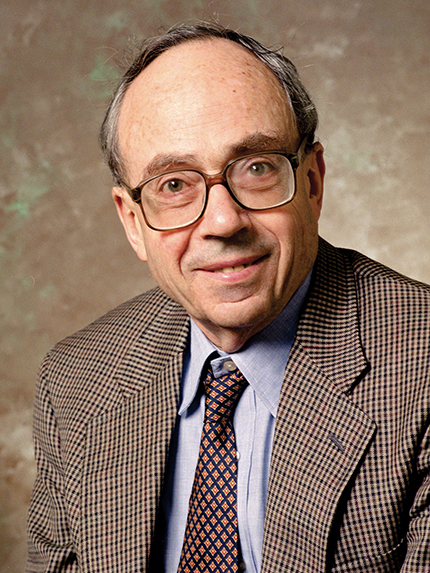
Stanley Mandelstam
DOI: 10.1063/PT.3.3565
Theoretical physicist Stanley Mandelstam died on 11 June 2016 in Berkeley, California. He was a leading expert and contributor to quantum field theory (QFT), the S-matrix approach, and string theory. His influences on theoretical and mathematical physics are deep and diverse and cut across almost all current major research efforts to deepen our understanding of the physical universe.

Stanley Mandelstam
UNIVERSITY OF CALIFORNIA, BERKELEY, DEPT OF PHYSICS
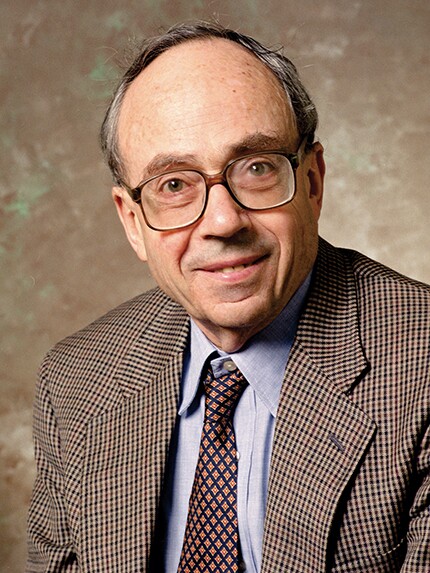
Born in 1928 in Johannesburg, South Africa, Stanley obtained a BSc in chemical engineering from the University of Witwatersrand in 1952. He switched his studies to theoretical physics at Trinity College, Cambridge University, from which he obtained a BA in 1954. Two years later he earned a PhD from the University of Birmingham under adviser Rudolf Peierls.
Stanley continued his research at Birmingham for another year before moving to New York City. From 1957 to 1958 he was a Boese research fellow in the department of physics at Columbia University. The next four years, 1958–62, can be called Stanley’s miracle years.
In a 1958 paper, he initiated what we now know as the Mandelstam representation in the Mandelstam variables for S-matrices. It was a daring leap from the insights Stanley had gained from perturbative results in QFT, the subject of his thesis, and from his advanced knowledge about functions of more than one complex variable. His presentation of the paper at the 1958 American Physical Society meeting in Washington, DC, caught the attention of Geoffrey Chew. The two met after Stanley finished his talk. At the end of their discussion, Chew offered Stanley a researcher position at the University of California, Berkeley, and Stanley accepted right away.
Stanley had two productive years at Berkeley. He consolidated the Mandelstam representation into its final form with the Mandelstam variables, worked with Chew to implement the representation into the S-matrix approach that Chew and his collaborators had developed, and initiated the idea of using Regge poles for high-energy behaviors in S-matrices.
In 1960 Stanley returned to Birmingham as a professor. His research output continued at a spectacular pace. During the next two years, with Berkeley and Birmingham colleagues, he published papers that consolidated the S-matrix approach. He not only delved deeper into the complex plane of angular momentum with Regge poles and cuts, but he also pioneered two far-reaching new directions: the gauge-invariant path-dependent fields for quantum gauge theories and the coordinate-independent path-dependent fields for quantum Einstein gravity. For both, he developed their Feynman rules in 1968.
Because of his achievements, he was one of the youngest participants invited to the prestigious 1961 Solvay Conference on Physics, which celebrated the 50th anniversary of the famous inaugural 1911 conference.
Stanley returned to Berkeley in 1963 as a professor in the department of physics. Among the groundbreaking work he produced during his 31-year career, there was the development of the precursor for the discovery of string theory, the elucidation of mechanisms for quark confinement in quantum chromodynamics, the nonperturbative constructions of the bosonization (or fermionization) in (1 + 1)-dimension QFTs, and the proof of the perturbative UV finiteness and β = 0, in any gauge to all orders, of N = 4 supersymmetric Yang–Mills theory. In 1992 he published the long-awaited first proof of the perturbative UV finiteness of string theory, so string theory can be considered as a contender for the theory of quantum gravity.
In 1994 Stanley became a professor emeritus. Until his death he continued to do research, to use his department office, and to live in the same Berkeley apartment that he had been in since 1980.
Stanley is being remembered admiringly by his colleagues in Berkeley’s physics department (http://physics.berkeley.edu/remembering-stanley-mandelstam ) and by his colleagues, students, and friends in the forthcoming Memorial Volume for Stanley Mandelstam, edited by Nathan Berkovits, Lars Brink, Kok Khoo Phua, Charles Thorn, and me (World Scientific).
Stanley’s influences live on. In his quiet, polite, attentive, and kind way, Stanley won the respect and love of his colleagues and friends. He is deeply missed.
More about the authors
Ling-Lie Chau, University of California, Davis.