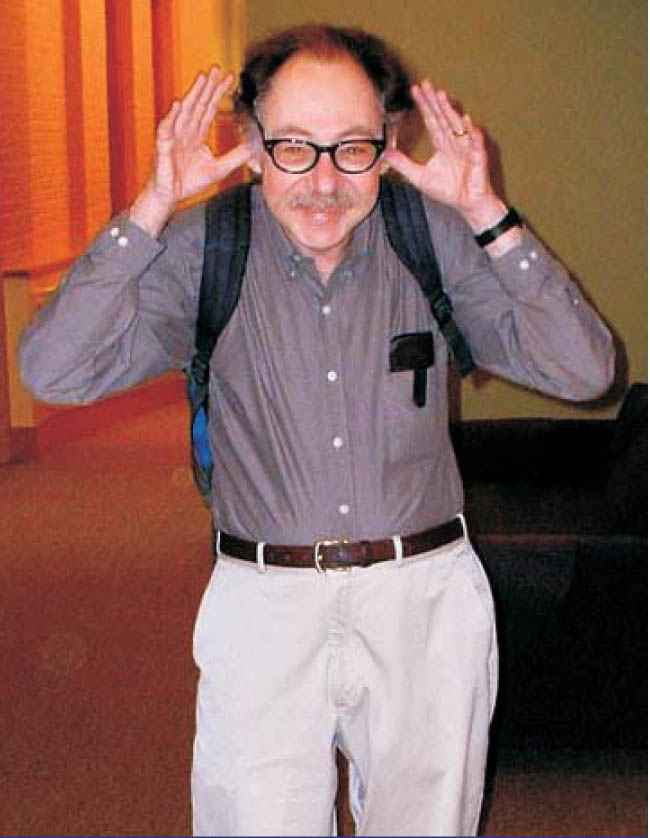
Sidney Richard Coleman
DOI: 10.1063/1.2930745
Cherished friend, colleague, and collaborator Sidney Richard Coleman, Donner Professor of Science at Harvard University, died on 18 November 2007 after a long struggle with Lewy body disease.
Sidney was born on 7 March 1937 in Chicago, where he grew up. In 1957 he received his BS degree in physics from the Illinois Institute of Technology, then entered graduate school at Caltech. We met in 1960 while I spent a postdoctoral year there. By then Sidney was just beginning his doctoral research under Murray Gell-Mann. We became fast friends with common interests in science fiction and in climbing Mount Wilson on weekends to escape the Pasadena smog. Our scientific collaboration began when Gell-Mann (and independently, Yuval Ne’eman) devised the unitary-symmetry scheme. While most of our colleagues were put off by the unfamiliar math, we became traveling disciples of the Eightfold Way and its sequels, such as the eponymous Coleman-Glashow mass formula. Sidney’s 1962 thesis, “The Structure of Strong Interaction Symmetries,” began with a presciently apt quotation from Justine by the Marquis de Sade: “What we do here is nothing to what we dream of doing.” So it would be!
In 1962 Sidney accepted an instructorship at Harvard. Throughout the 1960s we often traveled together to Europe, most frequently to Erice, Italy, to visit Antonino Zichichi’s subnuclear school, where Sidney could be counted on to present a formidable series of lectures. Many of those lectures are published in Aspects of Symmetry (Cambridge University Press, 1985), a book that remains essential reading to aspiring particle theorists.
To the world at large, Sidney is hardly as well known as such popular expositors of science as Isaac Asimov, Stephen Hawking, or Carl Sagan. But to the community of theoretical physicists he is a luminary. In the 1960s quantum field theory had lost much of its appeal. Whatever its great success for electrodynamics, QFT seemed unable to deal with the host of new particles being found and the puzzles they posed. Having devolved into a formal scheme of manipulating diagrams and following rules, the underlying physics was obscured. Sidney was, in large measure, responsible for the rebirth of QFT and thus laid the foundation for today’s standard model. Throughout the 1970s and beyond, Sidney understood quantum physics more deeply than most of his colleagues.
Although he collaborated with students on many of his papers, Sidney usually wrote them, as evidenced by their wit and lucidity. Of Sidney’s many significant contributions, I offer three examples.
The 1967 Coleman–Mandula theorem showed that no conventional Lie algebra could nontrivially incorporate both spacetime symmetries and such internal symmetries as charge conservation. That no-go theorem showed that many then-popular speculations were senseless.
The 1973 Coleman–Weinberg analysis of radiative corrections and spontaneous symmetry breaking, along with Sidney’s Erice lecture the following year on spontaneous symmetry breakdown and gauge fields, was an enormous contribution to our understanding of QFT. Previously, spontaneous symmetry breaking had to be put in explicitly via the Higgs mechanism. Sidney and Erick Weinberg showed how it could emerge from an effective potential V(ϕ) obtained by incorporating quantum radiative corrections, and, moreover, they showed that this potential is indeed the vacuum energy density in a state for which the field has expectation value ϕ.
Sidney’s papers “The Fate of the False Vacuum” parts I and II, the latter with Curtis Callan, and a third, “Gravitational Effects of and on Vacuum Decay,” with Frank De Luccia, make up another remarkable achievement. The titles tersely and clearly summarize the papers, as do all of Sidney’s sometimes whimsical titles. The potential of a quantum theory may have more than one minimum. Sidney calculated the decay rate of a higher (false) minimum: to lowest order in part I, with quantum corrections in part II, and in an expanding universe in the third paper. That work is central to many subsequent developments in both particle physics and cosmology.
Sidney’s fundamental contributions to our understanding of QFT earned him the 1990 Dirac Medal from the Abdus Salam International Centre for Theoretical Physics and the American Physical Society’s 2000 Dannie Heine-man Prize.
At Harvard, Sidney was a much-sought-after research supervisor. Most of his 40 or so thesis students are now well-known scientists. For more than four decades, virtually all physics students at Harvard—both graduate and undergraduate—have been inspired by Sidney’s wonderfully coherent and witty presentations of quantum mechanics and quantum field theory. Some of his legendary lectures were recorded for posterity; others were saved as lecture notes by diligent students so that their successors might have a taste of Sidney’s inimitable style.
In 2005 Harvard hosted a festival to honor Sidney. In attendance were many of his former students and many distinguished physicists. Steven Weinberg remarked that “Sidney is a theorist’s theorist. He has not been so much concerned with accounting for the latest data from experiments as with understanding deeply what our theories really mean. I can say I learned more about physics from Sidney than from anyone else.” In that connection let me recall an oft-told tale: Working late into the night as was his wont, Sidney rarely appeared at Harvard much before noon. He once arrived so late at a seminar by Weinberg that all he heard was Steve’s uncertain response to a question from the audience. “I know the answer!” shouted Sidney on entering the room, “What’s the question?” Indeed, he often answered questions before they were asked. Theorists who consulted him were often astounded as Sidney would patiently explain the implications of their own ideas.
Sidney was both an incomparable teacher and the most learned sage and sharpest critic in the world of theoretical physics: He was Pauli’s tongue in Einstein’s image. We have been deprived all too soon of one of our generation’s most profound and imaginative minds.

Sidney Richard Coleman
More about the authors
Sheldon Lee Glashow, Boston University, Boston, Massachusetts, US .