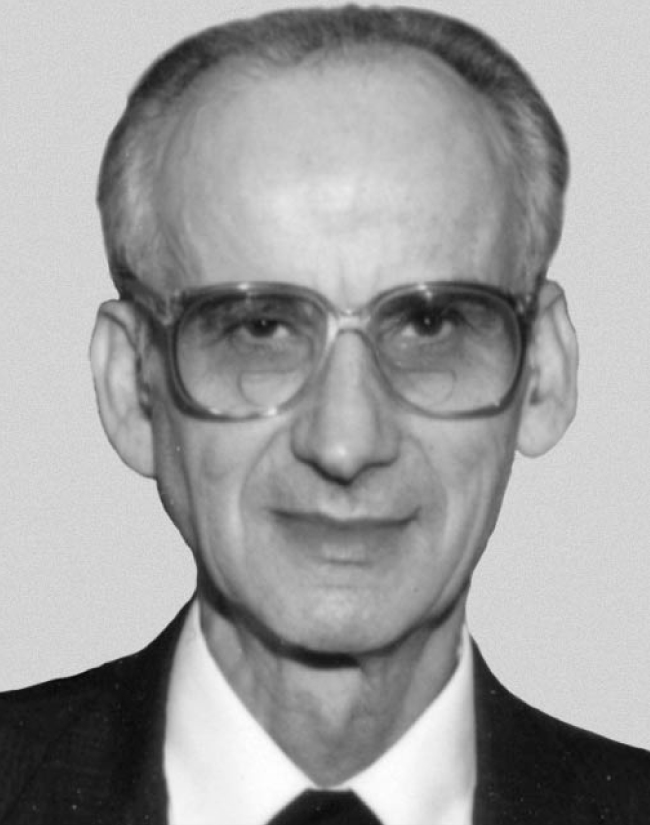
Samuel Newton Foner
DOI: 10.1063/1.1397403
Samuel Newton Foner, a pioneer in the science of very short-lived free radicals and highly reactive molecules, died from prostate cancer on 14 October 2000 in Tampa, Florida.
Born in New York City on 21 March 1920, Foner entered the Carnegie Institute of Technology at age 16, obtaining a double BS in physics and mathematics in 1940 and an MS in physics a year later. Before receiving his DSc in physics in 1945, under the direction of Nobel laureate Otto Stern and coadviser Immanuel Estermann, he was an instructor and worked with Stern from March 1944 to July 1945 on a secret program that was a part of the Manhattan Project.
Foner had an exceptional ability for developing simple experiments to resolve complex issues. He brought this talent to the Johns Hopkins University Applied Physics Laboratory (APL), then located in Silver Spring, Maryland, which he joined in July 1945 and where he worked for his entire professional career. For most of that time, he was a member of the research center, founded in 1947. Among his colleagues at the center were Ralph Alpher, Robert Herman, and James Van Allen. Foner conducted and led research in mass spectrometry, trapped free radicals, electron impact ionization, solid propellant combustion instability, and underwater sound.
In the article “Neutral Beam Kinetics,” Nature (volume 229, page 374, 1971), drew attention to the prolonged and painful evolution of the field, aided not so much by theoretical advances as by exquisitely subtle experimentation that emphasized direct observation. The article credited Foner and his colleague Richard Hudson for ingeniously combining two instruments—the molecular beam apparatus and the mass spectrometer—and using a novel scattering geometry to complete the first successful study of neutral atom–molecule reactions. Foner, who had learned the molecular beam techniques from their developer, Stern, had by then been working on refining mass spectrometers for at least two decades. He was the first to identify the elusive molecule hydroperoxyl (HO2) by mass spectrometry in 1953, nearly two decades after its existence was theoretically deemed essential for fully understanding the hydrogen–oxygen system.
By 1962, Foner had found a way to increase the concentration of HO2 by more than two orders of magnitude so that one could actually study, using a plethora of techniques, the molecule in the gas phase and as trapped in low-temperature solid matrices. Foner and his colleagues Chih Kung Jen, Edward Cochran, and Vernon Bowers had already pioneered techniques for trapping free radicals. The results of one such experiment, the trapping of hydrogen atoms in a solid hydrogen matrix at liquid helium temperatures and their study by electron spin resonance techniques, allowed Norman Ramsey to infer the lifetime of hydrogen atoms bouncing around in the maser chamber and to conclude that the system will not be too lossy. Ramsey could therefore confidently proceed with the building of the hydrogen maser.
Foner had great enthusiasm for science and was cognizant of its role in addressing national security problems. He also often judged science projects at local schools, served as science coordinator of the US science exhibit at the Seattle World’s Fair in 1962, and was adviser to NATO’s scientific affairs division (1973–82). He was the founding member of the APL Technical Digest; he served on the editorial board (1961–63) and was later the chairman (1963–79). He also served as vice chairman of APL’s Milton S. Eisenhower Research Center (1975–83). He retired from APL in December 1990.
Foner was a reserved and unassuming man who was truly embarrassed by praise. My attempts to recount Estermann’s high opinion of Foner, as expressed by Estermann to me, met with a quick change of subject. Used to doing first-rate research at an institute where such research was internally funded, he never took to proposal writing and seeking outside funds, even when it became de rigueur. He often said that such actions would soon lead the funding agencies to dictate the problems on which one could work. He was not entirely wrong. Foner was an exemplary scientist who leaves a strong scientific legacy.


More about the authors
Kishin Moorjani, Applied Physics Laboratory, Johns Hopkins University, Laurel, Maryland, US .