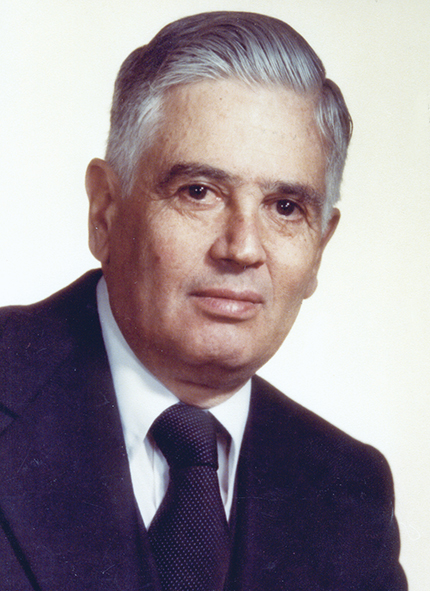
Robert Gomer
DOI: 10.1063/PT.3.3563
Robert Gomer, a pioneer in surface science, died on 12 December 2016 in Chicago after a long struggle with Parkinson’s disease.

Robert Gomer
AIP ESVA, PHYSICS TODAY COLLECTION

Gomer was born on 24 March 1924 in Vienna. He left for the UK in 1938 as part of the child transport rescue effort, and in 1940 he went to the US to meet his parents, who were already there. He earned his BA from Pomona College in 1944 and his PhD in chemistry from the University of Rochester in 1949. He then worked for a year on molecular chemical kinetics as a postdoctoral fellow with George Kistiakowsky at Harvard University.
From there Gomer went to the James Franck Institute and the department of chemistry at the University of Chicago. He spent the rest of his career there, first as an instructor and then as a professor. From 1977 to 1983, he was director of the institute. In 1984 he was named the Carl W. Eisendrath Distinguished Service Professor; he became a professor emeritus in 1996. Gomer won numerous awards for his work, including the American Physical Society’s 1981 Davisson–Germer Prize in Atomic or Surface Physics, the 1989 Medard W. Welch Award from AVS, and the American Chemical Society’s 1996 Arthur W. Adamson Award for Distinguished Service in the Advancement of Surface Chemistry.
Gomer’s research in what is now called surface science made him a world authority in the field. In the 1950s the investigation of surface processes had not proceeded much beyond Irving Langmuir’s achievements because researchers did not have the means to define the composition of a surface, routinely establish sufficient ultrahigh vacuum (UHV) conditions, measure the residual pressure, and prepare clean samples. It was still the age when tungsten was the sample of choice: Its high melting point made it likely that a clean surface could be obtained, although success could not be easily verified. There were none of the surface spectroscopies now amply available for standard characterization. Also, with the absence of commercial UHV apparatus and the lack of availability of single crystals, researchers used both filaments and evaporated films of often uncertain surface composition.
The field-emission microscope (FEM) offered promise, particularly when used with glass apparatus and tungsten samples, because the images could reveal surface cleanliness, adsorption of atoms and molecules, and work-function changes to quantify adsorption and estimate residual pressure. After hearing a talk by Erwin Müller, Gomer became interested in the technique, built his own apparatus, and used it to investigate atomic and molecular surface processes. He soon became one of the world’s top experts and conducted elegant experiments on the adsorption and thermal desorption of simple gases and alkali atoms. His 1961 book Field Emission and Field Ionization (Harvard University Press), based on lectures he gave at Harvard in 1958, is still a classic.
Gomer also developed theories on field-induced surface processes and desorption stimulated by electron impact. In the 1960s, when surface theory was in its infancy, he collaborated with J. Robert Schrieffer and published the first theoretical description of the adsorption bond. In 1964 Gomer and one of us (Menzel), and Paul Redhead working separately, created a semiclassical textbook mechanism, now known as the MGR mechanism, that explains electron-stimulated desorption as a transition from the neutral bound state to a charged-ion unbound state, modified by strong charge exchange with the substrate.
Later his interest shifted to surface diffusion, a key process related to catalysis and dynamics of two-dimensional systems. Gomer developed a novel method to study diffusion under equilibrium by measuring concentration fluctuations from FEM tunneling-current fluctuations. It is one of the few experimental methods to measure time-dependent correlation functions and test 2D dynamics. His classic 1990 review paper on surface diffusion has been heavily cited.
Gomer transmitted to his doctoral students and postdocs his enthusiastic approach to research. A person of high standards, he carried out an exhaustive set of experiments and developed a theoretical understanding of the phenomena being investigated. His high expectations and stringent insistence on hard work, experimental skill, and theoretical grasp have been lifelong lessons for his coworkers. Interactions with Gomer have contributed immensely to the maturing, scientifically and personally, of those fortunate enough to work with him, as we three can testify.
Besides his scientific pursuits, Gomer had an unusually broad range of interests—in theater, culture, government policies, and other arenas—that made people seek him out at Chicago and at conferences. He was an outspoken opponent of the proliferation of nuclear weapons, and he chaired the board of the Bulletin of the Atomic Scientists. He was an avid skier—alpine usually in the Austrian Alps and cross country at his Wisconsin farm.
Bob Gomer was a true groundbreaker and a complete scientist who engaged with equal expertise in experiment and theory and had an enormous impact on chemistry, physics, and materials science.
More about the authors
Dietrich Menzel, Technical University of Munich, Munich, Germany, Fritz Haber Institute, Berlin, Germany.
Michael C. Tringides, Ames Laboratory, Iowa State University, Ames.
Lanny D. Schmidt, University of Minnesota, Minneapolis.