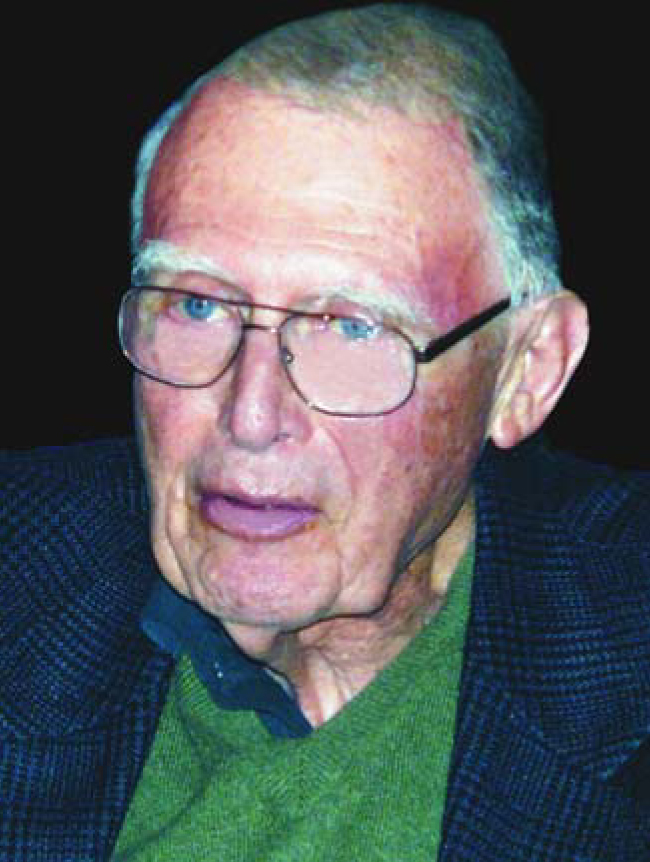
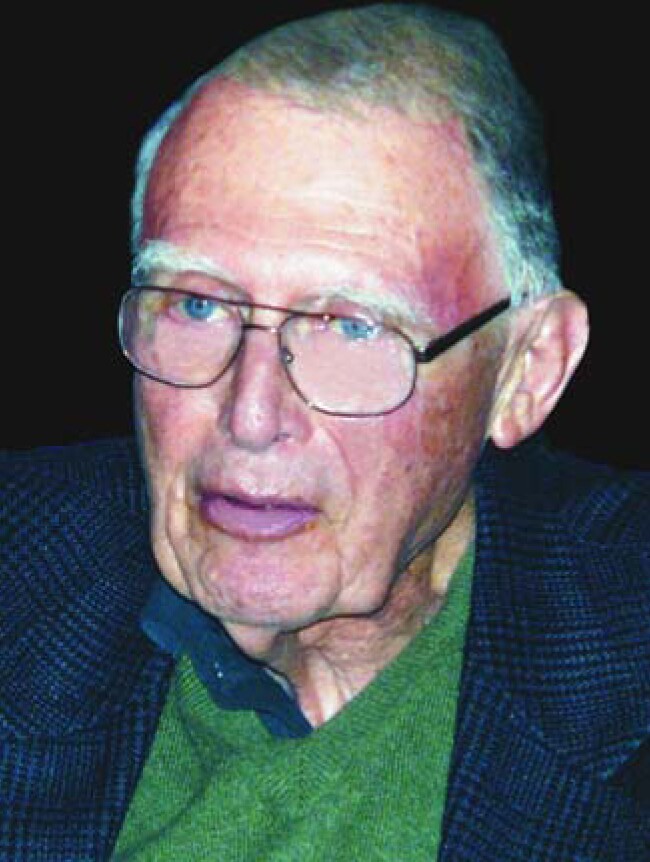
Norman Myles Kroll
DOI: 10.1063/1.2169457
Norman Myles Kroll, an emeritus professor of physics at the University of California, San Diego, and one of the pioneers of the field of quantum electrodynamics (QED), died in La Jolla, California, on 8 August 2004 after a brief illness.
Born in Tulsa, Oklahoma, on 6 April 1922, Kroll attended Rice University in Houston, Texas, from 1938 to 1940, then received his BA in physics and mathematics and his MA (1943) in physics from Columbia University. During World War II, he joined fellow scientists in radar research for military applications. He followed with graduate studies at Columbia, where he worked with his mentor, Nobel laureate Willis Lamb, on the theoretical explanation of the Lamb shift. Kroll received his PhD in physics in 1948. He collaborated with Lamb on their famous paper “On the Self-Energy of a Bound Electron,” which was published in 1949 in the Physical Review and reprinted by Dover Publications in 1959 as part of Selected Papers on Quantum Electrodynamics . Based on Kroll’s thesis work, the paper provided the first theoretical explanation of the Lamb shift in QED and became one of the most important landmarks of the field.
Kroll continued at Columbia as an assistant professor, associate professor, and full professor of physics, and quickly became a world leader in the field of QED. While at Columbia, Kroll pioneered important new calculations in QED using sophisticated theoretical tools in the evaluation of Feynman diagrams in higher orders of perturbation theory, tools used by generations of theorists in the last five decades. He was a Fulbright Scholar and Guggenheim Fellow in 1955—1956.
In 1962, UCSD recruited Kroll to become one of its physics department’s founding members and thereby bring to UCSD the prestige and recognition of a world leader in research. During his four decades at UCSD, Kroll continued his research in QED, developed with Marshall Rosenbluth a theory of the free electron laser, and participated in the design of particle accelerators. In addition, he made numerous contributions to the development of UCSD as one of the nation’s leading research universities and twice served as chair of UCSD’s physics department, from 1963 to 1965 and from 1983 to 1988. After retiring from teaching in 1991, Kroll continued as professor emeritus and research physicist until his death.
During his retirement years, Kroll kept a very active working relationship with SLAC, to which he commuted weekly until the fall of 2000. At SLAC, he was instrumental in developing the mathematical foundation for the design of a next-generation linear collider, a project that is among the highest priorities for particle physicists.
Kroll’s career included visiting appointments to many other prestigious institutions, including the Institute for Advanced Study in Princeton, New Jersey; Cornell University; the European Organization for Particle Physics in Geneva; the Niels Bohr Institute in Copenhagen; and the University of Rome.
A member of the National Academy of Sciences and the American Academy of Arts and Sciences, Kroll was very highly regarded by his colleagues. He was a brilliant theoretical physicist with deep physical insight and broad scientific interests. In addition to making significant scientific contributions, Kroll served on a committee that advises UCSD’s chamber music series; he is remembered by friends and family for his lifelong interest in opera and chamber music. He also had a passion for gourmet food and fine wine and enjoyed ocean swimming, boogie boarding, hiking, and observing and identifying wild-flowers. We at UCSD will miss his keen intellect and wise counsel.

More about the authors
Marvin Goldberger, University of California, San Diego, US .
Julius Kuti, University of California, San Diego, US .