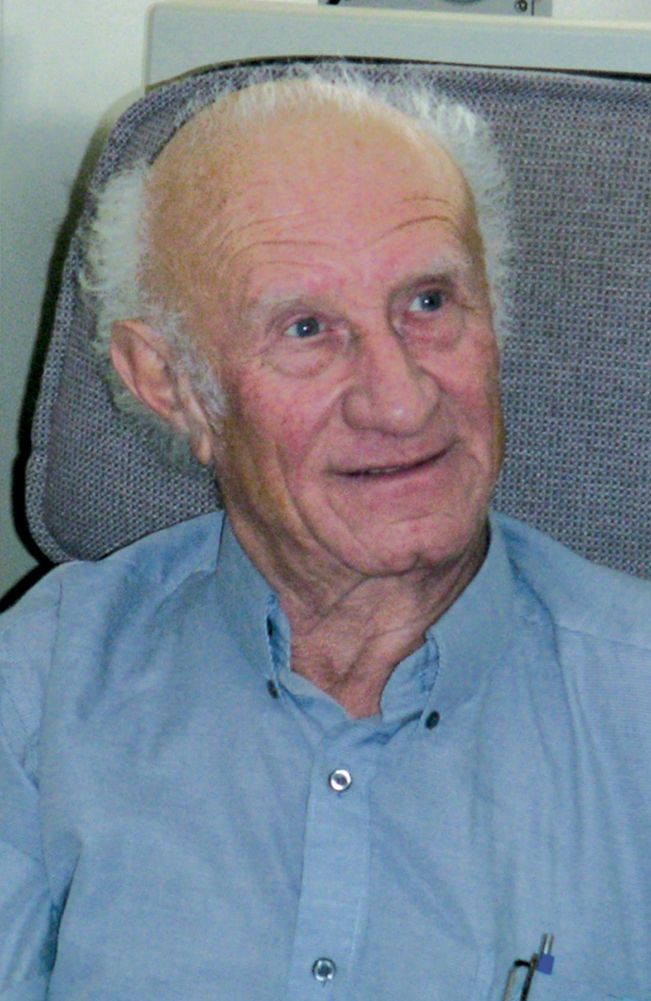
Mark Yakovlevich Azbel
DOI: 10.1063/PT.3.4597
Condensed-matter theorist Mark Yakovlevich Azbel passed away on 31 March 2020 in Petah Tikva, Israel. Azbel was a major figure in the development of the modern electron theory of metals. Most notably, his work showed how features of a metal’s Fermi surface can be manifest in various experimental measurements. Experiments based on the Azbel–Kaner cyclotron-resonance effect were, for many years, among the most powerful ways to study the Fermi surface of metals.

Mark Yakovlevich Azbel
ROMAN MINTS

Azbel was also known for his role as a leader of the “refusenik seminar” in Moscow during the mid 1970s. The refuseniks were scientists in the Soviet Union who expressed a desire to emigrate to Israel, as was their right under the law, and were fired from their jobs while being refused permission to leave the country. The weekly seminar, often held in Azbel’s apartment, kept alive the hopes of its refusenik participants, and it served to keep them informed of continuing developments in a wide range of scientific fields. It also attracted attention in the West and was an important factor in the outpouring of Western support for the refusenik cause.
Born on 12 May 1932 in Poltava, Ukraine, Azbel earned an MS in physics in 1953 and a PhD in theoretical physics in 1955, both from Kharkiv State University. He researched his thesis on the kinetic theory of conductivity in metals under the supervision of Ilya Lifshitz. In 1956 a pair of papers by Lifshitz, Azbel, and Moisei Kaganov on the behavior of metals in a strong magnetic field was one of the first demonstrations of the important effects that Fermi surface topology has on properties of metals. Thus, in a high magnetic field, a metal whose Fermi surface allows open electronic orbits—stretching to infinity when plotted as a function of momentum in the repeated Brillouin zone scheme—can have an electrical conductivity tensor that depends sensitively on the direction of the magnetic field relative to the crystal axes.
Azbel’s career had a meteoric beginning. Azbel and Emanuil Kaner published their paper on cyclotron resonance in 1957. Lev Landau highly appreciated Azbel’s work, and in 1957 Landau and Pyotr Kapitsa supported awarding a doctor of science degree, equivalent in the Soviet Union to the rank of a full professor, to the 25-year-old researcher. In 1960 Azbel showed how cyclotron resonance in a metal at high frequencies could lead to spikes in the AC electromagnetic field at positions much farther from the surface than the classical penetration depth. And in 1963 he elucidated singular features of the energy spectrum of an electron in a magnetic field and a periodic potential.
Azbel was invited in 1964 to join the physics department at Moscow State University, and when the L. D. Landau Institute for Theoretical Physics was created in 1965, he headed one of its eight research groups. His extraordinary chain of success was broken, however, by his application in 1972 to emigrate to Israel. Permission was withheld for five years, and it was during that period that Azbel helped organize and host the refusenik scientific seminar. Two of us (Halperin and Langer) had the privilege of attending the fifth-anniversary convocation of the seminar series in May 1977, where we observed firsthand Azbel’s powerful leadership. Particularly striking was his ability to provide concise summaries in English of talks given by Russian scientists on various topics and to provide lightning summaries in Russian of talks given by the Western participants.
In July 1977 Azbel was finally allowed to leave Moscow and meet the students and faculty of Tel Aviv University, where he had been appointed a professor in 1973. His association with the university lasted 47 years. He was a brilliant lecturer. His scientific work included contributions to the theory of mesoscopic electron systems and thought-provoking speculations on such diverse topics as the physics of DNA, aging, and evolution. In addition to an academic career in Israel and abroad, Azbel enjoyed an active role in Israeli radio and newspapers. His 1981 book Refusenik: Trapped in the Soviet Union described the history of his struggles to obtain permission to emigrate to Israel and to coordinate the work of the seminar.
Those of us who knew Azbel as a young researcher, a famous professor, or a senior statesman at Tel Aviv University will always remember his contributions to physics, his originality and inventiveness, his spirited temperament, his appetite for discussions, and his passion for thinking about the world in new ways. Life in his presence was never dull.
More about the authors
Bertrand Halperin, Harvard University, Cambridge, Massachusetts.
James Langer, University of California, Santa Barbara.
Roman Mints, Tel Aviv University, Tel Aviv, Israel.