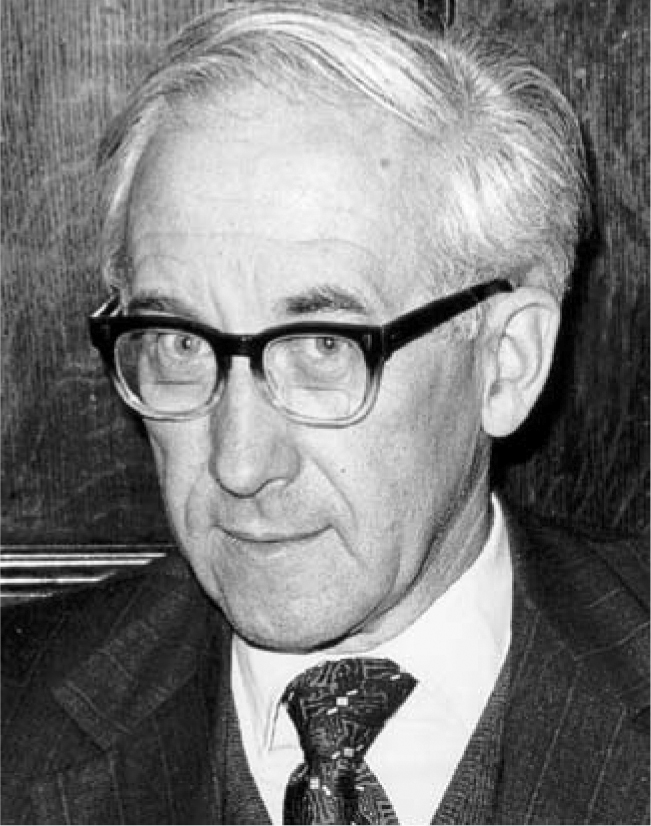
Mario Iona
DOI: 10.1063/1.1825281
Mario Iona, emeritus professor of physics at the University of Denver (DU) in Colorado, died of a heart attack on 27 February 2004 in Denver. A prolific author, Mario devoted more than 60 years to the improvement of physics teaching.
Mario was born on 17 June 1917 in Berlin, Germany. His father had been a student of Peter Debye and Max Born in Göttingen and was an industrial physicist who worked with x rays. Setting out on a career in physics, Mario entered the Theoretical Institute of the University of Vienna, in Austria. At the time, Austria had been annexed by Nazi Germany, but because he held Italian citizenship by birth, he was spared having to give the “Heil Hitler” salute to his professor at the beginning of each lecture. To keep his options open, he took most of the courses required for certification as a physics teacher. His studies, though, were hampered when the Nazis dismissed his major professor, Hans Thirring. Mario subsequently completed his PhD thesis on electron optics in 1939 under Roman Sexl.
Having received a scholarship at the University of Uppsala in Sweden, Mario left Austria in 1939, one week before Adolf Hitler’s army invaded Poland. Working with Ivar Waller, he carried out research on crystal vibrations. His parents had immigrated to Chicago; because of the U-boat menace to transatlantic ships, he later joined them in spring 1941, following a wintertime trip through Finland, the USSR, and Japan. Mario began work on neutron diffusion with Samuel K. Allison at the University of Chicago. Because Mario had come from Germany, he lost his clearance to do research and subsequently became a teaching assistant and, later, an instructor at Chicago.
Mario joined Marcel Schein’s cosmic-ray research group, which had conducted experiments in laboratories established by MIT on Colorado’s Mount Evans. His work with that group led to his joining the DU faculty in spring 1946. From 1947 to 1982, Mario directed the DU High Altitude Laboratories, a premier site for the investigation of cosmic rays.
Mario’s first publication in physics education, “On the Use of Units for Force and Weight in Physics Textbooks,” which appeared in 1944 in the American Journal of Physics , was the start of his lifetime service with American Association of Physics Teachers committees that were charged with advancing metrication in the US and with educating students and the public on the correct use of SI (Système Internationale) units. He was a leader in AAPT and served for many years as representative from the Colorado–Wyoming section and as chair of the section representatives. Throughout his service to AAPT, he was a central figure in maintaining the academic vitality of the Colorado–Wyoming section.
Mario will perhaps be best remembered for his intrepid campaign to call attention to errors in physics textbooks, especially in precollege texts. His column Would You Believe? was a regular feature in The Physics Teacher for 24 years. Unfortunately, he never ran out of material for the column. For that work, Mario received AAPT’s Distinguished Service Citation in 1971 and its Robert A. Millikan Award in 1986.
A consultant to many area school districts, Mario was also the president of the Colorado–Wyoming Academy of Science and adviser to the DU Society of Physics Students for 20 years and to the national organization of Sigma Pi Sigma for 40 years. He was proud of having installed eight Sigma Pi Sigma chapters in the western US. In the late 1950s, he created the Denver Area Physics Teachers, which continues to meet quarterly at DU as an informal gathering of high-school physics teachers. He arranged programs in which teachers could share their experiences and could hear about new developments in physics from invited speakers. Although Mario formally retired from DU in 1986, he remained active in physics education for another 15 years.
Mario’s selfless service to his profession is exemplified by the Iona family gift, in 2000, of a lounge within DU’s department of physics and astronomy for members of the Society of Physics Students and Sigma Pi Sigma. His colleagues and former students remember him with great appreciation and high personal regard for his academic integrity and for his devotion to physics education.

Mario Iona

More about the authors
Herschel Neumann, 1 University of Denver Denver, Colorado, US .
Albert Bartlett, 2 University of Colorado Boulder, US .