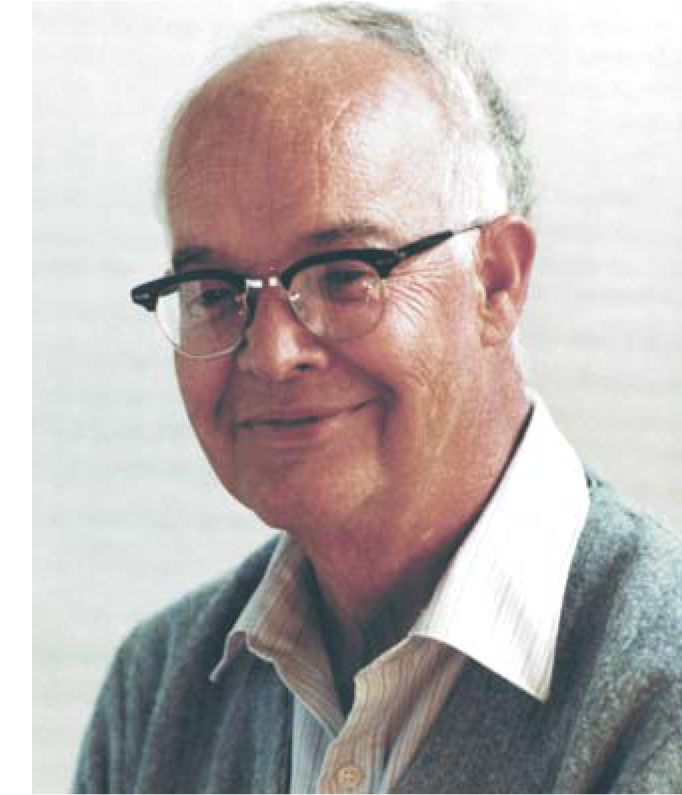
Marcellus Lee ‘Marc’ Wiedenbeck
DOI: 10.1063/1.1480794
Marcellus Lee “Marc” Wiedenbeck, a nuclear physicist, honored teacher, and professor emeritus of physics at the University of Michigan, Ann Arbor, died in Philadelphia on 16 June 2001.
Born on 11 October 1919 in Lancaster, New York, Marc received his undergraduate degree in physics from Canisius College in Buffalo, New York, in 1941. During World War II, he continued his education at the University of Notre Dame, where his thesis adviser was Bernard Waldman. While a graduate student, he taught in the military officers’ training program and also became involved in research related to the Manhattan Project. Marc and fellow graduate student Walter Miller operated Notre Dame’s Van de Graaff accelerator, which was used extensively by the physicists at the University of Chicago in connection with their activities at the Metallurgical Laboratory. In 1943, Waldman moved to the Los Alamos Laboratory; Miller followed him in 1944, leaving Marc as the remaining resident accelerator operator and expert. Marc completed his doctoral dissertation on nuclear isomerism in 1945, studying gamma transitions in several heavy elements.
Following service with the Atomic Energy Commission’s Office of Scientific Research and Development in 1946, Marc joined the physics faculty of the University of Michigan in 1946, where he remained until his retirement in 1986. Jim Cork had built a 40-inch cyclotron at Michigan during the 1930s that had been used for pioneering nuclear physics research, and Marc initially was part of Cork’s research group. However, Marc soon developed his own group in which he focused on beta-particle and gamma-ray nuclear spectroscopy, particularly the spectral classification of nuclear energy levels.
In 1959, Marc demonstrated that nuclear energy levels could be resonantly excited by x rays from an electron Van de Graaf and used this technique to identify the energies of metastable states. He then showed that internal-conversion measurements could be related to the multipole order of the radiation. To establish decay schemes, he and his students used a variety of methods to measure gamma and electron energies together with other properties of excited states and of nuclear transitions. For example, gamma-gamma directional correlation measurements were used to measure spins and parities of excited states and the multipole mixing of gamma-ray transitions. The systematics of the patterns found through these measurements helped to set forth the experimental basis for the now well-established models of the single-particle and collective behavior of nucleons in the nucleus. Marc was close to the instrumentation of nuclear physics; he made many contributions to this technology, from a multicell Geiger–Müller counter (in the days before good scintillation counters were available) to the most advanced scintillation counters. In the mid-1960s, he developed a high-resolution, bent-crystal gamma-ray spectrometer for use in his research program.
Marc also contributed extensively to the graduate and undergraduate educational programs at Michigan. He served as associate chair of the Michigan physics department (1978–86). He also cochaired Michigan’s engineering physics program. Of particular note is his direction of the doctoral thesis research of 40 graduate students, the most of any member of the Michigan physics faculty. More than half of those doctoral students joined the teaching faculties of colleges and universities, and several became senior administrators.
Marc will be missed by his very close-knit family and by those of us fortunate enough to have worked with him and to have benefited from his wisdom, breadth of experience, great common sense, and delightful personality. We will value his memory and his contributions to our Michigan physics department.

Marcellus Lee ‘Marc’ Wiedenbeck