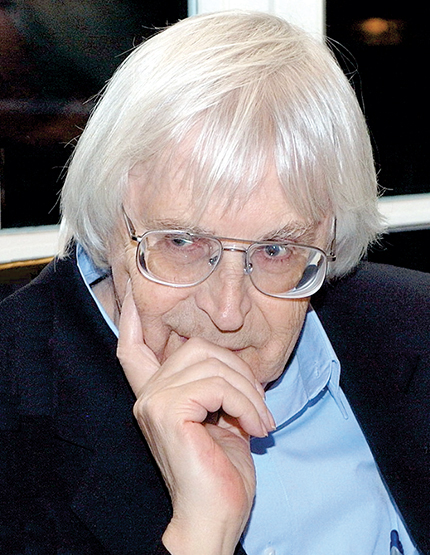
Lev Petrovich Gor’kov
DOI: 10.1063/PT.3.3564
Lev Petrovich Gor’kov, one of the creators of modern condensed-matter theory, died on 28 December 2016 in Tallahassee, Florida.

Lev Petrovich Gor’kov

Born on 14 June 1929 in Moscow, Gor’kov graduated from the Moscow Mechanics Institute in 1953. After passing Lev Landau’s famous “theoretical minimum,” he was accepted as a PhD student in the theory department headed by Landau at the Institute for Physical Problems. In 1956 he defended his PhD thesis on quantum electrodynamics of particles with integer spin.
During a seminar given in late 1957 by Nikolai Bogolyubov, the Landau group first heard of the microscopic theory of superconductivity developed by John Bardeen, Leon Cooper, and J. Robert Schrieffer. Within a few weeks, and before he had access to the BCS papers, Gor’kov derived what are now known as the Gor’kov equations, which established the field-theoretical formulation of superconductivity. In 1959 he used them to derive the Ginzburg– Landau equations and solved the conceptual meaning of the superconducting order parameter. His theory opened the way to describe inhomogeneous superconducting states in the presence of magnetic fields or electrical currents.
Over the next two years, Gor’kov, with Alexei Abrikosov, used his theory to create the theory of superconductors with nonmagnetic and magnetic impurities. They discovered that magnetic impurities give rise to gapless superconductivity and thus proved that the superconducting state could be an ordered state in the absence of a gap in the quasiparticle spectrum. For that body of work, Gor’kov, Abrikosov, and Vitaly Ginzburg in 1966 were awarded the Lenin Prize, the Soviet Union’s highest scientific award. Gapless superconductivity has since been discovered in pure superconductors, including high-temperature cuprate superconductors that feature d-wave pairing.
Superconductivity theory and other problems of statistical physics required the development of a new mathematical technique to generalize the Feynman diagram method to finite temperatures. That was the subject of Methods of Quantum Field Theory in Statistical Physics (Prentice-Hall, 1963), the famous monograph by Abrikosov, Gor’kov, and Igor Dzyaloshinskii. First published in Russian in 1962, it became the bible for subsequent generations of theoretical physicists.
In 1963 Gor’kov moved to Chernogolovka to head the theory department of the Institute of Chemical Physics. Shortly thereafter, he cofounded the Landau Institute for Theoretical Physics, which rapidly emerged to world prominence.
During the next two decades, he wrote a remarkable series of papers. In a 1964 landmark paper in mesoscopic physics, Gor’kov and Gerasim Eliashberg calculated the polarizability of small metal particles in a high-frequency field and showed that all three types of Wigner–Dyson level statistics are realized in such particles. In 1965 Gor’kov, Yury Bychkov, and Dzyaloshinskii showed that superconductivity and charge density waves compete in one-dimensional conductors, a discovery that is central to the physics of low-dimensional systems.
At the beginning of the 1970s, Gor’kov and Eliashberg developed a general theory of nonstationary phenomena in superconductors that has subsequently been applied to the description of dynamic dissipative processes. Those processes include the motion of vortices and domain walls in superconductors and in superfluid phases of helium-3, the conductivity of thin superconducting wires and superconductor–normal metal contacts, and the behavior of superconductors in AC fields. In 1984 Grigory Volovik and Gor’kov suggested a symmetry classification of superconducting states in crystals that has become the principal classification of superconducting phases in cuprate and heavy-fermion compounds.
In 1966 Gor’kov became the founding chair of the Problems of Theoretical Physics program of the Moscow Institute of Physics and Technology. During his tenure there, he could hire researchers from among the best students in the annual competitive exams, a measure of the unparalleled respect he commanded at the institute. In turn, he assumed a deep personal responsibility for the destiny of the students he mentored, dozens of whom became world-famous scientists.
During the Cold War years 1966–89, Gor’kov played an important role on the Soviet side in organizing a series of joint workshops on condensed-matter theory that were sponsored by the Soviet Academy of Sciences and the US National Academy of Sciences. One workshop, a landmark five-week meeting in Aspen, Colorado, that Gor’kov cochaired with Schrieffer, resulted in nine joint publications.
In 1991 Gor’kov left the Soviet Union to become a leading member of the US condensed-matter community, first as a distinguished visiting professor at the University of Illinois at Urbana-Champaign and then as cofounder with Schrieffer of the theory group at the National High Magnetic Field Laboratory in Florida. Diagnosed with cancer in 2015, Gor’kov continued to work intensively until his last days. In 2016 he published articles on superconductivity in low-doped strontium titanate, superconductivity under high pressure in sulfur hydride, and superconductivity enhancement at the iron selenide–strontium titanate interface.
Gor’kov was also a remarkably talented artist who expressed reality in surprisingly whimsical forms. His colleagues remember playing cards he created for Landau’s 50th birthday; Landau was pictured as a joker, who could be played in any combination with cards on which his disciples—Isaak Pomeranchuk, Evgeny Lifshitz, Abrikosov, Isaak Khalatnikov, and others—appeared in caricature.
Gor’kov will be remembered as an accomplished scientist, a devoted mentor, and a gifted author, a man and artist whose gentle personality and keen sense of humor are treasured by those who had the pleasure of his company.
More about the authors
Greg Boebinger, National High Magnetic Field Laboratory, Florida State University, Tallahassee.
Sergey Iordansky, Landau Institute for Theoretical Physics, Chernogolovka, Russia.
David Pines, Santa Fe Institute, Santa Fe, New Mexico.
Lev Pitaevskii, University of Trento, Trento, Italy, Kapitza Institute for Physical Problems, Moscow, Russia.