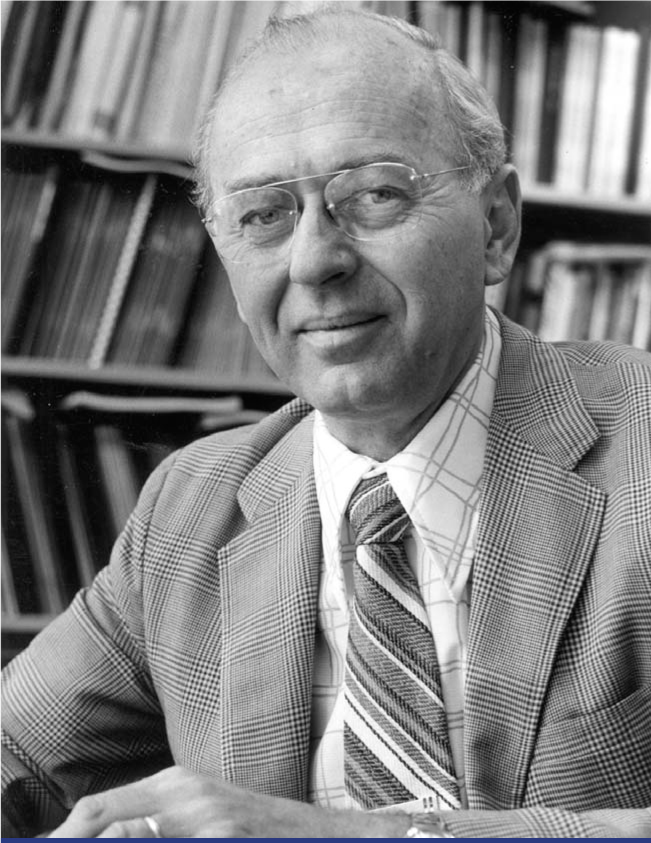
Kenneth Ingvard Greisen
DOI: 10.1063/1.2761816
Kenneth Ingvard Greisen, professor of physics emeritus at Cornell University, died of cancer in Ithaca, New York, on 17 March 2007. Greisen’s career in experimental cosmic-ray physics extended from his graduate work at Cornell to innovative experiments in the 1960s and 1970s. He will be most remembered for his realization that the cosmic microwave background limits the high-energy end of the spectrum of cosmic-ray protons that travel astronomical distances.
Born in Perth Amboy, New Jersey, on 24 January 1918, Greisen graduated from Franklin and Marshall College in Pennsylvania in 1938. He entered Cornell for graduate work in physics, where he was the first US graduate student of Bruno Rossi. His 1942 PhD thesis was titled “Intensity of Cosmic Rays at Low Altitude and the Origin of the Soft Component.” His joint 1941 review article with Rossi, “Cosmic-Ray Theory” in Reviews of Modern Physics (volume 13, page 240), was a standard for many years.
From 1943 to 1946 Greisen was a member of the group of physicists who worked on the Manhattan Project at Los Alamos. As one of the leaders of the detonation team, he was an observer at the Trinity test on 16 July 1945. His eyewitness report of that world-changing event is an important historical record. His comment “My God! It worked!” was typical of him.
Greisen returned to Cornell in 1946 as an assistant professor and thus initiated his 40-year career as a physics researcher, physics educator, mentor of students and postdocs, and public servant to the university community.
Greisen’s investigations of cosmic rays ranged from using detectors on high mountains and far underground in salt mines to using balloons to send gamma-ray detectors into the high atmosphere. With a gas Cherenkov detector in a 1971 balloon flight, he and his colleagues observed gamma rays from the Crab Nebula that were synchronized with its pulsar.
After the 1965 discovery of the cosmic microwave background, Greisen (and independently Georgii Zatsepin and Vadim Kuzmin) realized that the number of cosmic-ray protons at energies above 6×10¹⁹ eV is greatly reduced due to interactions with the microwaves. This GZK cutoff would virtually eliminate the highest-energy protons that travel cosmological distances.
Due to the extremely low rate of air showers with energies above 1019 eV, detectors of enormous size are required to detect cosmic rays above the GZK limit. Greisen and his group at Cornell designed a method of observing air showers that uses the fluorescent light created as the shower proceeds through the atmosphere. Near Ithaca in 1964–71, they observed the night sky with arrays of phototubes arranged in a “fly’s eye” configuration. This method was significantly refined and improved by physicists at the University of Utah and became the basis for the High Resolution (HiRes) Fly’s Eye experiment. In March 2007 the HiRes collaboration reported observation of the suppression of cosmic rays with energies above the GZK limit (see Physics Today, May 2007, page 17 ). Fluorescence detectors are one of the two principal components of the Pierre Auger Observatory, currently nearing completion in Argentina to study cosmic rays near and beyond the GZK limit.
Along with Cornell colleagues Philip Morrison and Hans Bethe, Greisen contributed to the work of the MIT-based Physical Science Study Committee (the source of the PSSC high-school physics curriculum) in the late 1950s. In 1969 he presided over a team from the Cornell department of science education and a group of physics colleagues working on a major revision of a 400-student introductory physics course. The result was an innovative, self-paced, auto-tutorial course that retains that format today. His service to the wider Cornell community included a term as university ombudsman from 1975 to 1977 and a term as dean of the university faculty from 1978 to 1983.
In 1971 Greisen cofounded the high-energy astrophysics division of the American Astronomical Society, and he was its first chair. He was elected to membership in the National Academy of Sciences in 1974.
In both the world of physics and the wider world, Greisen displayed a deep sense of responsibility to the people around him. His students and postdocs remember him as a brilliant physicist who was kind and generous and who encouraged them by respecting their competence. At a time when very few women attempted careers in physics, Greisen was exceptionally supportive of those who did.
Greisen enjoyed the outdoors and music; he played the flute and sang in choirs. Following his retirement in 1986, his persistent concern for the welfare of others led him to do volunteer work with various local organizations that served people in the community who were marginalized by age or economic circumstance.
Greisen combined his unfailing attention to the needs of those around him with a career in experimental physics at the top of his field. Cosmicray physics continues to be shaped by his accomplishments and those of his younger colleagues.

Kenneth Ingvard Greisen
RUSS HAMILTON/CORNELL UNIVERSITY

More about the authors
David G. Cassel, Cornell University, Ithaca, New York, US .
Edith Cassel, Cornell University, Ithaca, New York, US .
Donald F. Holcomb, Cornell University, Ithaca, New York, US .