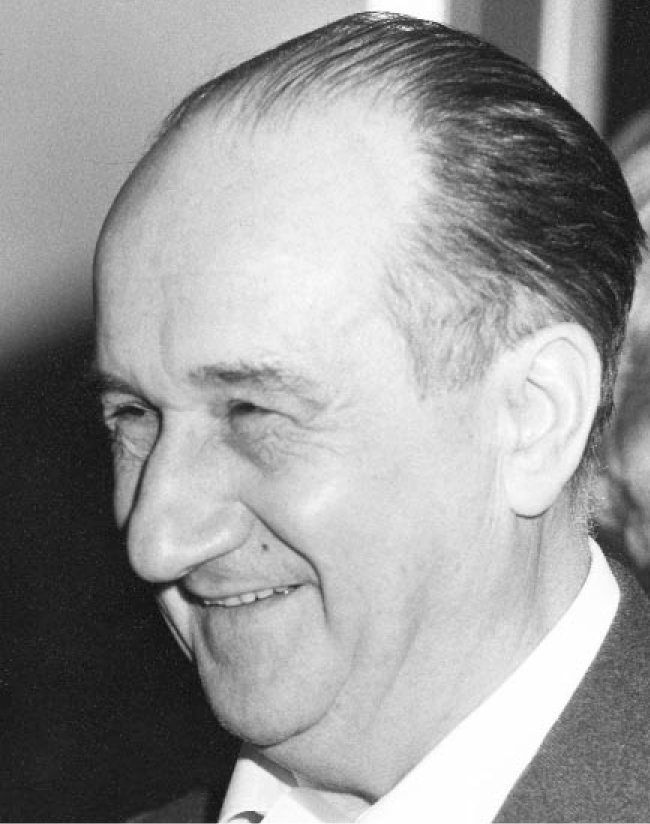
Jean Brossel
DOI: 10.1063/1.4776720
With the death of Jean Brossel on 4 February 2003 in Périgueux, France, the scientific community has lost a key figure in the development of modern atomic physics and quantum optics in France after World War II.
Brossel was born in Périgueux in 1918 and entered the Ecole Normale Supérieure de Paris in 1938. The war interrupted his studies for two years, but he completed them in 1945. At that time, French laboratories were in bad shape: The research groups were disorganized and the equipment was very poor. Alfred Kastler of the physics laboratory at the Ecole Normale advised Brossel to go to Manchester, England, to receive research training in Samuel Tolansky’s group at the physics laboratories of Manchester University. Brossel did. There, he learned Fabry–Pérot techniques and applied them to the study of atomic surfaces and the measurement of atomic hyperfine structures. The expertise he gained during that stay was very useful in his subsequent research work.
After three years in Manchester, Brossel returned to Paris. In the meantime, Kastler had received an offer from MIT to send one of his students to Francis Bitter’s group for PhD work. Kastler proposed that Brossel go, and Brossel happily accepted the offer and went to MIT in 1948. Bitter’s idea for detecting magnetic resonance in the excited state by changing the Zeeman structure of the emission spectrum didn’t come to fruition. But while working on that same idea, Brossel came up with another one—the double resonance method—that turned out to be very successful and made for an outstanding PhD thesis. Instead of looking for a change in the frequency of emitted light, Brossel suggested that one look for a change in the light’s polarization. That change would result from the radio-frequency–induced transfers between the excited Zeeman sub-levels. Kastler had independently come up with the same idea and, a few months later, proposed the optical pumping method—polarizing atoms in the ground state through a transfer of angular momentum from polarized photons to atoms.
After completing his doctoral work, Brossel returned to Paris. In 1951, he and Kastler founded a research group that is now called the Laboratoire Kastler Brossel, and so started a great period at the Ecole Normale. Researchers at the lab demonstrated optical pumping the following year and obtained a wealth of exciting new results. They observed multiphoton RF transitions between Zeeman sub-levels, where the atom absorbs several photons—not just one—during the transition. Other results included the observation of the narrowing of the magnetic resonance curves in the excited state due to coherent multiple scattering and the prediction and observation of light shifts.
I joined the group at the Ecole Normale in 1955 and recall the exceptional atmosphere that prevailed in the lab. There was a great intellectual complicity between Kastler and Brossel, combined with a complementarity of their talents. Kastler was a “poet” of physics who had numerous elegant ideas, whereas Brossel was an outstanding experimentalist who had a deep understanding of the physical processes. It was Brossel who first gave a transparent interpretation of multiphoton resonances in terms of conservation of the total energy and angular momentum during the transition. He was also the first to interpret the narrowing of magnetic resonance curves when the vapor pressure increases as being due to a partial transfer of the phase relations between the coefficients of the excited wavefunction from one atom to another in a multiple scattering process. Because Brossel made crucial contributions to the results obtained by the group, it was especially sad that he did not share the 1966 Nobel Prize that Kastler won.
A new period in Brossel’s career began when he became the lab’s director in 1967. He was very good at identifying young, bright physicists and encouraging them to start promising lines of research with complete freedom. He also led the rise of the atomic physics group at the Ecole Normale to become one of international repute. With teaching as one of his concerns, Brossel created a physics graduate program that played an essential role in the formation of generations of young physicists, not only in atomic physics, but also in particle physics, condensed matter, statistical mechanics, and astrophysics. And during his term as head of the physics department (1973–85), he attracted several new research groups in different areas of physics.
Brossel devoted his life to science and to the development of his students. He set very high standards for himself and his colleagues. Until the end of his life, he continued his experiments, even blowing glass and filling cells. He was rather shy and very discreet; people who didn’t know him were not easily inclined to approach him. But once they overcame this barrier, they discovered a warm and kind person, who enjoyed art, music, and history and also had a great sense of humor. Brossel’s former students, colleagues, and friends deeply miss him.

More about the authors
Claude Cohen-Tannoudji, Collège de France and Laboratoire Kastler Brossel, Ecole Normale Supérieure, Paris, France .