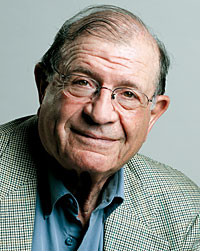
Ivan Paul Kaminow
DOI: 10.1063/PT.3.2593
Ivan Paul Kaminow, a luminary in the photonics community, passed away in San Francisco on 18 December 2013. For more than 50 years he had been at the forefront of light-wave-technology research that helped bring about a telecommunications revolution. His contributions are evident in the ongoing activities done by the researchers, engineers, and companies working in the field.

Ivan Paul Kaminow
UNIVERSITY OF CALIFORNIA, BERKELEY

Born on 3 March 1930 in Union City, New Jersey, Ivan received his BS in electrical engineering from Union College in 1952. After earning his MS, also in engineering, from UCLA in 1954, he began a 42-year career at Bell Labs. He earned a PhD from Harvard University in 1960; his thesis, under C. Lester Hogan and later R. Victor Jones, was on ferromagnetic resonance at microwave frequencies and high pressures.
Perhaps Ivan’s greatest technical legacy from his tenure at Bell Labs is the electro-optic modulator and its materials. His contributions also included creating titanium-diffused lithium niobate modulators and other integrated optics, developing birefringent optical fibers, analyzing Raman scattering in ferroelectrics, and demonstrating such semiconductor laser technologies as the distributed Bragg reflector and the ridge waveguide. Beginning in 1984 Ivan led the photonic networks and components research department. He and his team worked on wavelength-division-multiplexed local- and wide-area networks and on such components as a fiber Fabry−Perot resonator, an arrayed waveguide grating router, and an erbium-doped fiber amplifier.
Among Ivan’s best-known books are An Introduction to Electrooptic Devices (Academic Press, 1974) and the second through sixth editions in the Optical Fiber Telecommunications series (Academic Press/Elsevier, 1988–2013). The OFT series has chronicled the exciting evolution of the field of optical-fiber communications by the R&D community. Working on the editions brought Ivan great joy, and it enabled him to use his love and skill for writing, help explore the most significant technical issues, and interact with the best people in the field. The book series itself is a tribute to his effort, leadership, wisdom, and insight. In fact, the sixth edition was his last publication. Ivan coedited three of the books with another luminary, Tingye Li. They were lifelong friends and colleagues and shared much affection and admiration for each other.
Ivan received many awards for his contributions to photonics, including the 1995 Charles Hard Townes Award and the 2011 Frederic Ives Medal from the Optical Society (OSA), the 2010 Photonics Award and the 2013 Edison Medal from the IEEE, and the 1997 John Tyndall Award from IEEE/OSA.
After he retired from Bell Labs, Ivan served as an IEEE congressional fellow in 1996, and in 1999 he was a senior science adviser to OSA. He enjoyed his last years living in San Francisco with his wife, Florence, and being an adjunct professor at the University of California, Berkeley, where he took great pleasure interacting with the many bright, curious, and friendly students.
When reflecting on his career, Ivan considered himself very lucky to have been at Bell Labs during its heyday. He was fond of saying, “Over the years, I have benefited from many happy coincidences and lucky choices. Indeed, luck plays an important part in any career. Still, luck is not enough. I had to be in the right places at the right times in order to have a chance to seize these opportunities. As the old saying goes, It takes luck and pluck.”
It was always refreshing listening to Ivan; he had a unique and insightful way of understating things. Many people were fortunate to be able to learn from his wisdom and to interact with him personally.
In addition to Ivan’s illustrious career, his leadership, vision, gentleness, inquisitiveness, love of learning and teaching, and intellectual honesty were hallmarks of his personality. They will be most remembered by his friends and colleagues, who miss him greatly. His contributions to the optical-fiber communications community and technical field were monumental and will not be forgotten.
More about the authors
Connie Chang-Hasnain, University of California, Berkeley.
Alan E. Willner, University of Southern California, Los Angeles.