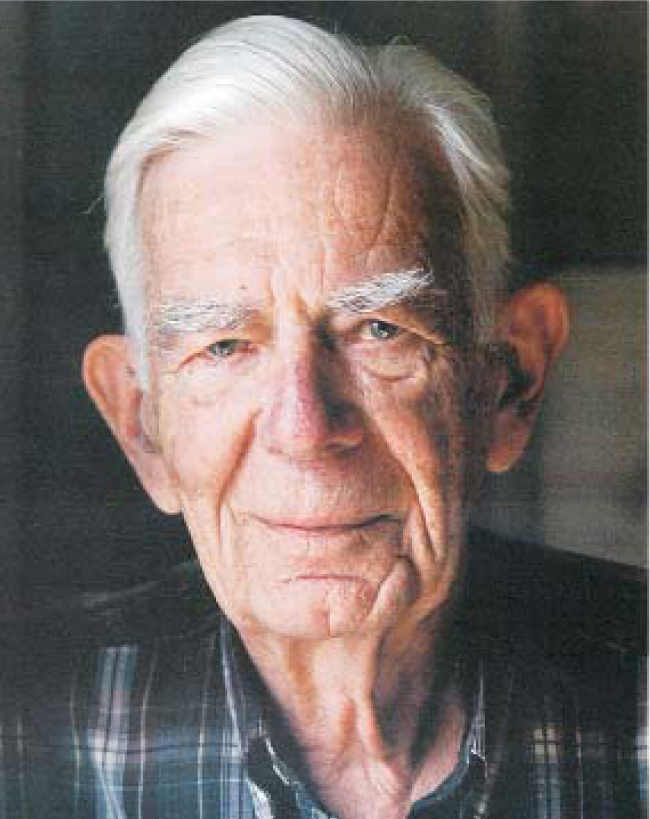
Horace Richard Crane
DOI: 10.1063/1.2812134
Experimental physicist H. Richard “Dick” Crane, who was the first to measure the magnetic moment of free electrons, died of age-related complications in Chelsea, Michigan, on 19 April 2007, just months short of his 100th birthday.
Born on 4 November 1907, Crane was raised in Turlock, a small farming town in central California. His parents encouraged their young son’s fascination with technology by letting him experiment with mechanical and electrical devices around the house. By age 14 he was licensed for amateur radio, an interest that lasted the rest of his life.
In 1926 Crane enrolled as a freshman at Caltech; when he graduated in 1930, jobs were hard to find, so he returned to Caltech for graduate school. He joined Charles Lauritsen’s group as a graduate assistant and helped build an accelerator used for studies of nuclear properties and for neutron production. Crane also tried to find evidence for the existence of the neutrino. By age 28 he had finished his thesis and done a year of postdoctoral work and had already been lead author on 17 letters and articles in Physical Review.
In 1935 Harrison Randall at the University of Michigan found the money to hire the bright Californian as an instructor. On arriving in Ann Arbor, Crane began building a 1-MeV accelerator and also undertook experiments with radioactive sources. Over the years 1936–40, he continued the study of nuclear disintegration, gamma and beta spectra, and mechanisms of electron energy loss.
He also continued to search for the neutrino. In 1938 he and Jules Halpern published the first convincing quantitative measurements of neutrino momentum. And in 1939 Crane searched for neutrino absorption by burying a radioactive source in a bag of salt and looking for sulfur produced by the inverse beta decay of chlorine; he was able to set an upper limit for the cross section of the process, and he also discussed the astrophysical implications of his result. Crane’s last publication on neutrinos, in Reviews of Modern Physics in 1948, received lavish credit from Ray Davis in his 2002 Nobel Prize acceptance speech.
During World War II, Crane worked on the development of the proximity fuse at the Carnegie Institution, the Johns Hopkins University Applied Physics Laboratory, and Ann Arbor. He also worked briefly at the MIT Radiation Laboratory and on the Manhattan Project.
After the war Crane expanded his research beyond pure nuclear physics. In 1946 he proposed and then built an 80-MeV electron synchrotron shaped like a racetrack that featured long straight-line sections of beam path suitable for placement of injectors, targets, and detectors. The synchrotron became operational in 1952 and served as the model for many accelerators built at other institutions.
The synchrotron’s electron injector was available before the rest of the accelerator was ready, so graduate student William Louisell applied it to Mott scattering, in which a magnetic field was used to guide electrons between the polarizer and analyzer. Crane realized that measuring the polarization’s dependence on magnetic field could provide an accurate value for the magnetic moment of the free electron; this “g − 2” experiment was a way to refute the then widely held belief, based on the uncertainty principle, that this quantity was not susceptible to meaningful measurement. The first Michigan results drew much attention when they were reported in 1953, and for the next decade Crane continued to improve the experiment with the help of Robert Pidd, Arthur Schupp, David Wilkinson, Arthur Rich, and John Wesley.
In the mid-1950s, with the success of his experimental programs established, Crane stepped more visibly into national leadership roles. He was president of the Midwest Universities Research Association from 1957 to 1960. In 1965 he was named to the National Academy of Sciences (NAS) and served on many of its committees. From 1965 to 1972, he was chair of the University of Michigan physics department. And from 1971 to 1975, he chaired the Board of Governors of the American Institute of Physics.
In the 1960s Crane began to devote more time to the improvement of teaching at the university level. This led to his serving as president of the American Association of Physics Teachers (AAPT) in 1965–66 and to his subsequent vice presidency of the Commission on College Physics in 1967–70.
Crane took uncommon pleasure in sharing his understandings with others. His ability to combine visual reasoning with formal calculation is nicely demonstrated in his expository papers on the principles of biological growth and in his 1956 analysis with Cyrus Levinthal on the unwinding of DNA. He returned to his love of tabletop experiments with a model to demonstrate geomagnetic field reversals. He showed how one could build a very short Foucault pendulum. And for many years, his column “How Things Work” appeared in The Physics Teacher ; 70 of those columns are collected in a best-selling AAPT book of the same name.
Having already accomplished much for the teaching of college physics by the mid-1970s, Crane started to direct more of his interest and resources to science education for K–12 schoolchildren and for community-college students. He was also a driving force and leading developer of exhibits for the Ann Arbor Hands-On Museum.
Combining relentless curiosity and quiet intensity with an astonishing intuition for physics, Crane was still a modest, reserved man who often described himself as a tinkerer. But the appreciation of his colleagues was clearly expressed: In addition to his election to the NAS, his many honors included the American Physical Society’s Davisson–Germer Prize in 1967, AAPT’s Oersted Medal in 1977, and the National Medal of Science in 1986.
In his later years, Crane often spoke of having enjoyed a long life in an era when there was so much to discover. He had time to work in many fields of science, but he also had time to play the violin, go fishing, raise orchids, paint, and enjoy friends and family. An icon of Michigan physics, Dick Crane showed his many friends and colleagues how a balanced life in science could be lived.

Horace Richard Crane

More about the authors
Jens Zorn, University of Michigan, Ann Arbor, US .