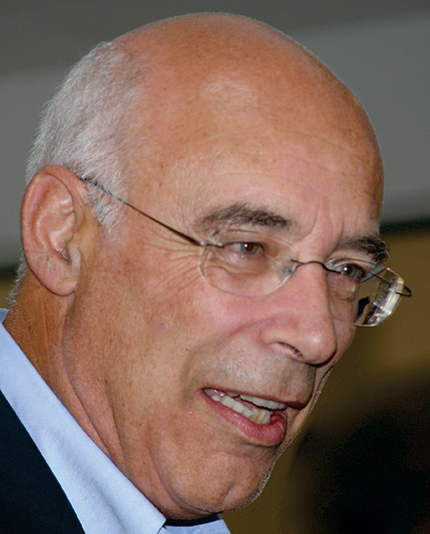
Guido Altarelli
DOI: 10.1063/PT.3.3114
Guido Altarelli, one of the most well-known and respected high-energy physicists, was born in Rome on 12 July 1941 and died in Geneva on 30 September 2015. His influence is ubiquitous. His most famous contribution is the discovery with one of us (Parisi) of the evolution equations of quark and gluon distribution functions inside hadrons.

Guido Altarelli

Guido graduated with a laurea in physics from the University of Rome “La Sapienza” in 1963; his adviser, Raoul Gatto, was at the University of Florence at the time. Guido collaborated on his thesis with his friend Franco Buccella on the process e+e− → e+e−γ; their computations were later used in experiments at the ADONE particle-beam collider at the Frascati National Laboratory. In 1964 he went to the University of Florence to join the lively and large group of young researchers (gattini) working under Gatto’s careful and inspiring supervision. Guido spent 1968–70 at New York University and at Rockefeller University.
In 1970 Guido became an assistant professor of theoretical physics at La Sapienza and was made a full professor in 1980. From 1985 to 1987, he directed the Rome section of the National Institute for Nuclear Physics. During that time he also spent long periods at other institutions such as the École Normale Supérieure in Paris and Boston University.
Guido became a senior staff physicist in the theory division at CERN in 1987; he worked there until 2006, and he served as the theory division leader in 2000–04. In 1992 he joined the newly founded University of Rome 3, where he remained until formal retirement in 2011. He then divided his time between teaching in Rome and conducting research, mostly at CERN. He continued his research up to his last months. Toward the end of his career, he received three prestigious awards: the 2011 Julius Wess Award from Karlsruhe Institute of Technology, the 2012 J. J. Sakurai Prize for Theoretical Particle Physics (shared with Bryan Webber and Torbjörn Sjöstrand) from the American Physical Society, and the 2015 High Energy and Particle Physics Prize from the European Physical Society.
Guido devoted his scientific efforts exclusively to the theory of high-energy physics. While he was in Florence, he worked with Gatto and the other gattini—among them Buccella, Giuliano Preparata, and one of us (Maiani)—mostly on topics that were fashionable at that time, such as SU(6) symmetries and Regge poles. After his arrival in Rome, Guido focused his scientific interests on the parton model. Later he concentrated on what we now call the standard theory; he followed the strong tradition of the Rome school, led by Nicola Cabibbo, of using field-theory tools to understand particle physics. He wrote many of the resulting research papers with Cabibbo, Keith Ellis, Guido Martinelli, Roberto Petronzio, and both of us.
Among Guido’s most important contributions are his papers on octet enhancement of nonleptonic weak interactions in asymptotically free gauge theories. He showed for the first time how the newly born theory of quantum chromodynamics (QCD) could contribute to solving some of the old mysteries of weak interactions—in this case, the dominance of the ΔI = ½ strangeness-changing processes over the much weaker ΔI = 3⁄2 processes. His other important contributions of that period are the first computation of the electroweak corrections to the muon magnetic-moment anomaly, the discovery of a large QCD correction to the naive parton prediction in μ+μ− production, and above all, the derivations of the Altarelli–Parisi equations. The evolution equations stemmed from an idea of Guido’s to make previously obtained results on scale violations clearer and more exploitable. The paper was written while both authors were in Paris, and Guido liked to remark that it is the most cited high-energy physics French paper.
In the 1980s Guido became interested in making predictions—specifically for production of jets, heavy-vector mesons, and other exotic objects like Higgs and supersymmetric particles—for future CERN experiments. He continued analyzing the consequences of QCD on weak interactions and computing the two-loop contributions. He also wrote seminal papers on the decay of heavy quarks. Guido started to be deeply intrigued by the polarized-proton structure function; with Graham Ross, he discovered the crucial interplay between the gluon anomaly and polarization effects.
Guido produced abundant results from his many interactions at CERN. Among the many problems he worked on were a model-independent analysis of electroweak data, done with Riccardo Barbieri, and theoretical predictions of the Higgs mass and production cross section.
With the new millennium, Guido started working on a subject he had become fascinated with: the elegance of the tri-bimaximal neutrino mixing. Many of his papers, mostly with Ferruccio Feruglio, are dedicated to the search for the origins of that baffling symmetry.
His scientific success was inseparable from his human qualities. Guido aimed to get a deep understanding of the world, hence his great passion for history, especially that of the many countries he traveled through. His characteristic traits were his great kindness and intellectual honesty, coupled with a rather ironic view of life in general and of himself. His great inquisitiveness and the enjoyment that he derived from learning new things and putting a puzzle together allowed him to summarize subjects in ways that permitted us to take stock of the current state of a field of research and see new directions to pursue. He liked clear, precise formulations that could be understood by all.
Guido was a generous scientist who conceived many of his works in a spirit not only of discovery but also of service to the community. He relished his collaborations in the large particle-physics community. It is difficult to think what the status of the field would be without his contributions.
More about the authors
Luciano Maiani, University of Rome “La Sapienza”, Rome, Italy.
Giorgio Parisi, University of Rome “La Sapienza”, Rome, Italy.