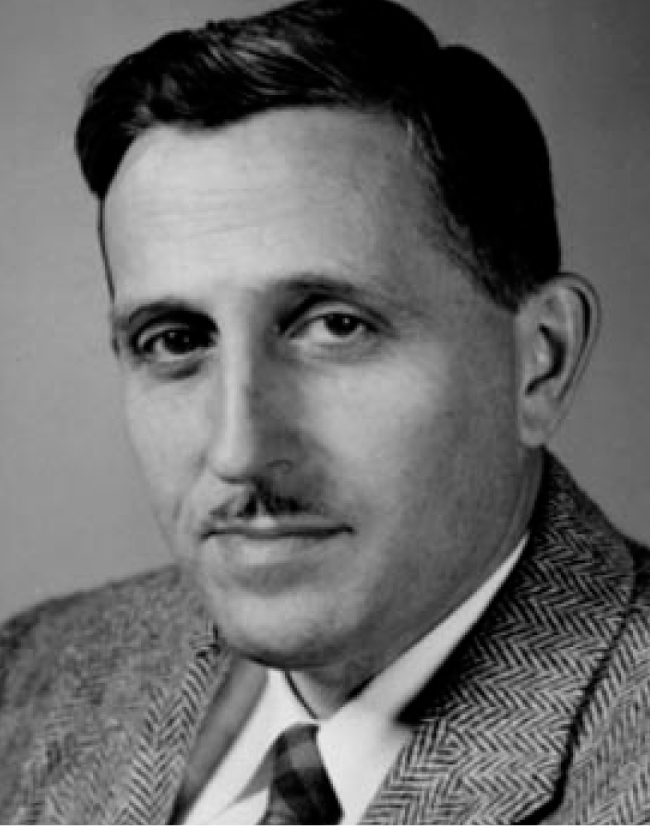
Emanuel Maxwell
DOI: 10.1063/1.1397407
Emanuel Maxwell, widely known for his research on superconductivity and low-temperature physics, died of heart failure in Cambridge, Massachusetts, on 6 October 2000.
Maxwell was born in Brooklyn, New York, on 16 December 1912 of parents who had emigrated from Russia. As a child, he built radios and became an amateur radio operator; he credited his teachers at Erasmus Hall High School for stimulating his interest in science. He received a BS (1934) and an MS (1935), both in electrical engineering, from Columbia University.
In the depression year of 1935, Maxwell’s first job was with RCA at the telegraph receiving station on Long Island, New York, where he relayed Morse code originating in Europe to New York City. In 1937, after seven months as a patent examiner in Washington, DC, he worked for Shell Oil in Texas, developing electrical prospecting techniques.
In 1941, he joined the MIT Radiation Laboratory and, during World War II, worked in the fundamental development group of the research division. This group of scientists and engineers, led by Edward Purcell, was assigned the task of making an X-band system to obtain higher resolution radar for aircraft and submarine location. The project was completed that summer and was of great importance to the allied forces. The even higher resolution K-band system was completed before the end of the war. Maxwell then began graduate work at MIT, receiving a PhD in physics in 1948. His thesis adviser was John Slater and his thesis topic was superconducting microwave resonators.
In 1948, Maxwell joined the cryogenics section of the National Bureau of Standards in Washington, DC. At that time, superconductivity remained unexplained. Suspecting that the metal lattice was related to superconductivity, Maxwell decided to test this conjecture, even though two previous experiments had found no dependence. The experiment consisted of measuring the superconducting transition temperature T c of mercury-198, a pure isotope, and that of natural Hg, which has an average mass number M of 200.6. The small difference in M required precise measurement of the temperature and the magnetic field, but the result clearly showed that the transition temperature of the lighter isotope was 0.021 K above that of natural Hg (T c = 4.156 K).
Almost simultaneously, a group led by Charles Reynolds and Bernard Serin found similar results with other mercury isotopes. The data fitted a simple relation: Tc ∝ M−α. Further measurements showed α ≅ 0.5, not only for Hg, but also for tin and thallium. Maxwell described his discovery—now known as the isotope effect—in an article he wrote for the December 1952 issue of Physics Today. The results suggested to theorists that an electron–phonon interaction caused superconductivity. Indeed, Herbert Fröhlich had previously developed such a theory without knowing about the experiments, but his theory and others proved unsatisfactory until the Bardeen-Cooper-Schrieffer (BCS) theory appeared in 1957. This theory, with extensions by other theorists, explained superconductivity as a time-retarded Coulomb interaction between electrons through lattice vibrations. Maxwell analyzed the thermodynamic implications of the isotope effect and the non-parabolic shape of the critical field, which he measured with Olin Lutes. With Paul Marcus, he generalized the two-fluid model of superconductivity.
In 1953, Maxwell returned to MIT, working at the Lincoln Laboratory. There he extended his work on radar components and superconducting microwave resonators, was active in the MIT low-temperature group, and started a low-temperature group at Lincoln to study fundamental properties of superconductors and liquid helium. With Charles Chase and Walter Millett, he determined the density of helium-4 through the λ-point to within 10−4 K of the singularity. With Myron Strongin and Thomas Reed, he showed that, for rhenium, α = 0.356, adding to the evidence that the BCS analysis of the isotope effect needed generalization.
Maxwell brought his low-temperature group to MIT’s Francis Bitter National Magnet Laboratory in 1963. Cerium magnesium nitrate was confirmed to have an antiferromagnetic transition at low temperature, a result of importance to temperature measurement in the millikelvin region (see Physics Review Letters, volume 6, page 308, 1969). With Brian Schwartz and Y. B. Kim, he studied flux flow near the critical field of superconductors. Maxwell’s knowledge of superconductivity and low-temperature physics was essential to the success of the program in spin-polarized electron tunneling carried out by Paul Tedrow and one of us (Meservey).
In the 1970s, Maxwell joined Henry Kolm, one of us (Kelland), and Israel Jacobs in the development of high-gradient magnetic separation techniques for coal, mineral ores, and water. Perhaps the most significant result was a process of microwave conversion of pyritic sulfur to magnetic pyrrhotite, which then was removed from ground coal.
“Mannie,” as he was called, was well informed and serious, but friendly with a subtle sense of humor. His many friends, students, and associates benefited from his insightful advice on physics and life, but often only realized later that he had given it. Tolerant of others, Mannie held himself to very high standards in his personal life and in science.


More about the authors
Robert Meservey, Massachusetts Institute of Technology, Cambridge, Massachusetts, US .
David R. Kelland, Massachusetts Institute of Technology, Cambridge, Massachusetts, US .