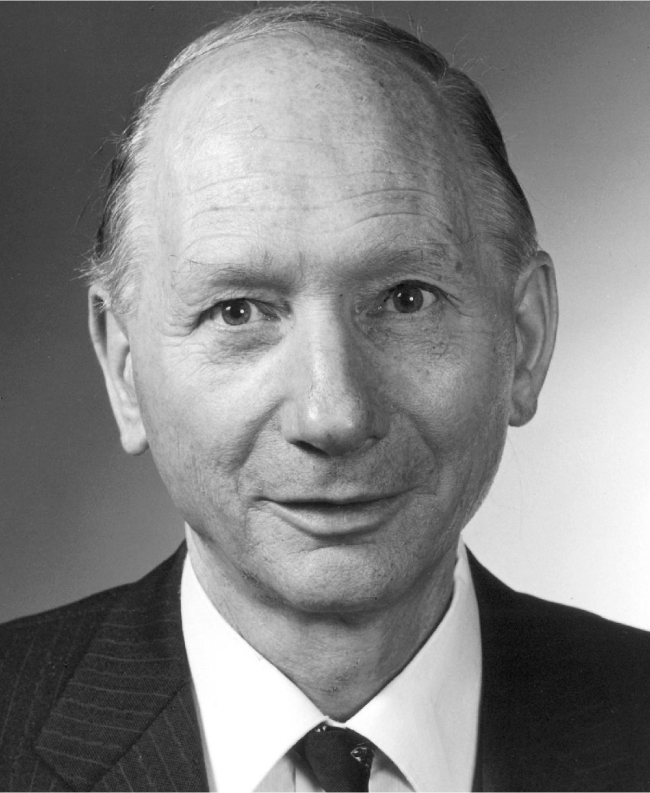
Edward Raymond Andrew
DOI: 10.1063/1.1485598
Edward Raymond Andrew, a pioneer in the development of nuclear magnetic resonance (NMR) and magnetic resonance imaging (MRI), died of cancer in Gainesville, Florida, on 26 May 2001.
Raymond was born on 27 June 1921 in the Lincolnshire town of Boston, England. He attended Christ’s College, Cambridge University, earning a BA in natural sciences with a specialty in physics in 1942. After spending the next three years on wartime radar research at the Royal Radar Establishment at Malvern, he returned to the university’s Cavendish Laboratory and, in 1948, completed his PhD in physics; he conducted his research on superconductivity under the direction of David Shoenberg.
In the Shoenberg group meetings, he was introduced to NMR, which became the focus of his career. In 1948, Raymond went to Harvard University, where he worked under Edward Purcell, who later went on to share the 1952 Nobel Prize in Physics for the codiscovery of NMR.
In 1949, Raymond became a lecturer at St. Andrews University in Scotland, where he designed what was, at that time, the largest permanent magnet in Britain. Shortly thereafter, he began to study molecular motions as manifested in NMR line shapes and relaxation times. In 1953, he used NMR to provide the first demonstration of molecular diffusion in the solid state.
A year later, he was appointed as a professor of physics at the University College of North Wales, Bangor. The next year, he published the first book on NMR, Nuclear Magnetic Resonance (Cambridge U. Press).
In 1959, Raymond introduced magic-angle spinning, a technique that revolutionized the study of solid samples by NMR. This technique sprang from his work on line narrowing that accompanies conformational dynamics and motional averaging in solids. He realized that physically spinning a solid sample about the “magic angle” of 54.7° to the magnetic field would achieve the same result. Using this technique, he became the first to resolve a spin multiplet pattern in a solid sample. Raymond’s studies of quadrupolar nuclei led to a method for distinguishing quadrupolar from dipolar relaxation, and his investigations of the anisotropies in relaxation and chemical shift provided further insights.
Raymond became the chair of physics at Nottingham University in the UK in 1964 and was dean of the Faculty of Science there from 1975 to 1978. Under his leadership, Nottingham became world-renowned for its NMR research and its development of MRI. An image of a lemon, obtained by his laboratory, graced the cover of Nature in 1971.
In 1983, Raymond moved to the University of Florida, Gainesville, where he served from 1984 to 1991 as the founding editor of the journal Magnetic Resonance in Medicine. At Florida, he extended his studies of the relaxation and dynamics of a number of biologically important molecules in both solid state and solution. He and his collaborators designed gradient coils for microimaging and obtained exquisitely detailed high-resolution images of the spinal cord. Raymond played an important role in establishing the National High Magnetic Field Laboratory in Tallahassee, Florida.
In 1984, Raymond was elected as a fellow of the Royal Society and a joint winner of the Royal Society Wellcome Medal and Prize. He also was especially proud to be a joint winner of the American Physical Society’s centennial contest for the most distinguished PhD lineage—with four Nobel laureates in his family tree!
In his 50 years as a scholar and teacher, Raymond trained 37 graduate students and nearly that many postdoctoral researchers. His lectures, expositions of his deep scientific insight, were a marvel of clarity and detail. He had a special knack for tuning his presentations to exactly resonate with his audience, the hallmark of a great teacher.
Raymond mentored many scientists from around the world. He was especially supportive of scientists from countries with limited scientific resources. As an editor, he was fair and thorough, often taking extra time with the manuscripts of authors whose science was not yet prominent, giving them extra advice and encouragement.
He was an engaging conversationalist, with a keen sense of humor and of intellectual curiosity. He had a wonderful smile and a twinkle in his eyes that showed an occasional hint of mischievousness. He enjoyed life, people, travel, and science, and he loved to talk about his travels and the people he met.
Those who knew Raymond treasure most his personal qualities: He was kind, compassionate, polite, and respectful of others. He was a devoted husband and extremely proud of his family. He was an excellent manager and organizer whose great contribution was the ability to create a climate in which work of the highest quality could flourish. He had encouraging, patient words of advice and wisdom for fledgling students and colleagues. He was the epitome of a scholar and a gentleman, and an academic statesman who shall be greatly missed but remembered with joy.

Edward Raymond Andrew

More about the authors
Richard W. Briggs, University of Florida, Gainesville, US .