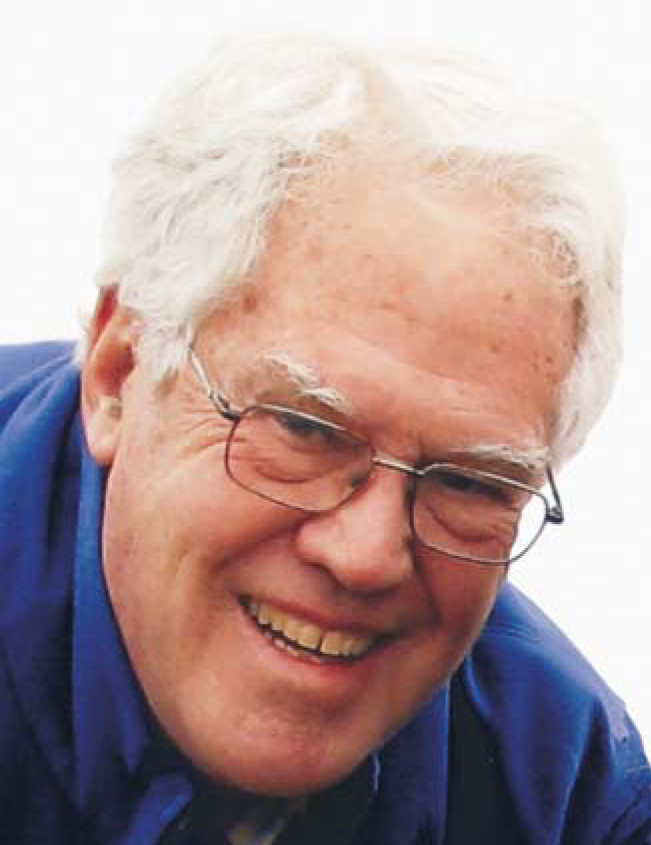
Edward Alan Knapp
DOI: 10.1063/1.3326995
Experimental physicist, accelerator-technology innovator, entrepreneur, and respected administrator Edward Alan Knapp died at his home in Santa Fe, New Mexico, on 17 August 2009 after battling pancreatic cancer for more than a year.
Born 7 March 1932 in Salem, Oregon, Ed received an AB in 1954 from Pomona College. He went to graduate school at the University of California, Berkeley, where, as center for the Le Conte Hall Lions basketball team, his soft hook shot was always a threat. He earned his PhD in physics in 1958 for accurate measurements of the differential cross section for the photoproduction of pions from hydrogen at Berkeley’s 340-MeV electron synchrotron. Although he worked in several areas of science, Ed was active in elementary particle physics throughout his career.
In 1958 Ed joined the magnetic confinement fusion program at Los Alamos National Laboratory (LANL). He loved the life, culture, and food of New Mexico and was a long-time devotee of the Santa Fe Opera. At every opportunity he and his family would go skiing, biking, hiking, or camping in the New Mexico mountains.
In 1962 Ed joined Louis Rosen as a founding member of the group that built the Los Alamos Meson Physics Facility (LAMPF; now the Los Alamos Neutron Science Center), an 800-MeV high-current accelerator for nuclear research and medical applications. Ed was responsible for the design and construction of the accelerator section. His team produced major innovations in particle accelerator design—primarily the side-coupled cavity system, which made possible ion-linacs such as LAMPF, and the post-coupled drift-tube linac.
Upon the successful completion of LAMPF, Ed assumed responsibility for its medical applications. He led a group of physicists in creating an extensive program of cancer radiation therapy that used exotic particle beams from the facility.
Ed had a continuing interest in applications of basic research. In 1968 he consulted with Varian Associates to design a compact, low-cost electron linac, based on his LANL research, for use in hospital cancer therapy. Today, variations of that design dominate cancer radiation therapy equipment. In 1968 he also cofounded SHM Nuclear, which built low-cost radiation therapy machines. Throughout most of his career, he served as a consultant to several firms, and he was on the boards of several startup companies, including Magnetic Pulse Inc, which made oil-well logging equipment, and International Isotopes Inc, a producer of accelerator-based isotopes.
After a 1972 sabbatical at CERN in Geneva, Ed led the LANL group that participated in the GAMS collaboration, which used Cherenkov calorimeters for exotic neutral meson spectroscopy at CERN and at the Soviet Union’s Institute for High Energy Physics. He and team members were responsible for a low-noise analog adder trigger system that made the original and subsequent versions of the experiment possible.
In 1976 Ed founded, organized, and led the LANL accelerator technology division, devoted to research on the physics and engineering of particle accelerators. The division developed several new techniques that reduced the cost and increased the reliability of particle accelerators, including the first demonstration of the RF quadrupole for linacs.
Ed’s low-key management style was to inspire, delegate to, and challenge his team members. Whenever they welcomed him home from his frequent travels, they joked that now they would have to deliver on more of his promises. Perhaps they were especially energized because Ed brought from CERN and shared with the division a newfound taste for espresso. He might leave a contentious meeting to get coffee and not return if he thought the participants should solve the problem without him.
In 1982 Ed was appointed LANL senior fellow; that same year he took leave to accept a presidential appointment as NSF assistant director for physics and mathematics and subsequently as NSF director, a post he held from late 1982 until mid-1984. During his tenure, the NSF budget grew by nearly 50%, and NSF established the young investigators program, supercomputer centers, and the engineering research centers.
Beginning in 1984 Ed was part of the group of LANL senior fellows that met regularly to conceive and found the Santa Fe Institute, a private, independent research institution that fosters multidisciplinary programs on the common fundamental principles in complex physical, computational, biological, and social systems. He became the first vice chair of the SFI board of trustees in 1985, was chair from 1987 to 1989, and served on the board until after his retirement.
From 1986 to 1989, Ed was president of the Universities Research Association, the consortium of more than 70 universities that operates Fermilab. Under his leadership, URA negotiated the Department of Energy contract for construction of the Superconducting Supercollider. In 1989 Ed returned to LANL to succeed Rosen as director of LAMPF; he served until 1991.
Ed was elected president of the SFI in 1991 and served until 1995. During his administration, the institute’s budget doubled, in part due to the cultivation of support from businesses and entrepreneurs, and SFI acquired its permanent campus. Under Ed’s oversight, the institute experienced a burgeoning of innovative research and education programs, including adaptive computation, neurobiology, and research experiences for undergraduates.
After his retirement Ed continued to consult and publish on high-intensity linac design and applications, including the design of a detector for antipersonnel mines and linacs for food irradiation.
Ed had a rare combination of traits. He was a skilled and innovative scientist and technician who had strong leadership skills, an outgoing and cheerful personality, and a low-key management style that encouraged those who worked with him to give their best. One worked with Ed more than for him.

Edward Alan Knapp

More about the authors
L. M. Simmons, Aspen, Colorado, US .