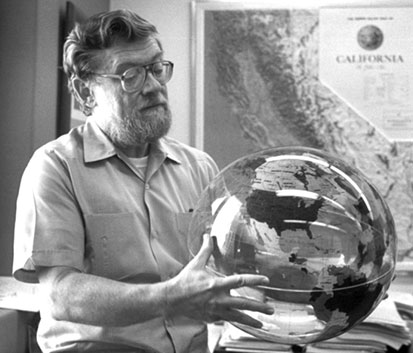
Don Lynn Anderson
DOI: 10.1063/PT.3.2988
Don Lynn Anderson, professor emeritus of geophysics at Caltech and former director of its Seismological Laboratory, died on 2 December 2014 of esophageal cancer at his home in Cambria, California. Don was one of the most influential figures in 20th-century solid-Earth geophysics, and his work and leadership vastly advanced our understanding of the origin, composition, structure, and dynamics of Earth and the terrestrial planets. In his quest to understand Earth’s interior, Don delved into every relevant branch of physics and Earth science, including petrology, geochemistry, planetary science, and solid-state physics. He was honored with the highest medals of the American Geophysical Union, the Geological Society of America, the Royal Astronomical Society, and the German Geophysical Society. In 1998 he also received the US National Medal of Science and the Crafoord Prize in Geosciences of the Royal Swedish Academy of Sciences.

Don Lynn Anderson
COURTESY, CALTECH ARCHIVES

Don was born on 5 March 1933 in Frederick, Maryland, and liked to claim that in honor of his birth President Franklin D. Roosevelt had proclaimed a 10-day banking holiday. Like many of Don’s pronouncements, that one had a hidden meaning—the danger of mistakenly attributing statistical significance to a coincidence.
After obtaining a bachelor’s degree in geology and geophysics from Rensselaer Polytechnic Institute in 1955, Don worked for a year for Chevron. He then joined the US Air Force Cambridge Research Laboratories and worked with Wilford Weeks studying elastic waves in floating sea ice off Thule, Greenland, to determine whether landing large airplanes on the ice was safe. In that work, he developed the theory of elastic waves in anisotropic media, which later proved essential to understanding Earth’s mantle, crust, and inner core.
Don began graduate work at Caltech in 1958. He earned a PhD in geophysics in 1962 when his adviser, Seismo Lab director Frank Press, unexpectedly told him that his new manuscript on elastic waves in layered anisotropic media would largely fulfill the thesis requirements. He stayed on as a research fellow and rose through the ranks of assistant, associate, and full professor in 1963, 1964, and 1968.
During that period, seismology advanced rapidly because of developments in computing and instrumentation that were spurred by government interest in detecting and identifying underground nuclear explosions. It became possible to measure accurately the dispersion of surface waves with periods of hundreds of seconds, which are sensitive to conditions at depths of hundreds of kilometers, and to compare the result with theoretical predictions. Those comparisons established the reality of a global low-velocity zone in the upper mantle and thereby resolved a long-standing controversy.
Don recognized that although surface-wave dispersion lacked adequate resolution at those depths, body-wave observations made possible with new instruments, particularly seismometer arrays, were ideal for studying the transition zone. However, this required that later-arriving branches of travel-time curves be treated on an equal footing with first arrivals. Collaborating with Lane Johnson, one of us (Julian), and Mansour Niazi, Don used body waves to study the structure of the transition zone and to demonstrate the reality of the two-discontinuity model.
Don hypothesized that the transition-zone discontinuities were caused by pressure-induced polymorphic phase transformations in minerals, and he realized that explaining the low-velocity zone and the transition zone required understanding the physics of rocks at high temperature and pressure. He expanded the Seismo Lab’s scope to address those problems; he hired Thomas Ahrens to establish a shock-wave laboratory and put students Hartmut Spetzler, Charles Sammis, Hsi-Ping Liu, and others to work applying techniques such as ultrasonic interferometry, Brillouin scattering, and Raman scattering to the study of minerals.
Responding to a need for a “standard” model of Earth’s interior elasticity and density, Don worked with Adam Dziewonski of Harvard University to generate the preliminary reference Earth model, or PREM, published in 1981. They chose the name to emphasize that knowledge in the field would always be in a state of flux, as became clear when in the middle of the work they concluded that the upper mantle in any adequate model had to be both elastically anisotropic and slightly anelastic on a global scale. Preliminary though it may be, PREM is still universally regarded as the standard Earth model.
Don spent the final quarter of his career studying Earth’s fourth dimension—how the mantle evolves. He questioned in particular the popular hypothesis that some volcanic regions, such as Hawaii and Iceland, are caused by narrow thermal plumes rising from the deepest mantle. After several years studying the evidence for plumes, Don concluded that “nothing seemed to fit.” He took up his final great scientific challenge, arguing that deep mantle plumes do not exist at all.
In collaboration with the other of us (Foulger), Don used the emerging internet to build an international, diverse group of colleagues; among the many contributors were James Natland, a geochemist at the University of Miami, and Dean Presnall, an experimental petrologist at the Carnegie Institution of Washington and the University of Texas at Dallas. With the underpinning of his favorite website, http://www.mantleplumes.org , he changed the subject from an assumption-driven endeavor to a question-driven one and opened many minds to the fundamentals of how we do science. Many of the questions he posed are still unresolved and today are the research subjects of choice for numerous scientists, young and old.
Don left us with a precious gift—a great new Earth science controversy. He also left us with the tools with which to address it—a wealth of knowledge and a legacy of superbly trained, deeply inspired students and colleagues to carry on striving for greater understanding of the internal workings of the planet on which we live.
More about the authors
Bruce R. Julian, Palo Alto, California.
Gillian R. Foulger, Durham University, Durham, UK.