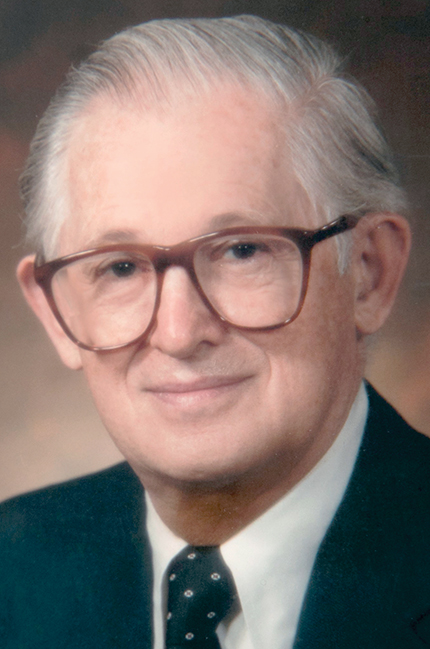
Benjamin Lax
DOI: 10.1063/PT.3.3115
Benjamin Lax, a pioneering solid-state and plasma physicist, an MIT professor of physics, and the long-time director of the MIT National Magnet Laboratory, died at age 99 on 21 April 2015 in Newton, Massachusetts.

Benjamin Lax
BACHRACH PHOTOGRAPHY

Born on 29 December 1915 in Miskolc, Hungary, Ben moved with his family in 1926 to the US, where they settled in Brooklyn, New York. After completing Boys High School in Brooklyn, he graduated cum laude from the Cooper Union for the Advancement of Science and Art in 1941 with a degree in mechanical engineering. He wanted to do graduate work in mathematics at Brown University, but he was drafted into the US Army in 1942. Assigned to the famous MIT Radiation Laboratory, he worked on a crash program to develop a new radar system, named Little Abner, which was successfully tested in the field. After World War II ended, Ben went to MIT, where he completed his PhD in physics in 1949 under Sanborn Brown. For his thesis, “The effect of magnetic field on the breakdown of gases at high frequencies,” he utilized cyclotron resonance, a technique that he continued to pursue throughout his career.
In 1951 Ben joined the MIT Lincoln Laboratory, where he made significant contributions to the understanding of semiconductors, particularly by using cyclotron resonance to study the semiconductors’ energy band structure. Ben and his coworkers employed cyclotron resonance absorption of microwave radiation to measure the effective mass of electrons, which was determined by the curvature of the energy bands. His studies of germanium and silicon were particularly important to the progress of semiconductor devices. Ben was also a coinventor on an early patent for the semiconductor laser. Because of his scientific advances and his abilities as a leader, Ben was made head of the Lincoln Laboratory’s solid-state division in 1958 and served as associate director of the lab in 1964–65. In 1960 he was recognized by the American Physical Society with the Oliver E. Buckley Condensed Matter Physics Prize “for his fundamental contributions in microwave and infrared spectroscopy of semiconductors.”
In the late 1950s, Ben led a group of scientists and engineers in proposing that a high-magnetic-field laboratory be built on the MIT campus to conduct research in solid-state and plasma physics, magnetic resonance spectroscopy, and magnet engineering. The successful proposal led to the 1960 establishment of the National Magnet Laboratory (NML), later renamed the Francis Bitter Magnet Laboratory. Ben served as director for its first 21 years. In 1965 he also accepted a position as a professor in the MIT physics department.
Under Ben’s leadership, the NML became known internationally for its wide-ranging research, including in such areas as the physics of solids in high magnetic fields; high-field nuclear magnetic resonance; biomagnetism; magnet technology, including magnetic levitation for trains; laser–plasma interactions in high magnetic fields; and laser–plasma diagnostics. He was also interested in the use of high magnetic fields to achieve better confinement of plasmas for fusion. The first high-magnetic-field tokamak confinement device, Alcator A, was constructed at the NML and successfully demonstrated the benefits of the high-field approach. But the research on fusion energy and plasma physics soon required larger facilities, which led to the creation of what is now the MIT Plasma Science and Fusion Center.
Ben supervised 36 PhD students, many of whom went on to highly successful careers in physics and engineering. Ben retired from the NML in 1981 and from the physics faculty in 1986. But he continued working in physics for over 15 more years, including being a consultant at the Lincoln Laboratory. He was coauthor with Kenneth Button of the classic book Microwave Ferrites and Ferrimagnetics (McGraw-Hill, 1962) and author or coauthor of more than 300 journal articles and book chapters.
Ben was also a talented athlete; he was a gymnast in his youth and began skiing at the age of 50. He brought to the athletic field the same intensity and enthusiasm he conveyed in the laboratory. He was a wonderful mentor to countless students, young scientists, and colleagues. Ben’s brilliance, his boundless energy, and his enthusiasm for physics will be greatly missed.
More about the authors
Daniel Cohn, Massachusetts Institute of Technology, Cambridge.
Richard Temkin, Massachusetts Institute of Technology, Cambridge.