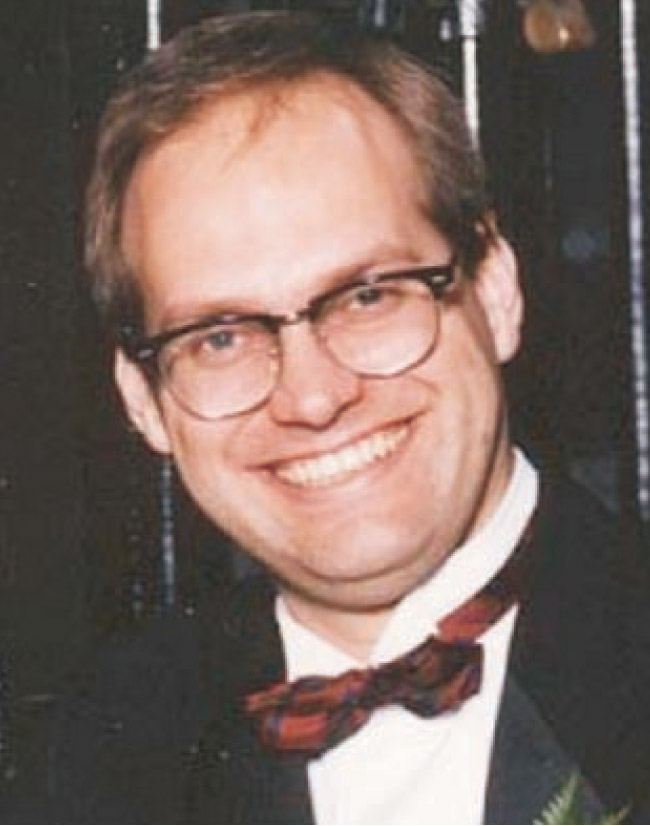
André Stephane Hamer
DOI: 10.1063/1.1634545
André Stephane Hamer, an accomplished young experimental physicist who was a major contributor to the success of the Sudbury Neutrino Observatory (SNO), died on 2 February 2003 in Ottawa, Ontario, Canada, after a courageous battle with colon cancer.
André was born on 17 January 1968 in Oshawa, Ontario. He was raised in a stimulating environment by loving parents who fostered his natural curiosity and provided him with broad learning opportunities. On completing high school, he obtained a BSc in physics at the University of Toronto in 1993 and moved on to graduate work at Queen’s University in Kingston, Ontario. He quickly demonstrated his strong aptitude and love for experimental physics. For his master’s degree work, André contributed to the ultrasensitive measurements of radioactivity used in SNO by developing a new technique for efficient assay of a few atoms of radon. He earned his MSc in 1997.
Continuing his doctoral work, also with one of us (McDonald), he made substantial contributions to the success of SNO by developing calibration devices and by providing a detailed understanding of the physics performance of the detector itself. André developed the primary energy calibration standard for the SNO detector: a source of radioactive nitrogen (16N) and lithium (8Li) that is produced by a neutron generator and transported to the center of the SNO detector via capillary tubing and that decays within a scintillator-lined chamber. The 16N source provided a triggered source of 6.13-MeV gamma rays with an accuracy of better than 1%. André designed and constructed this source, and used it and others to develop the full energy calibration for the SNO measurements.
André graduated with his PhD in 1999 and continued to work on the SNO project as a postdoctoral fellow at Los Alamos National Laboratory with the group led by one of us (Hime). He contributed substantially to the analyses in the first SNO publications in 2001 and 2002. On behalf of the SNO collaboration, he presented the first results of the comparison of the neutral-current and charged-current interactions on deuterium at the American Physical Society conference in Albuquerque, New Mexico, in April 2002. The results provided compelling evidence for flavor change for solar neutrinos.
All André’s work, whether experimental or analytical, was done to completion, well designed, implemented, documented, and intended to be used for the long term. He was also a leader, recognized by his colleagues as someone whose infectious enthusiasm and strong example should be followed. He approached projects completely, organized the work, and performed the most difficult tasks himself, because he really loved what he was doing. His sense of humor was evident at all times: A typical quip to a colleague while seeking a repair device at a local hardware store: “The two most important tools of the experimental physicist must be the car and the cell phone!”
André’s colleagues are benefiting from his legacy as they continue with the further phases of the SNO experiment. Unfortunately, his strong scientific contributions were cut short by his death not long after he had accepted a new position with the underground science laboratory (SNOLab) that is being developed in Canada.
André was a devoted husband and a loving father of three sons; the youngest was born one month after André died. He had already begun to impart his love for life, education, and science to his young sons. The SNO collaboration has established a fund in André’s memory for his children’s future education.
André gave 100% in all things: as a scientist, colleague, friend, father, husband, and family man. The world has lost a wonderful scientist at far too young an age.

More about the authors
Art McDonald, 1 Queen’s University, Kingston, Ontario, Canada .
Andrew Hime, 2 Los Alamos National Laboratory, Los Alamos, New Mexico, US .