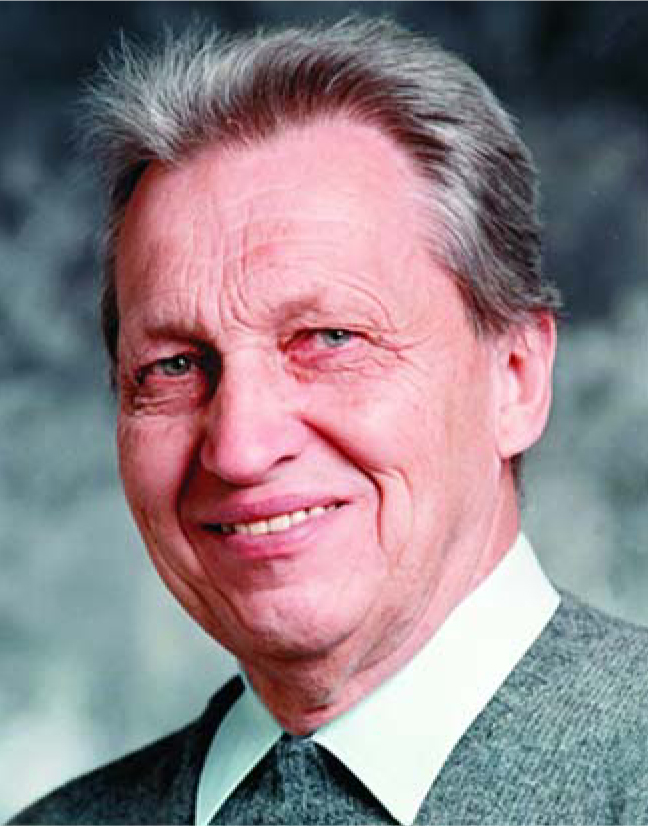
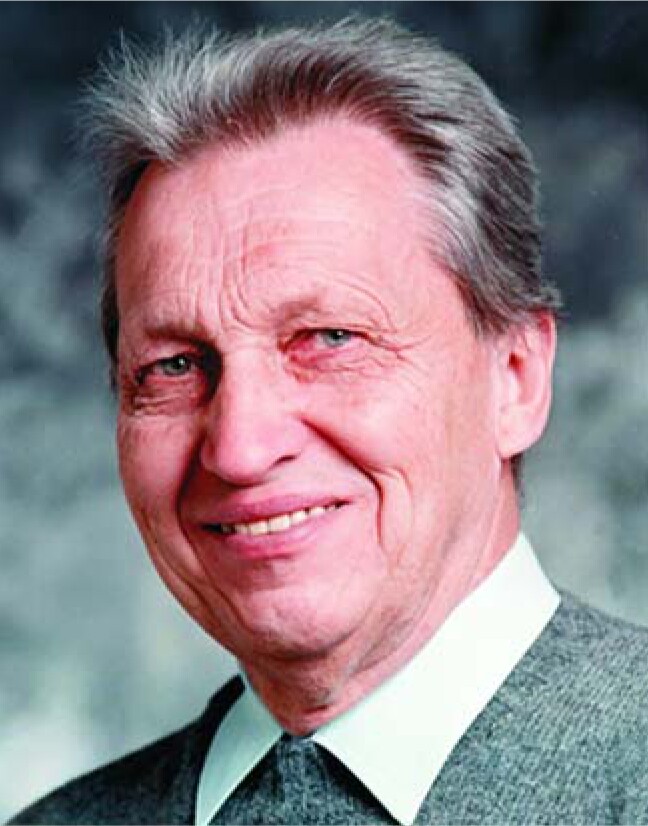
Anatoly Ivanovich Larkin
DOI: 10.1063/1.2207057
Anatoly Ivanovich Larkin—“Tolya” to his friends and colleagues—died of heart failure on 4 August 2005 in Aspen, Colorado. He was a universally recognized leader in condensed matter theory and a celebrated teacher of several generations of theorists. Until the very end, he was remarkably productive and remained a desirable collaborator for many younger colleagues. His recent publications have the same depth and originality as the first paper he published 47 years ago.
Born on 14 October 1932 in the small town of Kolomna in central Russia, Larkin went to Moscow to study physics at the Institute for Physical Engineering. He was taught by Igor Tamm, Mikhail Leontovich, Isaac Pomeranchuk, and Arkadii Migdal, and after two years of research under Andrei Sakharov’s guidance, he joined Migdal’s group at the Kurchatov Institute. In 1966 he moved to the newly organized L. D. Landau Institute for Theoretical Physics in Chernogolovka, near Moscow, which became his home for the next 25 years. In 1995 he joined the University of Minnesota as a professor of theoretical physics, but he returned to Chernogolovka every summer.
Larkin’s research career began at the time when young theorists were still expected to study all branches of theoretical physics. In his first papers, Larkin applied the newly developed Matsubara diagrammatics to the calculation of the thermodynamics of plasmas and the energy losses of fast particles passing through them. In a series of joint publications with Migdal, Larkin used the Landau Fermi-liquid theory to describe the properties of atomic nuclei.
Following the development of the Bardeen-Cooper-Schrieffer (BCS) theory of superconductivity in 1957, Larkin began his studies of that subject, which was to become his lifelong passion. Although he made a significant contribution to particle and nuclear physics and to the theories of phase transitions, magnetism, and disorder, it was superconductivity to which he kept returning and in which his impact was truly outstanding. Among his greatest achievements are the prediction of the fluctuation-driven enhancement of conductivity above the critical temperature T c, the theory of the Josephson effect in superconductor–normal metal–superconductor junctions and in superconducting point contacts, the prediction of pairing with finite momentum, a semiclassical theory of nonequilibrium phenomena including nonlinear flux flow, the theory of collective creep, and thermally activated flux dynamics in the high-T c materials.
In 1961 Valentin Vaks and Larkin suggested that the properties of soft pions could be explained by a BCS-like spontaneous breaking of chiral symmetry. That concept proved to be an important step toward the creation of the standard model of particle physics. In a 1969 paper, Larkin solved the problem of the singularity of thermodynamic functions at the type II phase transition in uniaxial ferroelectrics. It was the first successful application of the renormalization group to condensed matter theory. The paper was significant in the development of the theory of critical phenomena.
Larkin also made a great impact on the physics of one-dimensional metals. His calculations of the Green’s functions of fermions and the correlation functions of density and spin density laid the foundations of the modern theory of the field. His further contributions included applying the theory of collective pinning to the dynamics of charge density waves, and developing the theory of the thermal activation of Frölich’s conductivity. In the theory of disordered conductors, Larkin and his collaborators initiated several new research directions: weak localization, mesoscopics, and quantum chaos.
Larkin was also known as a great teacher, one who could work with students of different personalities. Lev Aslamazov, Vladimir Fileov, Lev Ioffe, Vadim Geshkenbein, Victor Galitski, Chushun Tian, and the four of us all did PhDs (or equivalent works) under his supervision. Yuri Dreyzin, Konstantin Matveev, and Valery Rupasov were his students as undergraduates. Working with Larkin created a unique feeling of joy, which attracted many different collaborators to him.
Larkin received many formal signs of recognition: He was elected a full member of the Russian Academy of Sciences (1991), and was a recipient of numerous prizes, including the Fritz London Memorial Award (1990), the Hewlett-Packard Europhysics Prize (1993), and the Lars Onsager Prize (2002). He was greatly respected by his colleagues, who admired him for his talent, modesty, and tireless work.
His death in the Colorado mountains was entirely unexpected. He was still hard at work on several ambitious projects. The coming years will doubtless see the publication of new papers under the familiar name of A. I. Larkin.

JOHN LINN
More about the authors
Konstantin B. Efetov, 1 Ruhr University, Bochum, Germany .
David E. Khmelnitskii, 2 Cavendish Laboratory, Cambridge, UK .
Yuri N. Ovchinnikov, 3 L. D. Landau Institute for Theoretical Physics, Moscow.
Paul B. Wiegmann, 4 University of Chicago, Chicago, Illinois, US .