AAPT honors two
DOI: 10.1063/1.2195324
The former head of the American Institute of Physics is one of two physics educators who have been honored this year by the American Association of Physics Teachers for their work in introducing physics concepts to students and the public.
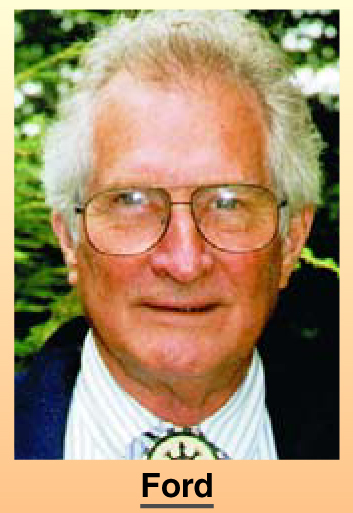
Kenneth W. Ford is the recipient of the Oersted Medal, AAPT’s most prestigious award. The retired executive director and chief executive officer of AIP, where he served from 1987 to 1993, Ford last worked as a consultant to the John Templeton Foundation in West Conshohocken, Pennsylvania, from 2001 to 2002. As part of the award, which was bestowed at a January ceremony during AAPT’s winter meeting in Anchorage, Alaska, he received a certificate and $10 000, and presented a talk, “Love Them to Death,” which focused on his teaching odyssey and the experience and importance of teaching science and physics to students at every level.
Neil Ashby, an emeritus physics professor at the University of Colorado at Boulder, will receive AAPT’s Richtmyer Memorial Award. An affiliate at NIST, Ashby is also a mentor to about 30 graduate students and postdocs who work at NIST and are employees of the University of Colorado. Ashby received a certificate and $7500 and presented a talk on “Practical Relativity,” which focused on demonstrations of fundamental relativity concepts and their practical applications in navigation, astronomy, and other fields such as meteorology.
AAPT also handed out five Distinguished Service Citations in recognition of exceptional contributions to physics teaching. Receiving the citations were Mario Belloni (Davidson College, Davidson, North Carolina), Steven Iona (University of Denver, Colorado), Zigmund Peacock (University of Utah, Salt Lake City), Gregory Puska (West Virginia University, Morgantown), and Frieda Stahl (California State University, Los Angeles).